


June 14, 2026, 4:34 am | Read time: 5 minutes
Wood floors and water have always been at odds. According to a survey by the German Insurance Association (GDV), a water damage incident occurs every 30 seconds in Germany. In 2024, homeowners insurance paid out a total of 4.9 billion euros for such damages, more than double the amount in 2015. More than half of all residential building damages are due to water leaks. Consequently, disputes often arise when wood floors warp as a result. myHOMEBOOK explains when a simple repair suffices, when a complete replacement is necessary, and who ultimately foots the bill.
Wood is durable and contributes to a pleasant indoor climate. This natural material absorbs and releases moisture, making parquet a particularly elegant flooring choice. However, wood floors can only handle moisture and water in moderation.
Moisture Damages in Various Ways
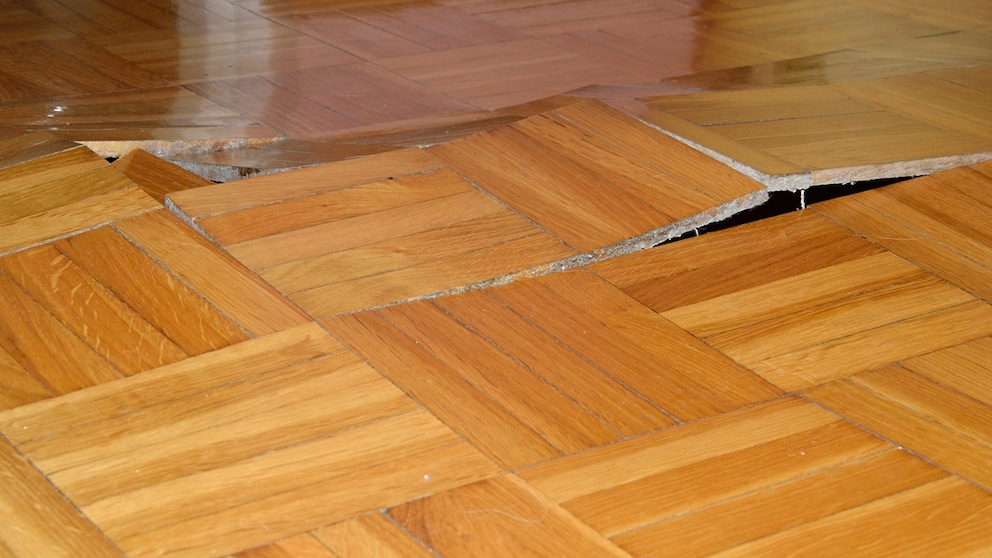
Excessive moisture causes wood to expand. A certain amount of expansion space is planned during installation. If too much water penetrates the wood, even this space is insufficient. The outer boards press against the wall, causing the parquet floor to buckle upward.
In households, several factors can lead to sudden water intrusion into wood floors, such as leaky windows, a leak in the underfloor heating, an overflowing bathtub, or a washing machine without an aqua-stop. Other common causes include hoses from aquariums or refrigerators that have come loose unnoticed, or overflowing plant saucers, all of which are classic entries in water damage statistics.
High indoor humidity can also cause parquet floors to swell unnoticed. If a room consistently has humidity levels above 50 percent, it can lead to long-term damage. At levels above 70 percent, visible buckling and mold growth may occur.
Also of interest: How colored parquet changes the room’s effect
Early Intervention Prevents Greater Damage
When large water accumulations become visible, quick action is crucial. Depending on the cause, significant damage to the parquet can still be avoided in the early stages.
This means:
- Identify and fix the cause as quickly as possible
- Remove standing water immediately
- For small puddles, cloths and buckets suffice; for larger floods, a wet vacuum is invaluable
- Relocate furniture and rugs to dry areas immediately
- Open windows wide and possibly set up fans
- For major water damage, dehumidifiers available for rent at hardware stores can help. However, caution is advised: if the floor dries too quickly, the boards may also warp.
If the cause of the water damage is quickly identified and addressed, only stains, discolorations, or slight edge buckling should remain. To remove these superficial damages, sanding the affected areas is sufficient.
Also of interest: Oiling, waxing, or varnishing parquet? The pros and cons
When to Call a Parquet Professional
A skilled DIYer can handle this, but otherwise, a parquet professional can help and reseal the floor. However, the freshly sanded area will always visually differ from the rest of the boards.
For localized damage, replacing individual boards may be advisable. In this case, the parquet installer cuts out the damaged sections, fits replacement boards, and sands the entire surface to the same height.
A complete replacement is unfortunately unavoidable if water has penetrated deep into the substrate. This often occurs with initially unnoticed water damage, such as when a faulty pipe in the wall or floor is responsible.
If the parquet floor has been sanded multiple times, the wear layer may be too thin for another sanding. In such cases, even minor damage necessitates a full replacement.

What Landlords Must Tolerate When Tenants Move Out–and What They Don’t

5 Common Mistakes Renters Should Avoid During Apartment Handover
Who Is Responsible for Parquet Floor Damage
Tenants and landlords often wonder: Who pays for the damage to the parquet floor? Lawyers typically respond: “It depends.” However, myHOMEBOOK sought legal advice.
Generally, a parquet floor is part of the rental property. Normal wear and tear from contractual use is the landlord’s responsibility. “Wearing shoes and keeping pets have historically caused confusion,” notes Thomas Pliester, a specialist in tenancy law from Mönchengladbach. “Indentations or scratches in the parquet floor from activities like walking in high heels no longer typically result in liability for damages. The same applies if a landlord allows pets in the rental unit. In such cases, a landlord anticipates scratches from dog claws or cat paws.”
For water damage that causes parquet floors to swell, the question of fault must first be addressed. “In Germany, we need a breach of duty, or fault, for claims for damages,” adds the attorney. The specific circumstances are crucial here.
The tenancy law specialist knows from experience, “The usual damages occur from improper cleaning, namely because too much water is used.” But what constitutes too much water?
Related: How to make a cleaning cloth only ‘damp’?
Duties of Landlords and Tenants
“To attribute fault to a tenant, they should be informed in advance about what they can and cannot do. Providing specific cleaning instructions is the landlord’s duty. If a tenant then violates these instructions, cleans the floor with too much water, and the parquet subsequently warps, they are liable for damages.”
Judges have consistently ruled in favor of tenants when such instructions were not provided by the landlord beforehand. According to the courts, knowing how to properly clean a parquet floor is not common knowledge. Therefore, landlords should ideally include such instructions in the rental agreement.
If the water damage, as described in this article, has other causes, the specific reason must first be clarified. Leaky windows or faulty pipes may indicate construction defects. The landlord would be responsible for repairs and any resulting damages. A leaking refrigerator hose or an overflowing bathtub falls under the tenant’s responsibility.
“Water has a particularity, namely § 536 c BGB. It states that if a defect in the rental property arises during the rental period, the tenant is obliged to notify the landlord immediately,” emphasizes attorney Thomas Pliester. Specifically, if a tenant is aware of a small trickle continuously flowing from a leaky window onto the parquet floor but fails to inform the landlord, the tenant is later liable for the damage repair.