


December 22, 2022, 1:56 pm | Read time: 4 minutes
Everyone wants to do their part for environmental protection. Some people are now turning to compostable trash bags made from bioplastics. But are they as beneficial as we think? Are we really helping the environment by using them?
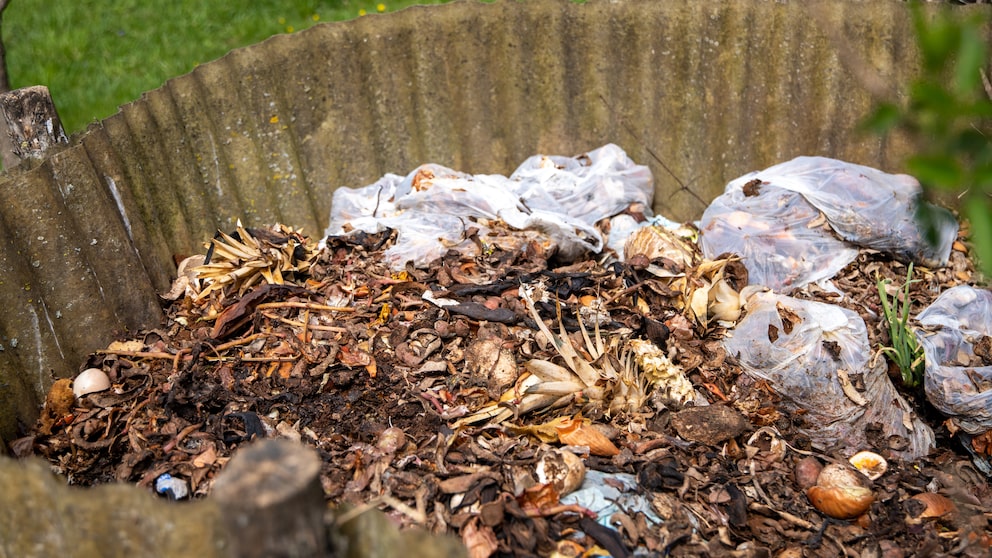
Compostable trash bags are now available in almost every well-stocked supermarket. Manufacturers claim they decompose over time without leaving residues. However, experts warn against their use. myHOMEBOOK knows why.
Overview
What are compostable trash bags?
The bags are marketed as “100 percent compostable” or “biodegradable.” They are advertised as being able to be hung in the bin, filled, and disposed of via the compost heap or organic waste bin. These bags are mostly made from corn or potato starch, but there are also petroleum-based compostable products.
Related: What can be disposed of in regular trash–and what cannot
“Plastic bags do not belong in organic waste!”
The Association of Municipal Enterprises has a clear stance on the disposal of compostable trash bags. It doesn’t matter whether they are made from bioplastics or biodegradable plastics. Other products marketed as biodegradable, such as shopping bags, disposable tableware, or to-go cups, should also not be disposed of in organic waste.
Patrick Hasenkamp, vice president of the VKU and head of the waste management operations in Münster, confirms that bioplastics are not always fully broken down in municipal composting and digestion plants. “The new ‘bioplastic’ products like packaging, coffee capsules, or collection bags are not biologically degradable, or they decompose too slowly, despite what the labeling suggests. They must therefore be laboriously sorted out, causing significant additional effort in organic waste treatment facilities. For climate protection, we want to increasingly substitute peat with organic waste compost to protect peatlands as carbon sinks. However, any foreign substances are disruptive–no one wants plastic fragments in their potting soil or on their fields.”
Biodegradable trash bags should not go in the organic waste bin–so why do they exist?
The VKU suggests that biodegradable trash bags are primarily intended to make everyday life easier and encourage consumers to separate waste. However, since there are still no uniform regulations on degradability, not all local composting facilities are equipped for such bags. “If these bags are not sufficiently broken down under the conditions of the local composting facility, the local waste management company may exclude them from collection.”
The basic idea of bioplastics is not wrong. In 2019, Germany had 6.28 million tons of plastic waste, according to the Federal Environment Agency. This problem needs to be addressed–but as is often the case, it takes time to establish uniform regulations.
Related: Do not flush wet wipes down the toilet

Who Is Responsible for a Clean Trash Can?

How to Properly Dispose of Decorations and Costumes After Halloween
How should bioplastics be disposed of?
This is the big question that even the European Commission has taken up. “On November 30, 2022, the European Commission published the second part of the Circular Economy Package in the Green Deal. It included political frameworks and legislative proposals for dealing with so-called ‘biodegradable and compostable’ plastics, a revision of the packaging directive, and a proposal for certifying climate-friendly carbon capture,” says the VKU.
So hopefully, the issue of bioplastic disposal is only temporary. “The optimal way to dispose of these materials may change in the future if these materials have different properties. Currently, biodegradability and recyclability, repairability, etc., are contradictory. Most of the time, they are even single-use products. This is a conflict of objectives that manufacturers and designers must resolve,” demands the VKU.
How should you dispose of your organic waste?
Since biodegradable trash bags are not an option and there are currently no viable alternatives, only one option remains, according to the VKU: “Our appeal to consumers is: Bring organic waste to the organic waste bin in a pre-sorting container, such as a small bucket or wrapped in a bit of newspaper, not in a plastic bag. Taking it out more frequently also helps prevent odors, vinegar flies, etc., in the kitchen.”