

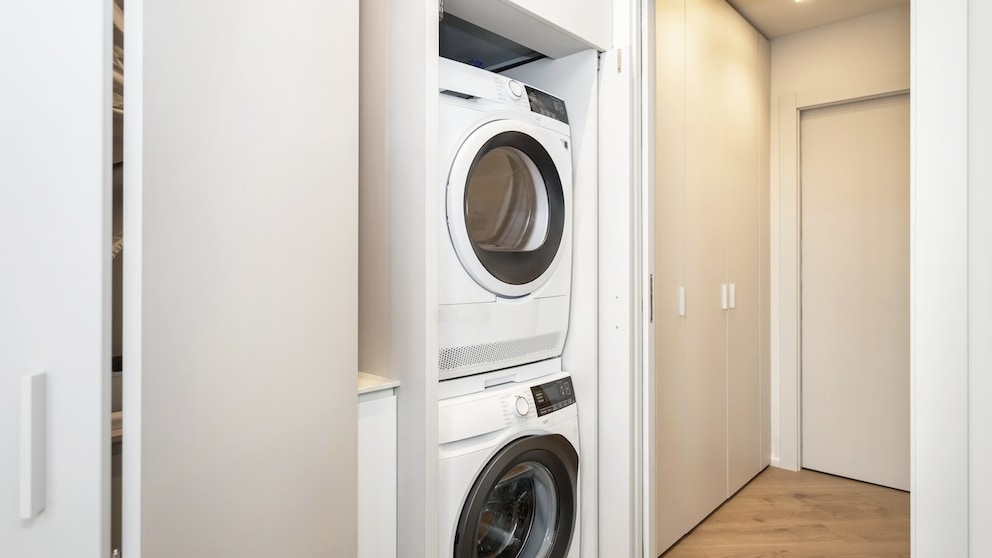

April 20, 2026, 3:48 pm | Read time: 3 minutes
Dryers are a practical invention. These devices dry laundry to varying degrees, from damp enough to iron to completely dry. However, they also require a lot of energy. That’s why the right location plays an important role. myHOMEBOOK reveals what to consider.
In Germany, many households now exclusively use heat pump dryers. The market has adjusted to the changed demand, says Claudia Oberascher, energy expert at the Association for Efficient Energy Use e.V. (HEA). She advises against acquiring a vented dryer or a conventional condenser dryer from the second-hand market, as the energy consumption is significantly higher compared to heat pump dryers. “Anyone who still owns a classic condenser dryer or even a vented dryer as an old appliance should definitely consider replacing it due to the high energy consumption,” recommends the energy expert from HEA in Berlin.
Follow myHOMEBOOK on WhatsApp now
Adequate Ventilation
When it comes to location, a room should meet certain criteria to accommodate a dryer. “It should be well-ventilated and dry,” explains Claudia Oberascher. Therefore, a small bathroom or a damp basement is rather unsuitable. “If you’re using a condenser dryer, ensure there is free air intake and exhaust. A heat pump dryer generates a lot of heat during operation. This heat should be able to escape; otherwise, the drying time may increase, which in turn raises energy consumption.”
In the long run, the trapped heat can also damage the device, adds the energy expert. Since dryers draw air from their surroundings, it’s essential to ensure free air intake when setting them up. This applies to all dryers. For condenser dryers with and without heat pumps, it’s also important to ensure the free exit of cooling air. The manufacturer’s instructions should be followed in this regard.

6 Common Mistakes in Planning and Installing Heat Pumps
When a Heat Pump Is Worthwhile for Heating
Utilize Existing Drains
Whether it’s a classic condenser dryer or a heat pump dryer, both types produce water during operation. This collects in the condensate container, which must be emptied regularly. “That’s why a location with a sink or another drainage point would be practical,” advises HEA energy expert Claudia Oberascher.
Also interesting: How to properly clean your dryer
It’s practical, similar to a washing machine, to drain the water directly into the outlet via a hose. However, this requires an appropriate drain at the location. This eliminates the need to manually empty the collection container.
Not a Good Location
Claudia Oberascher from the Association for Efficient Energy Use e.V. lists additional exclusion criteria for dryer locations: “An unventilated room, such as a windowless, small storage room. Additionally, the devices should not be placed outdoors, such as on a balcony or terrace. For heat pump dryers, the room temperature during operation should be between 41 and 95 degrees Fahrenheit. Other temperatures can have undesirable effects on the device’s performance.”
For modern dryers to operate as energy-efficiently as possible, the location plays a crucial role. Small, damp, and unventilated rooms are generally not recommended. Proximity to the washing machine is advisable, as there are usually drains and outlets available to manually empty water collection containers or automatically drain via a hose.