


September 2, 2026, 11:39 am | Read time: 6 minutes
If you have something to saw, it’s essential to have the right tool at hand. Almost any saw works for wood. However, with other materials, such as laminate, metal, or stone, the sawing result can be unsatisfactory. Frayed edges, damaged workpieces, or danger to life and limb can be the result. myHOMEBOOK has summarized which saw is suitable for which material in this article.
What Types of Saws Are There?
For wood, a simple handsaw is usually sufficient. However, in this article, myHOMEBOOK also wants to address materials that regularly cause problems during cutting.
Therefore, here is an overview of different types of saws with their advantages and disadvantages:
- Miter Saw: It features a tiltable saw head and a rotating table. This allows for precise angle cuts on moldings, beams, or pipes. However, it cannot handle large surfaces. The miter saw provides precise cuts only for individual workpieces.
- Circular Saw: As a table or hand circular saw, it excels at long, straight cuts. Its rotating blade cuts quickly and very precisely with a guide rail. It is not suitable for curves but delivers clean results on panels and boards.
- Reciprocating Saw: This type works with a coarse, back-and-forth swinging blade. The reciprocating saw is suitable for powerful work in hard-to-reach places, such as demolition or trimming pipes. Precise cuts are not its strength. However, it cuts through thick materials quickly.
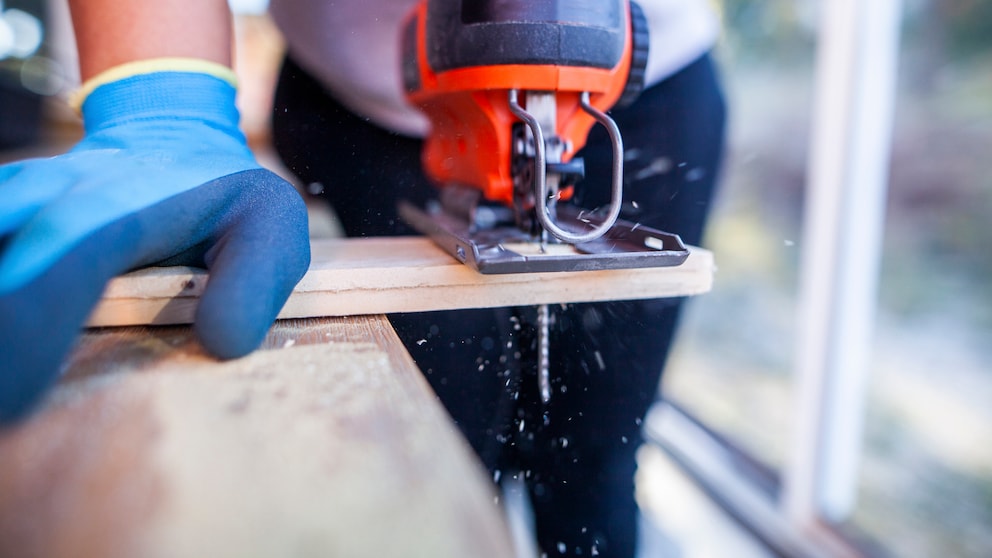
- Jigsaw: It is the all-rounder among DIY saws. Its thin blade moves through the material with a stroke motion. Curves, cutouts, and intricate shapes are particularly successful with it. Without a guide rail, the blade can easily deviate on long cuts. The jigsaw is unsuitable for tiles or concrete.
- Angle Grinder: The “Flex” cuts with a rotating disc instead of toothed blades. Depending on the attachment, the angle grinder works on metal, stone, tiles, or concrete. It is universally applicable but requires special caution during operation. A jammed cutting disc can lead to dangerous kickbacks.
Which Saw Fits Which Material?
As mentioned above, almost any saw can be used for wood. Curves and cutouts are successful with the jigsaw, long straight cuts with the circular saw, and precise angles with the miter saw. When sawing across the grain, a fine saw blade should be used. This ensures clean cut edges.
Cutting laminate flooring panels poses the greatest challenges for DIY enthusiasts. Especially with coarse teeth, the top decorative layer easily tears. Therefore, it’s better to use a fine-toothed saw blade. When cutting, always saw towards the decorative layer, not away from it, so do not pull. For straight paths, the circular saw with a guide rail is better suited than the jigsaw, which excels at round cutouts. Those who want to avoid sawing stress can get a manual laminate cutter. This promises clean edges without sawdust.
When sawing metal, patience is required. The cut takes significantly longer than with wood. Saw blades made of HSS steel or bimetal are robust enough for this work. The pendulum stroke function on the jigsaw should be turned off to keep the cut clean and not unnecessarily strain the blade. For straight cuts, the circular saw with a metal blade is suitable. For thicker pipes, the angle grinder with a cutting disc works well. Sharp edges should then be smoothed with a fine file.
For stone and tiles, an angle grinder with a diamond cutting disc is needed. These so-called segmented diamond discs also cut concrete, brick, and natural stone cleanly. A small tip: Some hardware stores offer wet cutting devices for rent. These bind the fine dust that is stirred up when sawing stone.
Saw and Blade Determine the Result
It should be clear: A clean cut is only achieved with the combination of a suitable saw and the right blade. So-called HCS blades made of carbon steel are suitable for wood and plastic. The aforementioned HSS blades made of steel cut metal. For curved cuts in wood or metal, bimetal blades are suitable. These combine flexibility and hardness. HM-coated blades, with teeth made of carbide, ensure precise cuts in tiles and other hard building materials.
The tooth configuration directly determines the quality of the cut. Few, widely spaced teeth saw quickly but roughly. Many closely spaced teeth produce a fine cut. Such saw blades are particularly suitable for laminate, veneer, or painted surfaces. In the angle grinder, the cutting disc takes on this role. The aforementioned diamond discs are suitable for mineral building materials. So-called corundum discs, which are special aluminum discs, smooth metallic surfaces.
What Types of Saws Are There?

14 Jigsaws for DIY Enthusiasts and Professionals Compared
Typical Mistakes
A saw blade chosen too coarse can damage the surface of finely coated panels. Then small pieces break off on the visible side. Here, a fine-toothed saw blade combined with tape along the cutting line helps. This trick prevents the surface from fraying.
Additionally, with too high a feed rate, the cut edge burns, especially with metal and dense woods. Therefore, move the workpiece slowly and evenly. Also, fix the workpiece for the cut with clamps or place it on a solid support. A precise cut through a coated panel is best achieved when the cutting line is scored with a utility knife beforehand.
Safety Tips for Sawing
For all the saw types listed, safety in use is always a priority. When using an angle grinder, both hands should always be used. According to figures from the German Social Accident Insurance for Wood and Metal (BGHM), about 40 percent of accidents with such a device occur because only one hand was used. Additionally, side grinding with a cutting disc is absolutely forbidden. The disc risks breaking.
Another risk is the so-called kickback. This occurs when the cutting disc gets stuck in the material, causing the angle grinder to kick back uncontrollably. According to the German Social Accident Insurance for Construction, this kickback is one of the most dangerous reactions when cutting.
Those who cut stone and concrete without a wet cutting device should definitely wear a dust mask and safety goggles due to the fine dust exposure. For longer tasks, the dust should be well extracted. Hearing protection is also advisable when working with a circular saw, miter saw, and angle grinder. Additionally, loose clothing and jewelry have no place near rotating saw blades.