


May 1, 2026, 5:05 am | Read time: 3 minutes
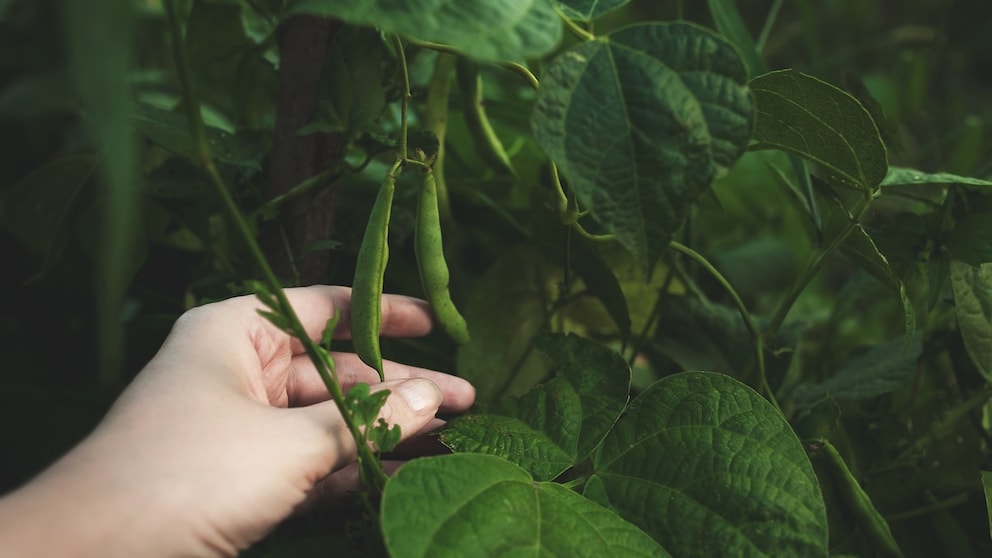
Pole beans are climbing artists in the vegetable garden. They require little ground space, grow quickly, and can even serve as a green privacy screen. However, cultivation doesn’t happen on its own.
If the poles tip over, flowers fail to appear, or only a few pods grow, it’s usually due to avoidable mistakes in the cultivation of pole beans. myHOMEBOOK gardening expert Katharina Petzholdt lists seven mistakes to avoid when planting pole beans.
1. Sowing Too Early
Pole beans are frost-sensitive and prefer warm soils. They should be planted directly in the bed only after the Ice Saints in mid-May, when no more frosts are expected. Beans germinate at soil temperatures as low as 46 degrees Fahrenheit, but germination is much faster and more uniform at 54 degrees. Sowing too early can hinder the growth of pole beans right from the start.
2. Choosing the Wrong Location
In cold, shady, and windy locations, pole beans remain stunted. They also fall short of their potential in unsuitable soil. Beans prefer a warm, sunny, and wind-protected location with deep, humus-rich soil that doesn’t tend to waterlogging or crusting.
3. Poorly Planning the Support Structure
Without stable supports, beans quickly grow chaotically. The shoots are harder to manage, break more easily, and harvesting becomes more difficult. Supports should be set up before sowing and well-anchored in the ground. Whether it’s a bean teepee, crossed poles, or a green privacy screen, the structure should allow for easy harvesting and be stable enough to withstand stormy weather. Cutting the shoots at about six feet promotes branching.
4. Sowing Too Densely
Even though pole beans grow upwards, they need enough space at the base. If too many seeds are placed around a pole or the poles are too close together, less air reaches the plants, the leaves dry poorly, and harvesting becomes tricky. A good guideline: Poles should be about 24 inches apart, with four to five seeds per pole.
5. Watering Too Little
If beans receive too little water, it negatively affects the yield. In extreme cases, the plants simply drop their flowers. From flowering to fruit set, the water demand for pole beans is highest. If the soil is protected with a mulch layer, watering the beans thoroughly once a week is usually sufficient. In particularly hot and dry periods, more frequent watering may be necessary.

5 Common Mistakes When Growing Pumpkins
How to Successfully and Reliably Grow Salad Greens
6. Over-Fertilizing
For pole beans, more fertilizer is not automatically better. The plants need significantly fewer nutrients than, for example, zucchini or pumpkins. A good base supply with compost before sowing is usually sufficient. Beans live in symbiosis with nodule bacteria that bind nitrogen from the air and make it available to the plants.
7. Not Harvesting Regularly
Leaving pole beans hanging for too long slows down the plants. Frequent picking, on the other hand, increases yield. It’s best to harvest every two to four days. When the pods can be snapped cleanly, and the seeds are not yet prominently visible, the beans taste best.