


June 17, 2026, 4:32 am | Read time: 4 minutes
When everything blooms and thrives in the summer months, the joy of having your own garden is especially great. It’s all the more frustrating when pests cause lasting damage and threaten the health of shrubs and trees. The brown-tail moth is one of them. What hobby gardeners should know about this garden pest.
With its white, furry wings, the brown-tail moth (Euproctis chrysorrhoea) looks quite cute, but the moth with the bright orange rear is one of the most feared garden pests in some regions. Especially in the caterpillar stage, it can cause significant damage. It poses dangers not only to native plants but also to humans. But what is really behind it, how can an infestation be detected early, and how can it best be combated?
How Does the Brown-Tail Moth Operate?
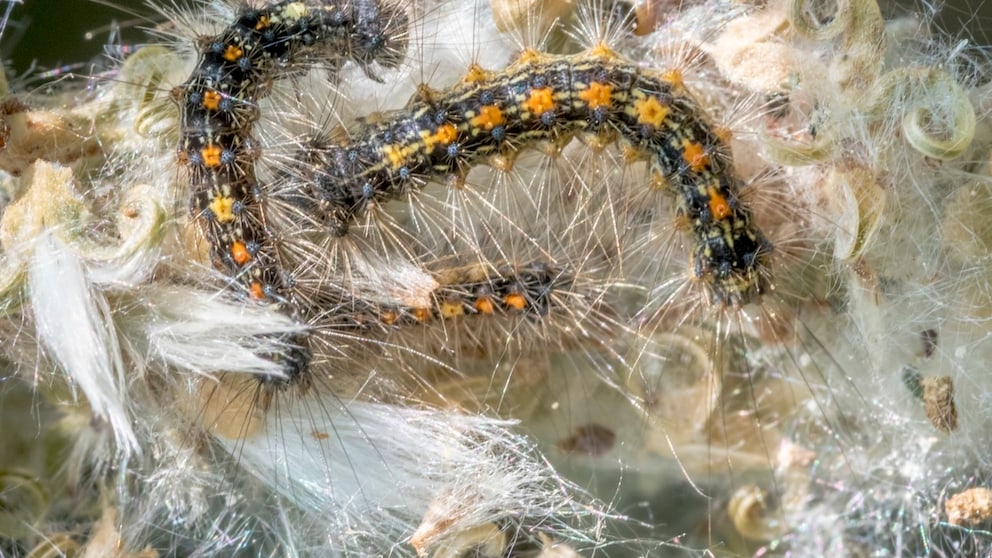
Before the brown-tail moth shines in all its glory, it first goes through the caterpillar stage. When nature awakens in spring, the small creatures hatch from their five- to ten-centimeter-long winter hiding places. These look like spun, silvery-white webs, are usually located on branch tips, and can house up to 100 caterpillars. To develop splendidly, they set out from there in search of food. They do not stop at buds or leaves. In a short time, they can destroy entire tree or bush crowns.
Like in 2009: At that time, a large-scale infestation with almost complete destruction was detected in the southern Franconian Jura near Ingolstadt on a 25-year-old sycamore avenue. And in 2026, the popular Luther Park in Bischofswerda had to be closed to visitors due to a brown-tail moth invasion, as reported by MDR in May.
How Dangerous Is the Brown-Tail Moth?
Encounters with the brown-tail moth can have far-reaching consequences, especially for humans. The caterpillars have tiny stinging hairs that can cause strong reactions when they come into contact with our skin due to the irritating proteins they contain. These include itching, welts, and rashes lasting several days.
Accordingly, the irritants can also trigger allergic reactions in sensitive individuals, which is why children and allergy sufferers should keep a safe distance. Especially airborne stinging hairs and those in the web nests are a serious, invisible danger.
Natural Paradise in Danger
The favorite plants of brown-tail moth caterpillars include fruit trees like apple or pear, but they generally settle on any type of deciduous wood. Sloe, rose bushes, and ornamental woods can also be affected. “The preferred habitats of this heat-loving species are outside the forest in the planar and colline altitudinal zones, especially on solitary trees, in hedges, on avenues, in orchards, and at sunny forest edges,” informs the Bavarian State Institute for Forestry and Forestry (LWF).
An attack weakens the natural barrier and makes the plants more susceptible to diseases and more vulnerable to drought. Repeated infestations with the brown-tail moth can sustainably weaken garden and forest plants. While older trees and bushes are more robust, the pest can be fatal, especially for young offshoots.
What to Do if You Find the Oak Processionary Moth in Your Garden
8 Poisonous Animals You Might Encounter in Your Garden
How to Recognize an Infestation
Once the brown-tail moth has settled in the home garden, it can be recognized during the bare months around the turn of the year. The caterpillars are still in hibernation and have retreated into their webs. Because there are hardly any leaves on the trees and bushes at this time, the conspicuous nests are easy to spot.
If you become aware later in the year, you should especially look for nibbled leaves, fine webs in the crown areas, and crawling caterpillars on the branches. “The white side spots and the two red tubercles are easy to recognize,” as the LWF describes. By this time, however, the infestation may already be so advanced that the affected plant has suffered lasting damage. Therefore, if you care about your plants, you should take a walk through the garden early in the year and take a close look at nature.
How to Combat an Infestation
If the brown-tail moth has infested the home garden, quick action is needed to prevent it from getting worse. Ideally, the infestation is detected in the fall or winter. Then the small visible web nests can be removed directly along with the branch and safely destroyed: According to LWF, “they can be cut off and burned.”
However, local regulations should be observed here. Disposal via the organic waste bin or compost is not recommended, as the creatures can spread from there. If they have already hatched in small numbers from their winter quarters, they should be collected as quickly as possible. When in direct or indirect contact with the caterpillars, appropriate protective gear and gloves should be worn. Due to the airborne stinging hairs, the area should be cordoned off to prevent physical reactions. If the infestation is too advanced or cannot be contained, it is worth hiring a professional service.