


October 18, 2026, 7:23 am | Read time: 4 minutes
There are plants that reveal their second most beautiful side only after blooming: Their seed pods and fruit clusters adorn garden beds and vases, and some also provide food for birds or shelter for insects. myHOMEBOOK presents eight species that have something to offer even as they fade.
In summer, the garden bed is full of color: red poppies, violet columbines, and love-in-a-mist in blue and white. Then the petals fall, and many hobby gardeners reach for the shears. But that can be a mistake, as some plants show once more how beautiful they are as they fade. The flowers turn into seed pods and fruit clusters, where the focus is no longer on color but on form.
Follow myHOMEBOOK on WhatsApp now
Love-in-a-Mist: Balloons Among Fine Threads
The annual love-in-a-mist blooms in blue, white, or pink, surrounded by thread-like bracts. After blooming, balloon-shaped seed pods surrounded by fine threads remain. Initially, they are greenish to cream-colored and often streaked with violet; later, they turn paper-brown and dry out. When the pods are ripe, they open and release their black seeds, which can spread around the plant. In dried bouquets, love-in-a-mist is an eye-catcher.
Also interesting: Planting and care tips for love-in-a-mist
Columbine: Five Fruits, One Star
The columbine is a short-lived perennial with nodding, usually violet-blue flowers and spurs. Each flower typically develops into five narrow fruits that stand together in a star shape and point upward. When they are dry and ripe, they open along a seam and release the black seeds. These can remain in the garden and produce new columbines, as the plant self-seeds very generously.
Teasel: Spiky Heads for Goldfinches
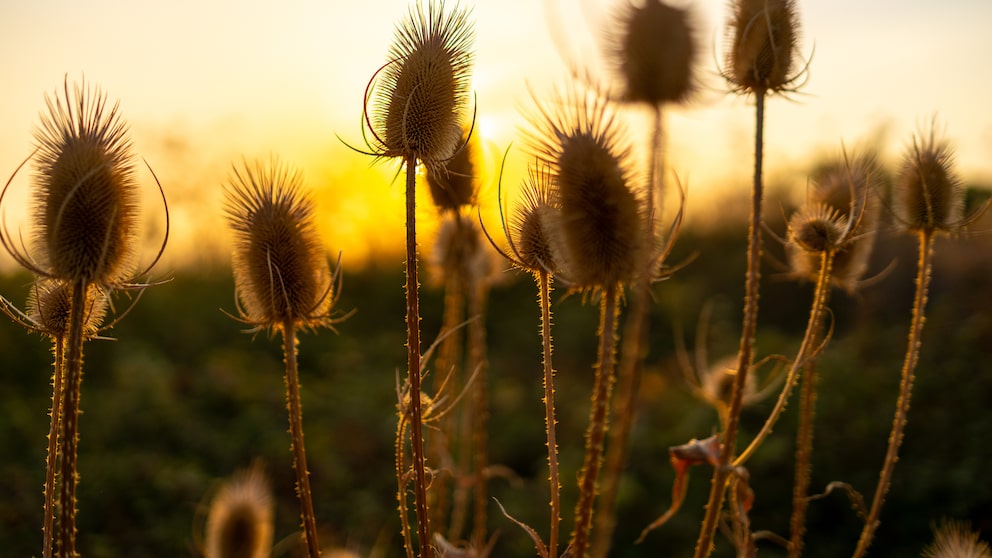
The spiky stem of the teasel bears violet flower heads in summer, which later become large, brown fruit clusters with numerous pointed bracts. These dry spiky heads make the teasel a visual highlight even in winter. Goldfinches use their pointed beaks to extract seeds from the heads. Insects overwinter in the dry stems if left standing until spring.
Poppy: The Capsule as a Little Shaker
After the bright red bloom of the poppy, a round capsule sits on a thin stem. Under its flat, radially ribbed lid are small openings through which the seeds gradually fall out. When the wind moves the stem, the capsule shakes out its seeds like a salt shaker.
Honesty: Transparent Discs
The biennial plant forms only a rosette of leaves in the first year and blooms violet or white the following spring. Then flat, oval fruits hang from the stem. As they mature, they burst open, and the seeds gradually fall out. The paper-thin discs, which shimmer silvery in backlight, are then revealed. The fruit clusters last long and are well-suited for dried bouquets.
Ornamental Onion: Spheres of Capsules
The flower spheres of some ornamental onion species can be as large as a child’s head. After blooming, spherical fruit clusters of numerous small capsules remain, in which the seeds ripen. The leaves have usually already retracted by then. In the garden bed and in dried bouquets, the fruit clusters last a long time.
Seeds and Berries That Attract Birds to Your Garden

How to Create a Cut Flower Bed in Your Garden
Purple Coneflower: Frosted Hedgehog Heads
In the purple coneflower, the center changes most after blooming. The conical flower base becomes a firm, hedgehog-like fruit cluster, with small fruits nestled between its stiff spikes. Birds pick them out. If the dry stems are left standing, frost collects in them in fall and winter.
Clematis: Feather Tails
Clematis are usually climbing plants and bloom with small bells or large flowers, depending on the species. Long, silky-haired appendages hang from the small fruits. Many together form silvery, feather-like tufts that resemble the beards of old men and remain on the plant well into winter for some species.