

May 9, 2023, 10:50 am | Read time: 8 minutes
Small and home gardens are also suffering from increasing dryness. Gardeners must adapt—with different plants and, above all, smart water management. Garden expert Sandra von Rekowski explains what needs to be done.
The gardener’s joy was once a neat piece of nature, either in the allotment settlement or at home. Neatly raked beds, a lawn like a carpet. But such a setup not only requires a lot of work—it also consumes a lot of water. And that is becoming increasingly precious in times of climate change. Despite the abundant rainfall since the beginning of the year, groundwater levels across Germany are concerning. How can you prepare your garden for the effects of climate change?
How climate change affects the garden
In Hesse alone, groundwater recharge has decreased by 27 percent below the long-term average since 2003, as reported by the Hessian State Office for Nature Conservation and Environment in August 2022. The drought monitor of the Helmholtz Institute currently reports “exceptional drought” for large areas in Saxony-Anhalt, Brandenburg, Mecklenburg-Western Pomerania, as well as small parts of Lower Saxony and the Breisgau region.
Sandra von Rekowski, a scientific associate at the Federal Association of German Gardeners (BDG/Berlin), can also confirm the seriousness of the situation. When the association visited 22 allotment gardens across Germany in the final round of its “Gardens in Urban Development” competition in summer 2022, some sites in Saxony-Anhalt faced significant issues due to the heat: “The municipalities turned off their water because it was too dry,” says von Rekowski. The allotment gardeners then developed methods to save water. Successfully: Gardens in Schönebeck and Bad Dürrenberg were awarded the bronze medal by the BDG.
Creating unsealed surfaces
The garden of the future must primarily save water. Gardeners have many options for this. It starts with unsealed surfaces where rainwater can seep in. “Every gardener must ensure they have as many of these as possible,” emphasizes garden expert von Rekowski, who studied horticulture and urban plant and open space management. This might mean tearing up a few square meters of asphalted driveway and filling it with soil or removing concrete slabs from the lawn. Every piece of earth where water can seep in has become precious.
But unsealing alone is not enough. Beds should be heavily mulched, ideally with grass clippings, slightly dried to prevent mold. In a layer about two inches thick, this valuable waste is placed around the plants—keeping the water in the soil longer.
The right planting
Additionally, garden expert von Rekowski advises lush planting of the beds because “bare soil is useless.” This means if you have a flower bed, you can plant spinach or lamb’s lettuce in the gaps between tulips or daffodils. Mixed cultures are also recommended for vegetable beds. Many plants thrive together: tomatoes harmonize with kohlrabi, potatoes with horseradish, and cucumbers with celery.
Sandra von Rekowski also recommends complementing strawberry beds with garlic plants. The main thing is to cover as many open spaces as possible with shading foliage. And planting thyme next to carrots has an added benefit: the scent of thyme repels the harmful carrot fly. Such mixed planting is not only ecologically sensible, but you can also eat its fruits.
As for the plants themselves: The increasing warmth means that olives and figs are now thriving in German allotments, replacing traditional, less heat-resistant Central European plants. “Our gardens are becoming a bit more Mediterranean,” predicts garden expert von Rekowski.
It’s also about growing water-saving plants. Sandra von Rekowski mentions grasses from prairie regions, perennials like coneflowers, Chinese silver grass, or fountain grass. Thick-leaved plants with hairy leaves, such as houseleek, spurge, or stonecrop, are also good. “These evaporate less water.” Excellent water savers include herbs like thyme, lavender, oregano, and marjoram. Here, the gardener not only enjoys the scent but also has beautiful spices for cooking.
When planting, always consider: Which plant suits the location? “That’s the order of the day,” emphasizes the Berlin garden expert. So if you have a garden with a lot of sunlight, you shouldn’t plant shade-loving plants like ferns, lily of the valley, Christmas rose, or autumn anemone, as the maintenance effort would be enormous.
Bloom time of fruit trees is changing
But what about the apple tree, the classic of every German garden? It will still be around, Sandra von Rekowski is optimistic. “It can withstand the heat.” But there’s another problem. Some varieties bloom early, but late frosts are becoming more common in Germany, as seen in early May in many places. This harms the fresh blossoms—and results in a poorer harvest. Garden scientist von Rekowski reports on experiments with trees bred to bloom later.
Read more: How does climate change affect fruit cultivation?
Climate change in the garden–the right irrigation
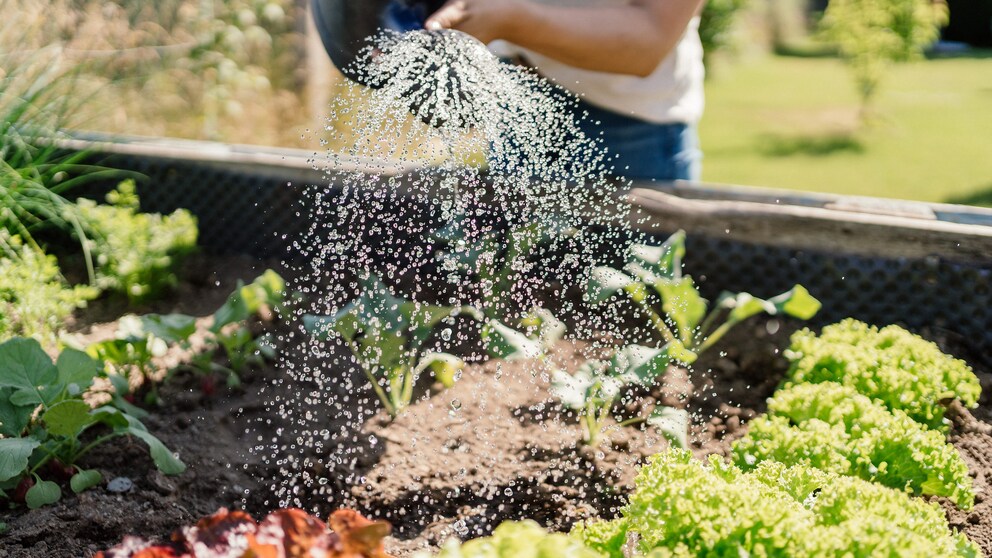
While the apple tree may still withstand the heat, optimizing the garden’s water balance involves not only different and as many plants as possible. Watering also takes on a new dimension. Traditionally, people watered their gardens daily in the evening. Wrong, says garden expert von Rekowski. The modern rhythm is: water everything thoroughly once, then pause for two days, and on the third day, it’s time to water again.
With such intervals, the gardener ensures that the plants strive with root growth. They must absorb as much of the rare water as possible, and this only works with a good self-supply system. Watering daily makes the plants “lazy,” meaning they don’t need to grow their roots because there’s fresh water every evening.
Sandra von Rekowski advises against evening watering anyway. The smart gardener reaches for the hose or can at the start of the day. Because: “In the morning, the plants also wake up and develop their roots.” It’s then the growth phase, supported by water. In the evening, however, the plants also get tired, and the energy for growth fades.
Use rainwater
Regarding water, the rule is: collect as much rain as possible, in barrels, tubs—whatever. Every drop is precious and saves valuable drinking water. It’s also advisable to create small depressions in the garden, where rain can collect. These don’t have to be large, maybe one or two square meters in area and ten or twenty centimeters deep, and you already have a small wetland in the garden, providing new habitat for plants and animals. Bees, for example, appreciate a watering place.
Read more: Methods for collecting rainwater in the garden
How Weather Fluctuations Affect Garden Plants

Is Gardening Without Digging Really More Environmentally Friendly?
Flower meadow instead of lawn in the garden
And when talking about plants, you must also talk about the lawn. While the silky soft carpet was once a trophy for every garden enthusiast, today it’s: the wilder, the better—flower meadow instead of Wembley lawn. Flowers should grow, weeds can thrive, and overzealous mowing is no longer necessary. The denser and more diverse the vegetation, the better the water retention and the lower the evaporation. And if it grows densely and colorfully, the bees are happy again.
Besides, this type of lawn care requires less maintenance. “If I want to remove every weed, I’ll never finish,” describes BDG expert von Rekowski the advantage of gentle wilding and says: “The focus of a garden shouldn’t be on the lawn anyway.” Because it’s of little use. But if you can’t live without it, you should have the courage to let the lawn dry out during severe drought, as drinking water is too precious to maintain a purely decorative area. “Don’t worry, when it rains again, it recovers quickly,” reassures the Berlin garden expert.
The concept of more nature, less precision in the garden also supports a slight mossing of the lawn. “Moss in shaded areas has the advantage of retaining moisture and releasing it to the lower soil layers,” explains garden scientist von Rekowski. It’s the sponge effect that the gardener can use. Moreover, moss is a good option for greening under trees that otherwise tolerate few plants in their immediate vicinity, such as walnut trees.
On the topic of trees, the BDG scientist has another tip: plant gardens in height layers. So under trees, place bushes, and under the bushes, smaller plants like perennials. “This principle is called a forest garden and also ensures that water is retained in the soil.”
Fertilize the garden with climate awareness
The question remains, how does a gardener fertilize in a climate-friendly way today? “With compost,” is Sandra von Rekowski’s only answer. And for that, at least two, preferably three compost heaps should be set up in the garden from leaves, clippings, and vegetable scraps. One is filled, the next rots away—and the third is “harvested,” with the fertilizer being applied in the spring. And when that’s harvested, the cycle starts again—like a three-field system. “Another fertilizer, such as chemical, is unnecessary and only costs money.”
But there’s another way to add nutrients to your beds: with so-called green manure plants. These include mustard seed, lupines, peas, and beans. “These are good nitrogen collectors,” explains Sandra von Rekowski. “If I don’t let them grow to harvest but work them into the soil beforehand, a lot of nutrients get into the soil.” Climate protection starts in the garden—and it’s easier than you think. It all depends on letting nature take its course as much as possible.