


August 17, 2026, 11:03 am | Read time: 5 minutes
Two neighboring gardens can feel completely different on hot days. One is pleasantly cool, the other almost unbearable. How to create a favorable microclimate in your garden that provides cooling on hot days is what we reveal at myHOMEBOOK.
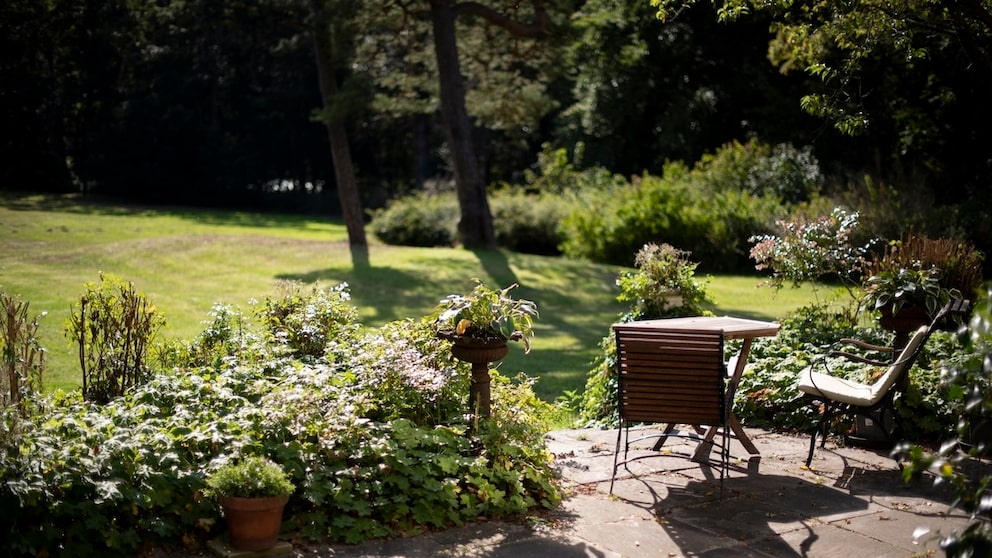
The sun has long set, yet the patio stones are still warm. Not as hot as at midday, when the terrace was impossible to walk on barefoot, but still quite warm. The stones have absorbed the day’s heat and are slowly releasing it. Just a few steps away, under an apple tree, it’s noticeably cooler. One spot retains the heat, while the other doesn’t heat up to the same extent. These differences in various areas have a name: microclimate. And these small climate zones near the ground can be influenced.
How Microclimate Develops in the Garden
Trees and shrubs provide shade, and plants and moist soil cool the surroundings through evaporation. Stone surfaces and other sealed grounds, on the other hand, store heat and release it slowly. How warm or cool a place feels doesn’t just depend on the actual air temperature. It’s also crucial how much solar radiation hits the body. That’s why a shady spot can feel much more comfortable, even if the air temperature is barely lower.
What Cools the Garden and What Heats It Up
Particularly effective are trees with dense, large canopies like oak, hornbeam, or field maple. They provide shade and release water into the environment through their leaves, which binds heat during evaporation. At the same time, these species cope relatively well with longer dry periods. How much water they evaporate and how much it affects the air temperature varies from species to species.
Smaller plants also influence the microclimate. Hedges act as natural windbreaks, reducing the rapid drying of the soil in their vicinity. However, if a hedge becomes too dense, it can completely block the wind instead of just slowing it down, causing heat to build up behind it. If the soil remains moist, plants can continue to evaporate water and thus contribute to cooling. Lawns and ground covers also take on this task, as long as they have enough water available.
The extent of the difference was recently demonstrated by a measurement in Munich’s Prinz-Eugen-Park, reported by Bayerischer Rundfunk: On the paved area, the thermometer showed 25 degrees in the shade of young, newly planted trees, and just a few steps away in the sun, 34 degrees, even though the trees don’t yet have expansive canopies.
Plants work against the heat, while stone surfaces work with it. Gravel and stone areas can heat up to 50 to 60 degrees on summer days, sometimes even up to 70 degrees. The heat accumulated in them during the day radiates well into the evening. Dark materials amplify this effect because they reflect less solar radiation. Unlike plants, such surfaces offer no cooling but extend the heat in the garden.
Also interesting: Neighbor’s tree shading your solar panels? Here’s what the lawyer advises

The best tips against heat in the house and garden

How to Green Partition Walls in a Row House Garden
How Water Improves the Microclimate in the Garden
Water doesn’t cool the garden because it’s cold, but because it disappears. Every drop that evaporates from a pond takes heat from the surrounding air. If you don’t have space for your own garden pond, a small water feature or fountain can at least achieve a mini-effect. Even if the cooling power remains low: Every water source counts for birds and insects.
Short-Term Measures, Long-Term Measures
A layer of mulch on the beds keeps moisture in the soil longer, allowing plants to evaporate water longer and thus cool. It’s also sensible to remove unnecessary gravel or paved areas and plant them. If paths need to be maintained, at least their surface temperature can be reduced: By widening the joints and planting them with hardy plants like thyme or star moss, the area can store more water and heat up less.
Climbing plants on house walls, garages, or privacy fences also help: Once they cover the surfaces, they prevent the masonry from heating up significantly and radiating heat like a radiator at night.
Even though trees often take decades to reach their full potential, newly planted trees already provide shade, and each year a little more. A hedge reaches its goal faster and can fully play out its potential after just a few years. As heatwaves continue to increase due to the climate crisis, a tree planted today will cool the summers that will need it even more in the future.
No one can accurately quantify how many degrees your garden can be cooled overall, as a garden has too many different areas. However, by combining several cooling measures, you can shift the balance in favor of the pleasant zones. And that’s what determines whether you’ll be grilling on your terrace in the coming summers or getting grilled.