


March 26, 2026, 5:02 am | Read time: 6 minutes
They are certainly practical, but rarely beautiful. The partition walls to the neighbors define many row house gardens. However, with climbing plants and suitable underplanting, these walls can be greened and made attractive. What to consider in this process can be found here on myHOMEBOOK.
In a row house garden on the south side of the house, the narrow locations at the partition walls to the neighbors follow their own rules. Here, the microclimate influences plant growth much more than in conventional beds. Planning for this from the start can save you trouble later with limp shoots or bare spots.
Why South Side Is Not Just South Side
To understand these location-specific rules, you should observe the sun’s path. For plants, it makes a big difference at what time of day they receive direct light.
On the wall that gets the morning sun, heat stress is usually not an issue. “The plants start evaporating in the morning and are most efficient at this time. The surrounding air is still cool, and the morning sun is gentle. The plants can start the day relaxed,” explains Sandra von Rekowski from the Federal Association of Allotment Gardeners in Germany.
The situation is quite different on the opposite wall, which is only sunlit from midday onwards. By then, the air has already heated up significantly. Sandra von Rekowski: “The plants are immediately under much higher stress because their evaporation increases massively. Additionally, the heated wall acts like a radiator: It radiates heat directly back onto the plants—and often releases this stored heat into the night. So, in addition to direct sunlight, there is an additional heat load. Ground and surrounding surfaces now also radiate more heat.”
At noon and in the afternoon, the plants are more exhausted than in the morning and can no longer adequately regulate heat and strong sunlight. “This significantly increases the risk of drought stress, sunburn, and overheating,” says the expert.
Three Rules for Greened Partition Walls
To ensure the greening in the narrow partition wall beds is successful long-term, three basic requirements must be met.
1. Keep a distance: Mount the trellis at least ten centimeters away from the wall. This allows air to circulate sufficiently behind the foliage. The airflow acts as a natural cooling system and prevents heat from building up between the stone or wooden wall and the leaves, mitigating the radiator effect.
2. Encourage depth: In narrow strips, space is limited, and the topsoil dries out quickly. Loosen the soil as deeply as possible before planting. Only if the roots can penetrate the cooler, moist layers will the plants have a chance to supply themselves with water on hot afternoons.
3. Utilize plant heat tolerance: The placement of plants depends on their resistance to high temperatures. True heat artists that can handle the radiation from the heated wall belong on the side that gets afternoon sun. Plants that need sun but wilt quickly in stagnant heat are better placed on the cooler morning side.
We present three plant combinations that work well in the bed strips between the terrace and partition wall. Often, the width of these strips is around 80 centimeters. However, there are also narrower and wider side strips. In most cases, the planting ideas can be adjusted to be slimmer or more lush, depending on the space available. The combinations, therefore, rely on a few species that repeat along the walls, creating a cohesive and calm appearance.
1. Classic Duo with Rose and Clematis for the Wall with Morning Sun
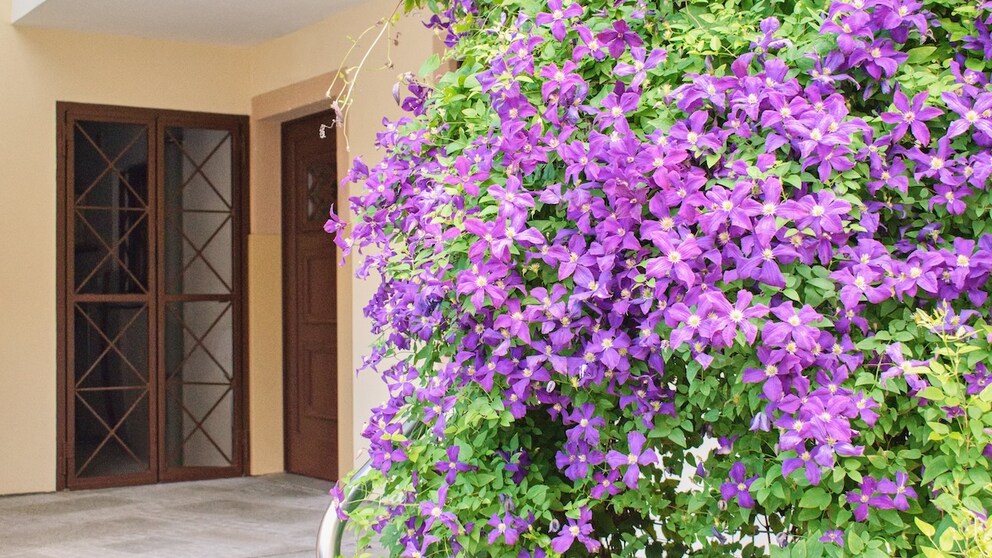
On the morning side, the risk of drought stress is lower, which benefits the clematis in particular. It needs sun above but prefers a cool base. A robust Clematis viticella (such as ‘Etoile Violette’) is a good choice here to green partition walls: Cut it back radically to 30–50 centimeters in March to prevent it from becoming overgrown or taking over the narrow bed, and it will bloom on new wood during the season.
The climbing rose (e.g., the repeat-blooming ‘Guirlande d’Amour’) frames it. At the base, a dense stand of cranesbill (Geranium macrorrhizum) can cover the area. This keeps the soil cool and moist, providing the clematis with the desired conditions. At the front edge towards the terrace, clusters of catnip break up the cranesbill carpet and frame the lower shoots of the rose.

The Best Plants for Natural Shade in the Garden

Greening an Old or Dead Tree With Climbing Plants
2. Edible Greening with Mini-Kiwi for the Wall with Morning Sun
On the milder morning wall, a mini-kiwi (Actinidia arguta) is well-suited if there is enough length available. It grows vigorously and should be trained from the start so that its shoots can be easily arranged and shortened if necessary. To green the partition walls, train it fan-shaped on sturdy wires upwards. Important: Since the plant develops considerable weight over the years, a firm anchorage is essential. The ‘Issai’ variety is particularly practical here. Unlike most other kiwi plants, it is self-fertile and can be planted alone.
The ground can be covered with wild strawberries (Fragaria vesca). In between, clumps of garlic chives (Allium tuberosum) fit well, providing a nice contrast with their white flowers in late summer. As a fourth species, the spice plant salad burnet (Sanguisorba minor) fits in. However, it should be planted sparingly between the strawberries to prevent the area from becoming too cluttered and to ensure each plant gets enough light.
3. Grape Vine and Drought Artists: The Heat Experts with Afternoon Sun
On the hot afternoon wall, grapevines (Vitis) really thrive. Since they directly convert the stored heat of the wall into fruit ripening, they are ideally suited for this location. Particularly mildew-resistant table grapes like the blue ‘Muscat Blue’ or the light ‘Birstaler Muscat’ are suitable here.
As underplanting, lamb’s ear (Stachys byzantina), meadow sage (Salvia nemorosa), and lavender (Lavandula angustifolia) complement the bed. All three plants are physiologically adapted to intense sunlight and dry soils. While the silvery-haired lamb’s ear forms a dense carpet, meadow sage and lavender provide vertical structure and color. All three species are very low-maintenance after establishment and require little additional watering.