


September 25, 2026, 10:11 am | Read time: 6 minutes
Sealed areas in the garden can be transformed into blooming beds for just a few dollars, which can absorb heavy rain, attract insects, and are more beautiful than any pavement. Find out how to best remove paving and plant here on myHOMEBOOK.
You probably have a bed on your property that you don’t even know about. It could be right under a sealed garden path, an unused terrace, or a driveway and has never seen the light of day. Between you and this bed is just one to-do: removing the paving. Those who unseal an area to redesign it as a bed often expect a lot of work and high costs: removing stones, sand, and gravel, bringing in new soil, and planting perennials or shrubs. “A classic reconstruction can quickly cost 80 to 240 euros per square meter,” says landscape architect and author Jens Maute (“Cleverly Manage Water in the Garden”). However, when removing paving according to the Marburg model, which he co-developed, it costs only a few euros for compost and seeds. Marburg residents don’t even pay a euro.
Removing paving as a competition: If you’re up for a little contest: The “removing paving” competition is currently running nationwide for the second time, where cities and municipalities compete in three groups based on population size. The one that unseals the most square meters wins. The event is supported by the University of Social Design in Koblenz. It runs until the end of October and is set to continue in 2027. Those who want to participate can register their own unsealed area on the competition website.
One Person’s Trash is Another’s Resource
Directly under paved areas, the substructure is usually sand, gravel, or crushed stone. In traditional ornamental gardens, this material is considered a problem that must be disposed of before planting the area. For a naturally designed garden with wild plants, however, this lean, permeable soil is the ideal foundation. “Two garden worlds collide here,” says Maute. What traditional gardeners see as a deficit is a resource in a natural garden. “These beds are about retaining rainwater where it falls so that it benefits the plants later,” the expert explains. “And because sand and gravel are so low in nutrients, they also provide a habitat for an astonishingly large number of plants and animals.”
Removing Paving According to the Marburg Model in 7 Simple Steps
1. Test Conditions
Remove a stone and see what’s underneath. If loose material like sand, gravel, or crushed stone appears, you can start. Only with a concrete base layer or continuously asphalted and concreted surfaces does the Marburg model end before it begins. Then only heavy equipment and a professional company can help.
Also interesting: What the pH value reveals about garden soil
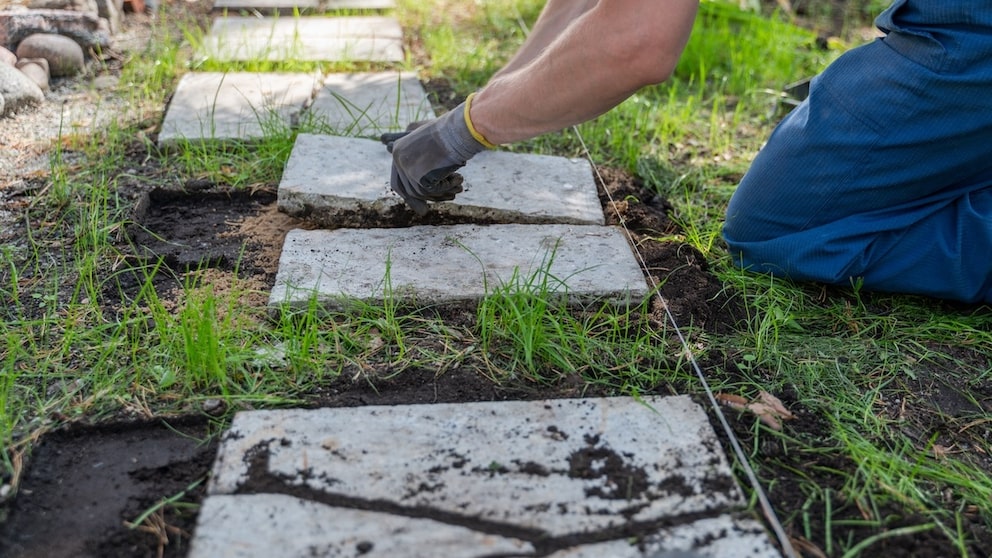
2. Remove Paving Stone by Stone
With a pickaxe, the remaining stones can be quickly loosened. It’s best to stack them in a place where they won’t interfere with further work and can be easily transported later.
3. Consider Existing Edging
Most paved areas are surrounded by edging that holds everything together. If you prefer convenience, simply leave the edging in place and pull some of the exposed, loose material from the center of the area to the edge until the tripping step is wedge-shaped filled. If the area is already bordered by lawn or a bed, the edging can disappear entirely. If you want, bring out the sledgehammer.
If you only remove part of the area, you should re-edge the remaining paved area so it doesn’t lose stability.
4. Reuse Old Material
The removed stones don’t necessarily have to go to the recycling center. They can be used, for example, as backfill for a dry wall or, loosely stacked, as a shelter for lizards and other small animals. Sometimes the neighbor is also pleased.
5. Apply Compost
Before sowing or planting, the barren subsoil needs a little boost: Apply a thin layer of green waste compost (about two liters per square meter) and lightly work it into the sandy soil.
Also interesting: These plants reseed themselves
6. More Beautiful Parking: Plant or Sow
How you want to use the area later determines what you sow or plant. The Marburg model distinguishes between two main variants: If the area is to remain walkable or even drivable, such as a parking space, low wildflowers and resilient grasses are suitable. If the area is rarely walked on, the plants can grow taller: pure wildflower mixes or, for faster blooming results, additionally planted wild perennials. Using regional seeds also supports biodiversity.
Regional Seeds: “Wildflower mix” sounds like a single product, but it isn’t. Insects and plants in a region have adapted to each other over millennia. Therefore, some seed suppliers work with several origin areas instead of a single nationwide mix.
7. Minimal Maintenance
Unlike a traditional flower bed, the new area requires little attention. No fertilizing, and watering only in the early stages. “After that, you just go over it with a brush cutter twice a year, and you’re done,” says Maute.
Square Foot Gardening: Small Plots for Diverse Harvests

How Sponge Gardens Efficiently Water Your Plants
Climate Adaptation in Bed Format
Whether an unpaved area is just one square meter or a hundred times that size: “Every area helps,” says Maute. When the next heavy rain comes, the loose soil absorbs the water instead of letting it flow into the sewer. If the rain then stays away for months, it releases the water again, and even the groundwater below benefits. Meanwhile, the area cools the air a little on every hot day, simply because its plants evaporate water.
Such a bed is thus an element of a sponge garden and possibly a cell of a sponge city. “Imagine two neighboring cities with similar conditions. In one, many garden owners have removed paving and planted, in the other not. It won’t be long before you see the differences,” says Maute, adding: “In the next weather extremes, which are becoming more frequent and severe due to the climate crisis, one will struggle with dried-up plants and flooded basements, and the other won’t, or at least much less. I’m absolutely convinced of that.”
The Island Bed on the Terrace
While researching for this text, I visited a friend. We sat on her terrace, and I told her about removing paving. Even as I explained, she stood up and walked back and forth on a few terrace stones as if she wanted to stake out a bed–a kind of island in the middle of the terrace. She said the clothesline would always stand there anyway. And it would be well placed on a gravel lawn area.