


April 26, 2026, 11:18 am | Read time: 5 minutes
Gardening in squares is a response to two extremes: scarcity or abundance. The scarcity concerns space. Those with only a few square meters of green space must use every inch efficiently. Square foot gardening addresses the problem from both sides. It is a system for people who want diverse harvests in a small area.
How Square Foot Gardening Began
The American civil engineer and efficiency strategist Mel Bartholomew developed this system in the 1970s. In traditional vegetable beds, which he saw as simple copies of large-scale agriculture, he primarily identified an efficiency problem. The typical row planting would lead to massive space loss due to paths and unnecessary work.
His solution was to move away from this “mini-agriculture” in favor of optimized land use. Planting vegetables in squares instead of rows was a break from a centuries-old tradition, long ridiculed but increasingly gaining fans worldwide.
How Square Foot Gardening Beds Are Structured
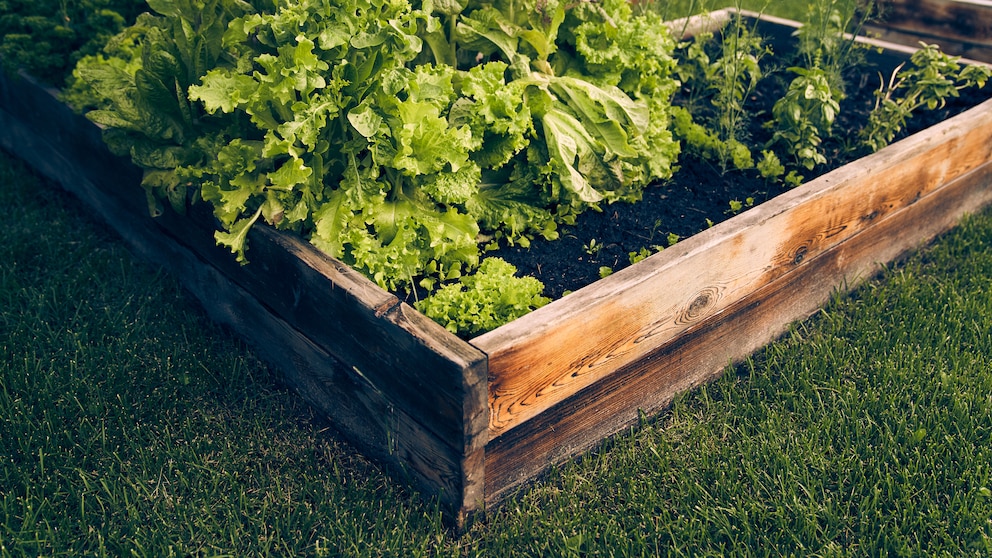
The principle is simple: You create a raised bed, ideally with a side length of 1.2 meters and a height of 15 to 30 centimeters. This size is not a random idea but a matter of convenience, as it allows you to reach every plant from the edge without ever stepping into the bed. This ensures soil that remains as fluffy as a freshly sifted pile of compost.
This raised bed is divided into smaller plots by a wooden grid or stretched strings. It acts like a compartmentalized box for your vegetables. Each type gets its own clearly defined space, preventing chaos from the start. Common sizes are squares of about 30 x 30 to 40 x 40 centimeters. Choosing smaller units creates 16 plots, while larger variants have nine.
How to Plant Square Foot Gardening Beds
In square foot gardening beds, planting is denser than in conventional beds. In the smaller squares (30 x 30 centimeters), you can fit about 16 carrots, 9 bush beans, 16 scallions, 4 Swiss chard, 4 leaf lettuces, or 16 radishes. Larger crops like peppers, broccoli, cucumbers, or tomatoes usually require larger plots. If those seem too small, several plots can be temporarily combined. Climbing plants like pumpkins or cucumbers can be placed at the edges to grow beyond the border—or you can use trellises to guide the harvest vertically, saving space.
Generally, each square should host a different crop, automatically leading to a mixed culture. To further promote plant health, ensure that plants from the same family are neither directly adjacent nor follow each other in the same square. In square foot gardening, idle plots are a no-go: Once you harvest a square, the next seeds are ready to go. This continuous planting acts like a yield booster but comes at a cost: Without consistent fertilization, the system quickly reaches its limits.
Watering is also a challenge. On one hand, dense planting shades the soil and retains moisture longer in the bed. On the other hand, the high number of plants increases water demand, and raised beds dry out faster than traditional garden beds. A regular finger test in the soil is essential. If it feels dry, it’s time to water.
The Ideal Location and the Right Soil for the Square Bed
Square foot gardening beds can be set up anywhere that is as sunny as possible. The soil filled into the raised beds plays a crucial role, as it determines success or failure with this rather dense planting. Square foot gardening inventor Mel Bartholomew created a special soil mix called “Mel’s Mix.” However, due to issues such as the use of peat, gardeners today experiment with their own mixes. The key is that the substrate is humus-rich, nutrient-rich, and well-draining, with good water retention. A mix of plenty of good compost, sand, and garden soil can meet these conditions.
How Raised Bed Height Affects Plant Growth

6 Winter Vegetables to Plant in Fall
The Advantages of Square Foot Gardening
The biggest advantages lie in efficiency and low effort.
- Space-saving: Due to their small size, the beds can be set up anywhere, even on terraces or in backyards. On paved surfaces, a fleece and a thin drainage layer should be placed under the soil.
- Beginner-friendly: The division into small squares never makes the area overwhelming. Additionally, there are planting plans and even templates for sowing available online and in books.
- Very low maintenance: Since weeds find little space and the squares are quickly tended to, the time required for maintenance is minimal.
- Optimal soil quality: There is no dependency on garden soil, as the beds are filled with high-quality substrate.
- Great variety, small quantities: Instead of harvesting baskets full of the same thing, you enjoy a varied buffet: Here, three radishes for breakfast, there, a handful of spinach for a smoothie.
- Easy snail protection: Protective measures like snail fences or copper bands can be easily attached to the frame of the beds.
The Disadvantages of Square Foot Gardening
Despite all the advantages, the system has its limits.
- Low yields: The harvests do not replace a weekly grocery trip but only add some extra vegetables to the table.
- Financial and time startup costs: Building raised beds and purchasing high-quality soil is not cheap and also requires a significant amount of time.