


July 31, 2026, 4:31 am | Read time: 6 minutes
When water no longer makes things wet: During long heat waves, garden soil loses its ability to absorb water. Find out what earthworms, bacteria, and fungi have to do with it here.
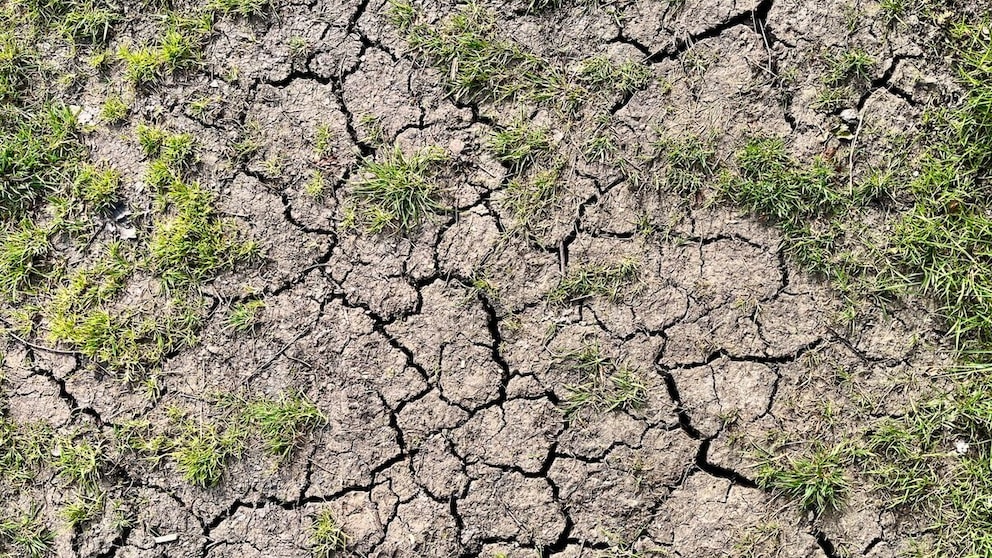
During a heat wave, you can see the thirst in the garden soil. The surface turns light gray, and when you use a hoe, you get powder and clumps instead of crumbs. It seems as if life has vanished. But that’s not true. Beneath the dusty surface, millions of organisms are busy surviving the drought, each in its own way.
Thirst Weighs Heavier Than Heat
During a heat wave, two forces act on the garden soil: temperature and drought. “Usually, the lack of water is a greater burden on soil life than high temperatures alone,” says Martin Schädler from the Helmholtz Center for Environmental Research (UFZ). The biologist is researching how the climate crisis affects soil life at an outdoor facility in Bad Lauchstädt.
The two forces cannot be separated, as they amplify each other. As long as the garden soil is moist, evaporation cools it during a heat wave, similar to how sweating cools the skin. Once the water is gone, this cooling effect disappears, and the surface heats up further. Dry soil becomes hotter than moist soil, and this additional heat drives out the last bit of moisture. The top few centimeters are hit hardest. Further down, it remains cooler and moist for longer, and life shifts there.
How Earthworms Survive Heat and Drought
This is most evident with earthworms. They breathe through their skin, which must remain moist. Earthworms are most active at soil temperatures between 50 and 68 degrees Fahrenheit. They handle cool temperatures better than intense heat, especially when combined with drought. Their main working time is in spring and fall when the soil is well-tempered and moist. If drought sets in early, they disappear sooner and have less time for feeding and reproduction.
If it becomes too dry, deep-burrowing species retreat to moister layers, often about 12 inches deep. There, they expand their burrow into a chamber, curl up into a tight knot, and slow down their metabolism. The knot serves a purpose: It reduces the body surface area through which water can evaporate. In this state of dormancy, a worm can wait several weeks without water. Not every worm manages to retreat. If the drought lasts too long, the animals die, and the population relies on the cocoons, the worm eggs, which endure more than the adult worms. The population returns slowly: Native species produce about one generation per year. What the worms leave behind are their tunnels. The burrows of deep diggers extend several meters and remain for years after the animal has died.
Bacteria and Fungi Wait in Water Droplets
The invisible soil inhabitants have different survival strategies during a heat wave in the garden soil. Bacteria and fungi live in thin water films between soil particles. These films break when the soil dries. “Many survive drought in dormant stages or protected soil pores,” says Martin Schädler. In the dormant stage, metabolism almost shuts down, and some species encase themselves in a resilient shell until water returns. The protected pores are the finest in the soil. There, capillary action holds water the longest, even when everything around is dry. This creates tiny refuges measuring only fractions of a millimeter.
So the soil is not dead. It’s more like a workshop where someone has turned off the machines: Leaves and other plant debris are no longer decomposed, and plants receive fewer nutrients just when the heat is already stressing them excessively.
How to Encourage Earthworms in Your Garden
Tips to Loosen Dry Soil
Why Garden Soil Repels Watering
The crumb structure, through which water evenly penetrates the soil, doesn’t form by itself. It is constructed. Earthworms create tunnels, microorganisms glue the crumbs together with plant roots, and pores of all sizes form in between. “If this biological soil structure is missing, the soil’s ability to absorb and retain water decreases,” says Schädler.
There’s also a physical effect. According to common explanations, fats and waxes from organic components dissolve during severe drying and form a film around soil particles. The surface becomes water-repellent, and water beads off instead of soaking in. Experts refer to this as water repellency. It doesn’t develop gradually but kicks in once the water content falls below a certain level: Until then, the soil absorbs water; afterward, it repels it. Sandy and humus-rich soils are particularly susceptible, which is exactly what many garden beds and almost every flower pot contain. You can see this in two seconds: Pour a splash of water on a dried-out garden bed. On absorbent soil, the spot darkens immediately; on water-repellent soil, the drops stand for a moment as if there were a film.
And here, what is usually a great advantage becomes a drawback: the worm tunnels. In a living, absorbent soil, they are beneficial because even large amounts of rain quickly penetrate downward instead of running off the surface. But if the surrounding soil no longer absorbs anything, the tunnel becomes a slide. The same applies to the cracks that dry soil forms. The watering rushes downward and bypasses the root zone.
How Soil Life Recovers
How quickly garden soil regenerates after a heat wave also depends on how the rain returns. A cloudburst that overflows the rain barrel in minutes hits dry soil like a paved path: Most of it runs off the surface, and the rest disappears into the cracks. If the water comes as a long, gentle rain, it goes quickly. Bacteria and other microorganisms become active again within a few days. It takes longer for larger animals, and after long or repeated dry periods, not all return.
This topic extends beyond a single summer. “If extreme dry phases occur more frequently, these species can disappear, and the soil community can change permanently,” warns Schädler. The garden soil is then not only drier than before. It is different.