


July 26, 2026, 7:18 am | Read time: 5 minutes
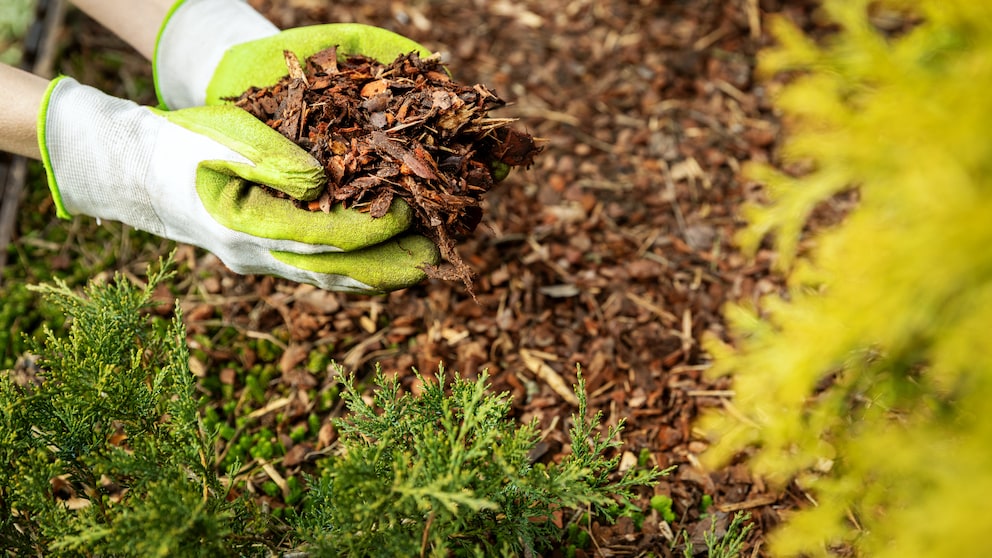
Bark mulch is very popular in gardens but has its pitfalls. However, there are plenty of bark mulch alternatives, some even free from your own garden. We’ll explain which material suits which plants here on myHOMEBOOK.
Bark mulch is used in many gardens for good reason: It suppresses weeds, retains moisture in the soil, and looks tidy. However, the classic made from conifer bark shows weaknesses in flower beds. During decomposition, microorganisms bind nitrogen, which then becomes unavailable to plants, potentially leading to a deficiency. Additionally, the pH level of bark mulch is acidic, which many plants dislike. Bark mulch is not suitable for young plants, vegetables, and perennials. It works well under shrubs and trees and is also effective on paths, where its disadvantages are less significant.
There is a milder version of the classic: bark compost, made from the same material but already pre-composted. The decomposition is well advanced, so it hardly draws nitrogen and is less acidic, making it suitable for perennial beds. However, it costs more and is less effective at suppressing weeds.
Bark Mulch Alternatives Free from Your Own Garden
Nutrients and protection don’t have to cost anything. Those who use the garden waste that naturally occurs are practicing circular economy in the garden.
Grass Clippings and Vegetable Scraps
Freshly mowed grass is the mulch that almost every garden provides, and like bark mulch, it is often used incorrectly. Because it has a narrow carbon-nitrogen ratio, it decomposes quickly, releasing nitrogen and potassium into the soil. However, if applied fresh and thick, it quickly turns into a dense, rotten mass. Therefore, you should let the material dry before spreading it and only apply it as a ground cover, replenishing it more frequently. Applied this way, it suits practically all crops. Only fresh seedlings remain unmulched until they are strong enough. Healthy harvest scraps can also stay on the bed: Lettuce leaves or pruned tomato shoots return their nutrients directly instead of taking the detour through compost.
Tip: Tomato plants thrive in their own waste. You can use healthy tomato leaves or shoots to mulch the tomatoes. Alternatively, you can use the leaves to mulch your cabbage plants. Some pests are deterred by the smell.
Autumn Leaves
Under shrubs, hedges, and on tree discs, autumn leaves have their natural place. They decompose over the winter and build humus. Additionally, you can use them on harvested beds: A loose leaf cover protects the bare soil from erosion over the winter and feeds the soil life. In spring, rake the remnants aside to allow the soil to warm up. You can also use autumn leaves to create a new bed: Cover the lawn area to be transformed thickly with leaves, and the grass underneath will suffocate over the winter. By spring, a well-plantable bed will have formed without needing to use a spade.
Wood Chips
Chipped tree and shrub cuttings make a particularly durable covering and reliably suppress weeds. Like bark mulch, they draw nitrogen during decomposition and remain for years, making them suitable for garden paths and under trees, but not for vegetable or perennial beds.
Chinese Reed (Miscanthus)
The tall ornamental grass is found in many gardens, mainly because it looks beautiful even in winter. After pruning in spring, the stalks can be chipped and spread on the bed. They are as structurally stable as straw and keep pumpkins or zucchini clean. Besides the vegetable bed, Miscanthus can be used in perennial beds, under roses, berries, or shrubs. If you don’t have Chinese reed in your garden, you can buy ready-made Miscanthus chips. They are available in garden centers as bagged goods, but they are not cheap.
Which Tricks Really Keep Plants Moist Longer in Summer
Trends in Gardening for 2026
Byproducts from Agriculture
Some materials are byproducts of agriculture, both in plant cultivation and animal husbandry.
Straw
Straw is very structurally stable. Strawberries love it as mulch material because it keeps the fruits clean and dry. Whether the English word “strawberry” really comes from the straw under the fruits is debated among linguists—but it has always fit. Crops like rhubarb, pumpkin, and zucchini also benefit from a straw base. Since straw draws some nitrogen from the soil, applying horn meal before spreading helps.
Sheep Wool
In the bed, sheep wool has two strengths. During decomposition, it slowly releases nitrogen, similar to horn shavings, and it stores multiple times its weight in water, which it gradually releases. It is available commercially as fleece or loose wool. When purchasing, ensure it is approved for organic farming to prevent residues from animal husbandry from ending up in the bed.
Permanent from the Quarry
Mineral materials do not decompose and therefore do not need to be regularly renewed.
Lava Mulch
The porous volcanic rock is pH-neutral, stores solar heat during the day, and releases it at night. Its fine structure also retains water and releases it slowly. Lava can be used for Mediterranean and perennial beds, as well as for path coverings. However, the stone has two disadvantages: It is expensive, and it is heavy, making it difficult to spread over large areas. You should not use lava mulch under deciduous trees, as leaves get caught between the stones in autumn and are difficult to rake out.
Gravel and Chippings
Gravel and chippings are well-suited for paths, and in gravel beds with drought-loving perennials, they are considered suitable mulch material. On regular beds, however, they store too much heat in summer, and nothing organic is added to the soil from above.