


October 11, 2026, 7:11 am | Read time: 4 minutes
Autumn leaves often end up in the compost bin, yet they can do a lot in the garden. Learn how leaves can improve the soil and how you can use them in your garden here on myHOMEBOOK.
Those who remove every leaf from the garden in the fall turn a natural cycle into a drain. If the autumn leaves remain in the garden, they are broken down into humus by soil organisms. This acts as a natural soil enhancer, creating a loose and stable soil structure.
How Autumn Leaves Turn into Humus
For fungi, bacteria, woodlice, and earthworms, autumn leaves are food. They help transform them over time into dark, crumbly humus. In sandy soils, it retains water and nutrients, while in heavy soils, it makes them loose and airy. Additionally, the leaf cover itself acts like mulch, protecting against drying out and extreme temperature fluctuations.
Is Autumn Leaves a Fertilizer?
Autumn leaves are hardly suitable as fertilizer. Before the leaves fall, trees draw many nutrients back into the trunk and roots, leaving little in the leaves. Therefore, fallen leaves do not remedy an acute nutrient deficiency.
Fast and Slow Rotting Leaves
Each type of leaf has its own pace. Leaves from linden, hazel, maple, hornbeam, elder, and fruit trees decompose relatively quickly and are well-suited as mulch between perennials and under trees and shrubs, as well as on vegetable beds, where they protect the soil over the winter and suppress weeds. For perennials, about two inches is sufficient; low-growing and evergreen plants should not be buried. If applied too thickly, leaves can form a dense, wet layer that allows little air to reach the soil.
Oak, walnut, and chestnut leaves decompose more slowly. The Bavarian Garden Academy attributes this less to the often-cited tannins and more to their higher degree of lignification. They belong where they can decompose undisturbed: as mulch under hedges, shrubs, and trees.
Also interesting: What happens if you simply mow over autumn leaves?

How to Properly Care for an Apple Tree After Harvest
Which Mulch Alternatives Suit Which Plants
Composting Autumn Leaves or Piling Them for Hedgehogs
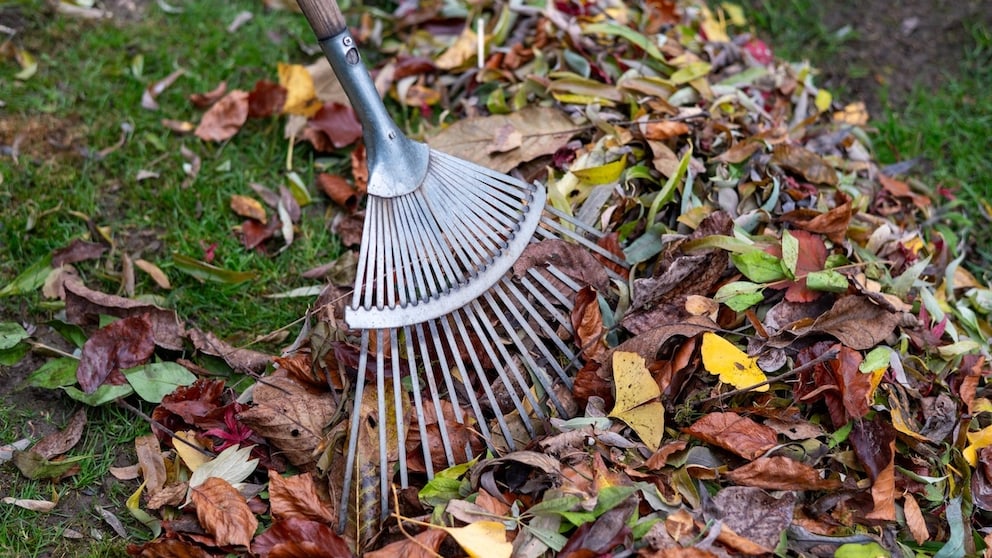
It’s better to sweep leaves off lawns, paths, and terraces. Under dense leaves, grass lacks light and air, and the moisture promotes diseases like snow mold. On paths and terraces, autumn leaves quickly become slippery when wet.
Leaves that you don’t spread in beds or under trees can also be added to the compost. Shredded and mixed with other organic waste, they decompose faster.
If you’ve gathered larger amounts of leaves, you can create a pure leaf compost. For this, collect the leaves in an airy container, such as a wire basket. After one to two years, fine leaf humus forms, which is excellent for soil improvement.
Alternatively, you can pile the leaves in a dry, sheltered corner of the garden. Together with branches and twigs, it becomes a winter shelter. Hedgehogs use such piles as a refuge, but insects and other small garden dwellers also find protection there.
What to Do with Diseased Leaves?
Diseased leaves should not remain in the garden. This includes, for example, rose leaves with black spot, maple leaves with black tar spots, or chestnut leaves infested with the leaf miner. Pathogens and pests can overwinter in fallen leaves and cause problems again in spring.
They also don’t belong in the compost, as this would spread the pathogens throughout the garden the following year. It’s best to collect them consistently and dispose of them in the trash or compost bin, depending on the disease and local regulations.