


May 28, 2026, 5:31 am | Read time: 6 minutes
When the heat comes, plant care becomes a marathon with the watering can. Numerous ideas circulate on how to keep water in the soil longer. Some are sensible, others less so. myHOMEBOOK gardening expert Katharina Petzholdt presents some unconventional water storage solutions for plants and evaluates which ones really work in practice.
Follow myHOMEBOOK on WhatsApp now
In the aisles of garden centers, you almost inevitably stumble over pallets of expanded clay. Those looking for a solution to the rapid drying of potted plants often reach for it, hoping to create an additional water reservoir for the plants. However, classic expanded clay serves a different purpose. The brown balls are primarily intended for drainage and reliably prevent waterlogging, but they hardly store water permanently. Those seeking effective water storage for plants need materials with an open-pore structure.
Expanded Clay or Plant Granulate?
Both terms are often equated in the market, but they mean different things. Classic expanded clay is largely closed-pore on the outside and conducts water well but hardly stores it. Plant granulate (such as Seramis) has an open-pore structure and can bind moisture much better. Those looking for a water reservoir should pay attention to the exact product designation.
Especially on social networks, many supposed water storage solutions circulate that often do not work as well in practice as they appear online. However, there are also organic and mineral materials that have proven to be effective water reservoirs.
Related: A simple trick with old corks can help houseplants
Microplastics and Germ Risks from Sponges in Flower Pots
Household sponges are often recommended as water storage for plants. However, synthetic sponges break down over time into microplastics that remain in the soil. Additionally, used kitchen sponges can promote germs and decay processes.
Those who still want to use sponges can opt for biodegradable natural sponges like loofah or konjac. They can be used in balcony boxes and pots, serving as water storage until they decompose.
Pine Cones: Drainage with Variable Effectiveness
Pine cones are occasionally used as a natural drainage layer in pots. When freshly added, they create cavities in the substrate, improving water drainage. However, as water storage for plants, they are hardly effective in this state.
As the material decomposes, its structure breaks down, and its properties change. In this phase, organic components can bind water, but without stable storage effects. At the same time, the decomposition process can deplete nitrogen from the soil. This makes the effect overall difficult to calculate and only limitedly usable in the long term.
Hydrogel: High-Performance Storage with Side Effects
Water storage granules and hydrogels initially seem technical, but they are familiar to many in everyday life, such as from the absorbent core of modern diapers. The internet suggests using such materials or diaper components as water storage in plant containers. The logic sounds convincing: What keeps a diaper dry could also keep soil moist. But the comparison is flawed. The superabsorbents they contain, usually sodium polyacrylate, can bind large amounts of water but are not designed for plant use. They do not release water to roots as needed and can burden the soil with released sodium ions.
Hydrogels are only sensible if they are specifically developed for horticulture and incorporated into the substrate in the correct dosage. They are not suitable as an improvised solution from the diaper bag.
Brick Fragments and Clay Shards: Professional Material with DIY Pitfalls
Brick fragments have good water capacity due to their porous structure. In professional substrates–such as for green roofs–pure brick chips, especially from masonry bricks, are valued because they can efficiently store moisture and slowly release it back to plants.
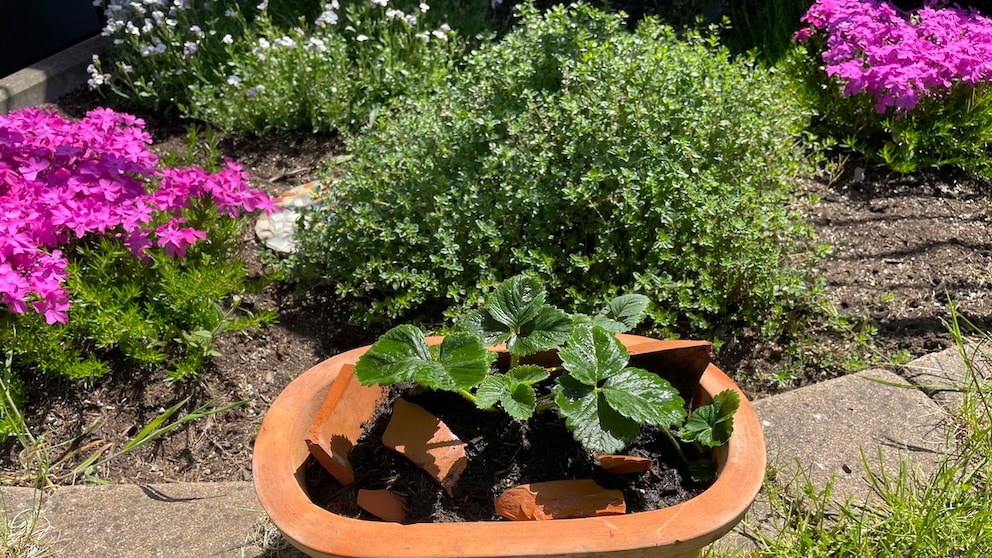
However, those who take a hammer to old masonry bricks at home often bring in mortar residues. Since these are alkaline, they can change the pH value in the pot. Not every plant can handle this. Old clay shards from flower pots are safer in this regard. They also absorb water but do not bring mortar residues.
Also interesting: Expanded clay or potting soil–what is suitable for which plants?
Sheep Wool: Organic Water Storage for Outdoor Use
Compared to standard expanded clay, sheep wool is a very good water storage material. It is either worked into the soil as highly compressed pellets or as unwashed raw wool. The fibers absorb moisture like a wick, hold it, and slowly release it. Additionally, wool provides valuable nitrogen, potassium, and phosphorus as it breaks down.
It is ideal for heavy feeders in vegetable gardens but can also be used well in pots and boxes. Indoors, however, it poses a risk of odor. As an untreated natural product, prolonged moisture can trigger a decomposition process that releases a very authentic barn aroma.
Protect Plants from Waterlogging with Effective Drainage

6 Tips to Avoid Plastic in the Garden
Mineral Water Storage for Plants: Lava and Pumice
Lava and pumice are proven mineral water storage materials for plants. Their open-pore structure allows them to absorb water while ensuring stable aeration. As a substrate additive, they are suitable for houseplants as well as for pots and beds. Being purely mineral, they are durable, odorless, and mold-resistant.
Biochar: The Long-Term Depot for Garden Beds
Biochar is the professional solution for those who want to make their soil crisis-proof in the long term. It is a central component of the legendary fertile black soil Terra Preta. Its microscopically small chambers store water and nutrients for decades.
However, biochar must be activated before use, such as by soaking in compost or organic liquid fertilizers, so it does not initially bind nutrients in the soil.
Its area of application is mainly in garden beds or larger raised beds. There, it fully utilizes its strength as a long-term storage and structural improver.