


June 5, 2026, 10:45 am | Read time: 5 minutes
For decades, coffee capsules have faced criticism: too much packaging, too little sustainability. New variants made from paper or compostable materials promise a better ecological footprint. But is that really the case? myHOMEBOOK spoke with an expert about it.
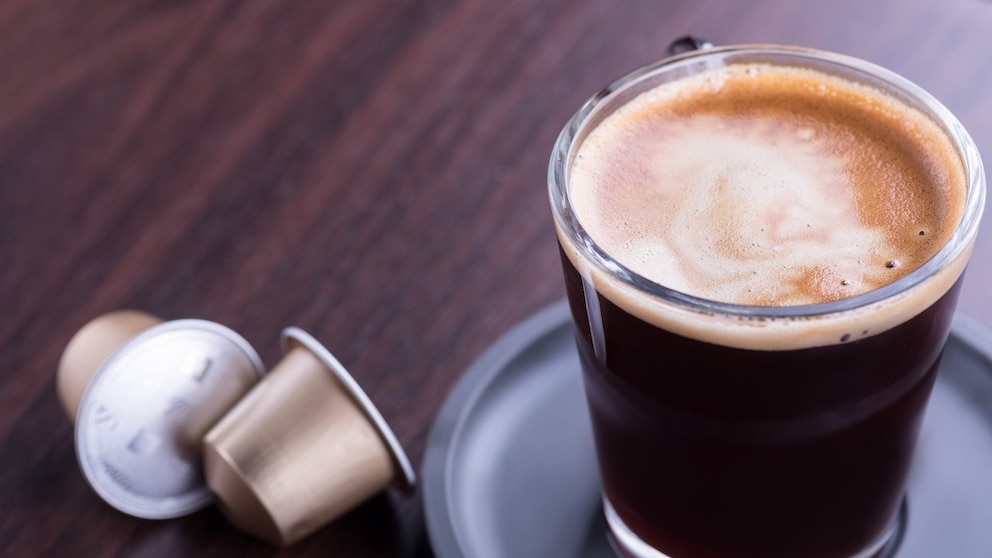
When the coffee craving hits, it needs to be quick. Especially in the morning, time before work is tight. That’s why ready-made machines have become popular. Insert the capsule, press a button, and the power drink is ready to kickstart your day. Until now, the capsules for these automatic machines were mostly made of aluminum and plastic. A survey by the German Environmental Aid (DUH) in 2024 showed that around 2.8 billion coffee capsules are consumed annually in Germany. This equates to a waste pile weighing about 10,000 tons, comparable to 100 to 150 fully loaded freight cars. These numbers highlight the scale of the problem. Therefore, and because environmentalists’ criticism has grown, manufacturers now also offer paper variants.
How sustainable are paper capsules really?
At first glance, paper coffee capsules seem like a real coup. Easy to handle and, incidentally, sustainable–or so the manufacturers claim. But appearances can be deceiving. Although certain products are labeled as compostable or biodegradable, they are not yet allowed to be disposed of in the organic waste bin according to waste and fertilizer laws. “Certification as biodegradable does not necessarily guarantee complete and residue-free decomposition,” explains Thomas Fischer from the DUH in response to a myHOMEBOOK inquiry.
There are simple reasons for this: “To make the paper stable in form–with binders–and withstand the high pressure during the brewing process, many paper capsules are sealed inside with plastic. Bioplastics certified as biodegradable can also be used for this.” However, these are also not allowed in the organic waste bin to prevent microplastic residues in compost.
The decomposition of the material also takes too long, leading to capsule shells being labeled as contaminants. Furthermore, “That’s why coffee capsules are sorted out in many composting plants and incinerated as residual waste,” says the expert. Incidentally, they should not be disposed of in paper waste either due to the coffee powder residue and inner coating. Fischer advises disposing of them in residual waste to be on the safe side.
Single-use remains single-use
The biggest problem is not the material itself, but the fact that it is a single-use product with an unbalanced ratio, as Fischer emphasizes. “Packaging coffee by the gram is inherently unecological–completely independent of the material.” He continues, “The smaller the packaging, the more packaging material is needed, and the more waste is generated.” According to DUH calculations, certain brands produce about 40 grams of packaging waste for every 100 grams of coffee powder.
Recycling could improve the balance, but in practice, this rarely happens, mainly because coffee capsules still contain coffee residues or moisture. Many products cannot be recycled or composted. They are simply incinerated. Fischer advises, “If it has to be a capsule, opt for a reusable variant available from several providers. Filling them is quicker than many think, and you can feel good about it.”
Also interesting: It’s better not to brew coffee with water directly from the tap
Environmental groups accuse manufacturers of greenwashing
Environmental groups, in particular, view manufacturers’ marketing promises critically. The DUH also accuses manufacturers of greenwashing: They mislead customers with promises like “ecological” or “biodegradable.”
Most studies by environmental groups reach a similar conclusion. Regardless of the materials used, capsules are significantly less ecological than traditional coffee preparation methods.
Chemical and Natural Stain Removers Compared

Does Coffee From Compostable Capsules Taste Different From Aluminum Capsules?
Paper-based vs. conventional capsules
The DUH generally advises against coffee capsules, regardless of the material they are made from. If you still want to use capsules, paper-based variants perform slightly better in terms of material use and disposal. At least they are considered somewhat more environmentally friendly. However, they do not solve the fundamental problem: the excessively large amount of packaging waste and resource consumption.
“Even paper requires water, energy, chemicals, and wood in its production. Since it is a single-use product, the ecological balance remains poor compared to other systems,” Fischer summarizes. If you have to choose, always opt against aluminum capsules, as their environmental impact is particularly high. “Such capsules often consist of new material, the extraction of which can destroy natural areas and produce toxic slag as a byproduct.” The high melting point of over 600 degrees Celsius is also a problem and is demonstrably “energy-intensive and thus harmful to the climate,” according to the DUH.
Alternatives at a glance
Buying coffee in larger quantities results in proportionally less packaging waste. Therefore, fully automatic coffee machines, portafilter machines, or French presses, where coffee powder or beans are used, are better for the environmental balance.
If you don’t want to give up your capsule coffee, choose the reusable capsules recommended by the DUH. These can be used in the same machines as regular capsules and refilled with coffee powder for each use. The most sustainable solution remains simply coffee without single-use packaging. Anything else is at best a compromise.
In principle, foreign capsules from other manufacturers can also be used in branded coffee machines. However, there may be minor inconveniences in handling because the closing mechanism may not work as well, or the capsules may not be optimally pierced.