


June 3, 2023, 3:10 am | Read time: 6 minutes
Whether in the vegetable garden, on a burger bun, or in a salad bowl: lettuce is a must! Learn how to sow, plant, and care for this easygoing green here on myHOMEBOOK.
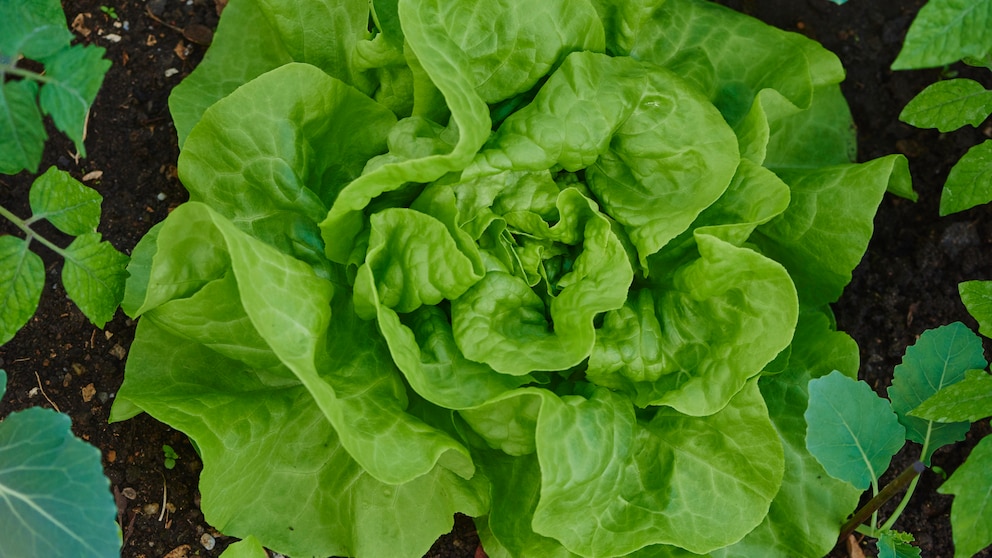
Head lettuces (Lactuca sativa var. capitata) are among the garden lettuces and are a must-have for many vegetable gardeners. They are also called butter lettuces, which relates to the texture of their leaves. These are more tender than crisp. Head lettuces likely originate from Western Asia and are believed to descend from wild lettuce. They are annuals and, like leaf lettuces, belong to the daisy family.
Sowing and Planting Head Lettuce
Head lettuce is one of the crops suitable for garden beginners. It can be pre-cultivated or sown directly. Depending on the variety, cultivation for the cold frame can begin as early as the end of January. For outdoor lettuces, the starting signal for cultivation is at the end of February. Direct sowing outdoors is advisable from April. Important: The sowing should never dry out. Those who sow several batches in a staggered manner and choose varieties suitable for the season can significantly extend the harvest period. The time windows for sowing can be found on the seed packets.
Lettuces are light germinators. This means that the seeds should be covered with soil only very thinly, if at all. Also to note: At temperatures above 68 degrees Fahrenheit, lettuce seeds take a break. They then either do not germinate at all or only very hesitantly.
From mid-March, the pre-cultivated lettuce seedlings can move outdoors. However, it is advisable to protect them with a fleece. From mid-April, the young lettuces can also manage without protection. Make sure to plant the lettuces so that the leaf base is above the ground. Otherwise, rot threatens. A distance of 12 inches within a row and between individual rows gives the head lettuces enough space for undisturbed development.

What Does Head Lettuce Look Like?
Head lettuces are aptly named. In this particular form of garden lettuce, the leaves grow so closely together due to the shortened stem axis that they form a compact, rounded head shape. The leaves are tender and soft and, depending on the variety, range from green to reddish. Most varieties have smooth leaves, but some have curly ones.
Location and Soil Requirements
Head lettuces prefer sunny locations but can also tolerate partial shade. Since harmful nitrate can accumulate in the leaves due to lack of light, a full-sun location is especially preferred in spring and fall. The soil should be humus-rich and deep. Balcony and terrace gardeners can also grow head lettuces. They thrive in containers and pots as well.
Head lettuces are very compatible garden partners. They get along well with beans, peas, cabbage, leeks, carrots, tomatoes, beets, radishes, and herbs like dill and chervil. Parsley and celery are unsuitable.
Varieties
For spring cultivation, the “Maikönig” is suitable, a popular variety known for its refreshingly spicy taste. Also recommended is “Baquieu,” a very old, robust, and fast-growing variety that forms small red heads and is suitable for both spring and fall cultivation. For summer cultivation, choose bolt-resistant varieties like “Dolly,” “Goldforelle,” “Kagraner Sommer,” or “Pirat.”
Related: Which Lettuce Varieties Are in Season When
Caring for Head Lettuce
There is not much to consider when caring for head lettuces. If the soil is occasionally hoed, weeded, and kept moist, the lettuce is well cared for.
Watering
Lettuce needs relatively moist soil. If the soil conditions are favorable and a protective mulch layer is present, head lettuce can supply itself well with water using its long taproot. During dry periods, however, it should still be watered in a timely manner. Two things should be noted: Water less frequently but thoroughly rather than often and superficially, and water the soil so that the lettuce leaves remain dry.
Fertilization
During growth, head lettuces do not need fertilization. If the soil is loosened and enriched with compost before planting, it is sufficiently supplied with nutrients.
Propagation
To harvest your own seeds from head lettuces, choose the most beautiful and robust specimen and let it bloom. After flowering, seeds form. These are ready for harvest after a few weeks and are best collected in dry weather. Ensure the seeds are completely dry before storing them for sowing the following year.
Alternatives
Another variant of garden lettuces is the so-called leaf lettuces. They are not harvested as a whole but leaf by leaf over a longer period. Learn how to grow leaf lettuces in the garden here.
Diseases and Pests
Downy mildew is a common head lettuce disease. It occurs especially in overly wet weather and appears as light, later brown spots on the underside of the leaves. If an infestation is detected, the leaves should be removed to prevent spreading. Prevention includes ensuring the leaves do not get wet when watering. A nitrogen-rich fertilization also promotes infestation.
Slugs love lettuce. But that’s no reason to lose your head. With slug collars or slug fences, the tender greens can be well protected. By the way, red-leafed lettuces are less attractive to slugs than green ones.
How to Successfully and Reliably Grow Salad Greens

How Savoy Cabbage Is Grown in the Garden
Harvest
When a head lettuce is ready for harvest depends on the variety. Fast-growing varieties can be harvested after just two months, while slow-growing ones take about four months. Once the lettuce has reached a satisfactory size, you can grab a knife and cut the lettuce as a whole. At the latest, when the lettuce starts to grow upwards, it should be harvested, as the leaves then lose tenderness and flavor.
Note: Since lettuces quickly lose freshness, they should be harvested as needed. Freshly harvested lettuces usually last only a few days in the refrigerator. Learn how to keep lettuce fresh longer in the fridge here.
Use in the Kitchen
Mixed salad with radishes, cucumbers, and tomatoes is the classic among salad recipes. For those who like to experiment, head lettuces can be blended into smoothies, processed into pesto, prepared as creamy salad soup, or combined with strawberries, raspberries, or other fruits.