


September 11, 2025, 10:46 am | Read time: 3 minutes
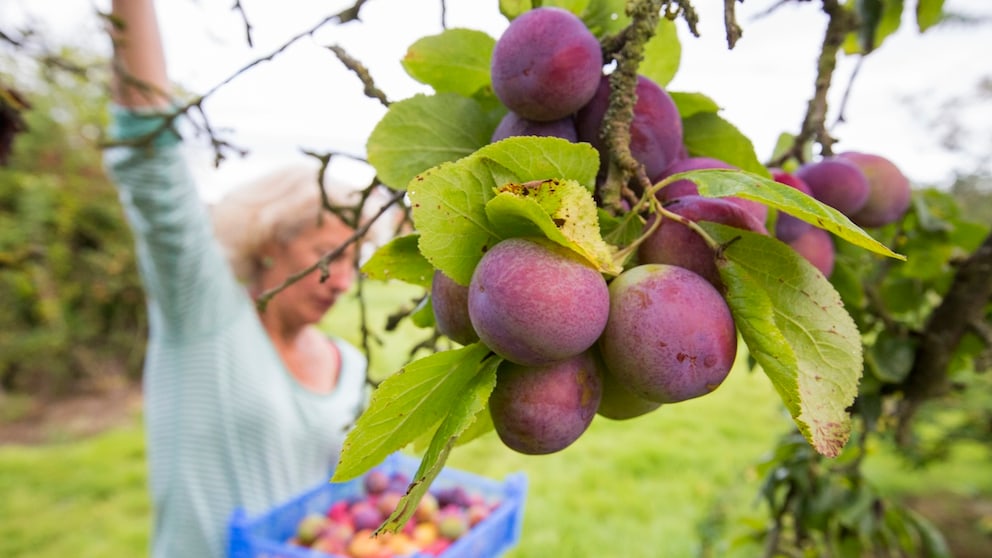
Late summer is considered plum season: The fruits taste great fresh, as well as in cakes or jams. Plums and damsons, along with apples, pears, and cherries, are among the most popular local fruits and can be used in many ways. However, the question often arises whether plums and damsons are different types of fruit or merely variations of the same fruit.
The Difference Between Plums and Damsons
Plum, damson, mirabelle, and greengage: These are not just different names for the same fruit. All four are subspecies of the common plum species (Prunus domestica), explain the experts at the Bavarian Garden Academy.
The damson, also known as zwetsche, zwetschke, or quetsche depending on the region, has an oval to elongated shape and firm flesh that usually separates easily from the flat stone. This makes it ideal for baking. There are several varieties that can be sweet, acidic, and aromatic. Some varieties are harvested as early as July, while others are picked in September.
Also interesting: Blueberry or Bilberry – Is There a Difference?

3 Ways to Process Quinces in the Fall

3 ways to process grapes when they are ripe
Plums Are Less Suitable for Plum Cake
Plums, on the other hand, are rounder in both fruit and stone. The flesh is softer, so plums should not be stored for too long. Because they contain a lot of juice, they are less suitable for cakes.
Greengages are also round, but unlike plums, they are not blue and violet but greenish. Their flesh is difficult to separate from the stone. Mirabelles, on the other hand, are only cherry-sized and have a yellow color, sometimes with red cheeks. They taste very sweet.
Mirabelles Are Suitable for Jam
Mirabelles can be very sweet and sometimes slightly tart. However, their taste is unique. Mirabelles are also wonderfully suited for making jam.
Recipe for Mirabelle Jam
Mirabelle jam is quick to make and is great for gifting or simply enjoying yourself.
What you need:
- About 1 kilogram of mirabelles (weight without stones)
- 300 grams of 3:1 gelling sugar (if you like it very sweet, you can also use 500 grams of 2:1 gelling sugar)
- Lemon juice
- Blender or hand blender
- Pot
- Spoon
- Sterile jam jars
- Small chilled bowl
Here’s how:
- First, the mirabelles need to be pitted and briefly pureed. The finer you want the jam to be, the longer you should blend the mirabelles.
- In the next step, the measured sugar must be boiled with the mirabelle puree. Let the mixture simmer gently for about ten minutes.
- Add a little lemon juice gradually. This is necessary for the jam to gel.
- After about ten minutes, you can perform a gelling test. Take the chilled bowl and put a dab of jam in it. It will cool quickly, allowing you to check if it is firm enough or still runny.
- If it is still too liquid, add a little more lemon juice and perform another gelling test after about three more minutes.
- Once the jam has reached the desired consistency, it can be poured into sterile jars.
- Optionally, you can briefly turn the jars upside down afterward to prevent germs in the lid or to create a tighter vacuum.