


October 13, 2025, 2:11 am | Read time: 2 minutes
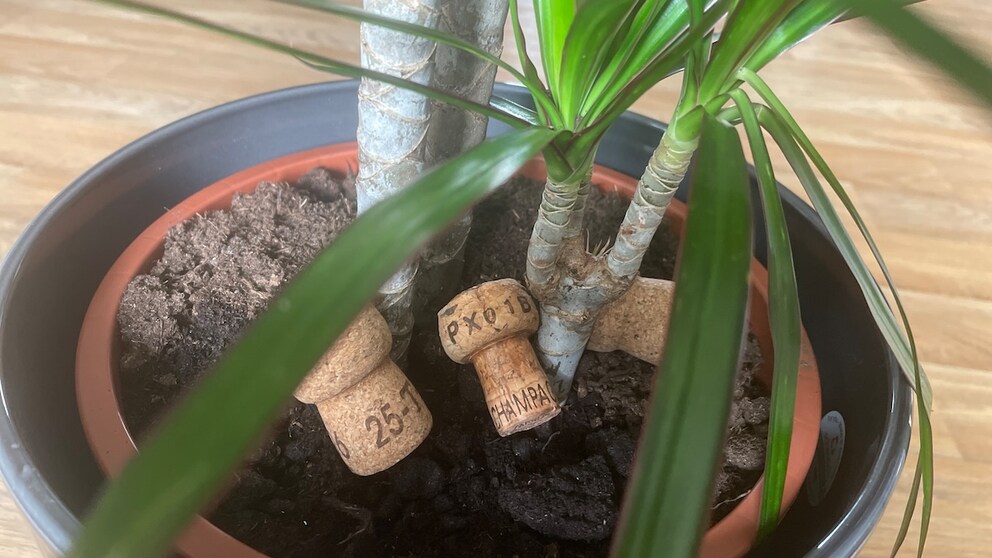
After a party or a social evening with wine, corks often remain. They don’t have to end up in the trash; cleverly placed in a flowerpot, they can still serve valuable purposes. myHOMEBOOK gardening expert Franka Kruse-Gering explains why corks and flowerpots can be a very good combination.
Ways to Use Corks in Flowerpots
Whether simply stuck into the soil or placed at the bottom of the pot, corks can be a valuable addition to a flowerpot and help in various ways.
1. Corks as Drainage in Flowerpots
Depending on the size of the pot, corks can be distributed at the bottom. This gives the corks a second life and also saves money on expanded clay. The corks ensure smooth water drainage and prevent waterlogging. They can also act as insulation. Especially for balcony plants, this can keep cold away from the roots. Corks are also very light, so the flowerpot won’t be as heavy as with expanded clay or gravel.
Note: You should only use natural cork. Synthetic or pressed cork usually contains glue or resins. It’s also important to know that natural cork decomposes over time, so it’s not a product for eternity.
Protect Plants from Waterlogging with Effective Drainage
What to Consider When Repotting Potted Plants
2. Loosening Soil with Corks
Many plants thrive best when their roots can grow in loose, airy soil. A heavily compacted soil retains too much water, leading to a lack of oxygen. This often results in roots growing poorly or even rotting. Herbs, succulents, Mediterranean plants, or plants with fine roots are particularly sensitive to this.
Here, cut wine corks can help in a simple and natural way. By cutting natural cork into small pieces and mixing them into the potting soil, a loosened structure is created. The cork pieces act like tiny spacers in the soil, creating air spaces between the soil particles.
Corks Are Not Suitable as Water Reservoirs
Anyone who thinks corks can be used in flowerpots to store water is mistaken. Quite the opposite. Wine corks are not suitable as water reservoirs because their material is naturally water-repellent. Cork is made from the bark of the cork oak and consists of many tiny, closed air cells coated with a waxy substance called suberin. This suberin ensures that cork neither absorbs nor transmits water—exactly why it’s used as a bottle stopper.