


February 3, 2026, 10:07 am | Read time: 3 minutes
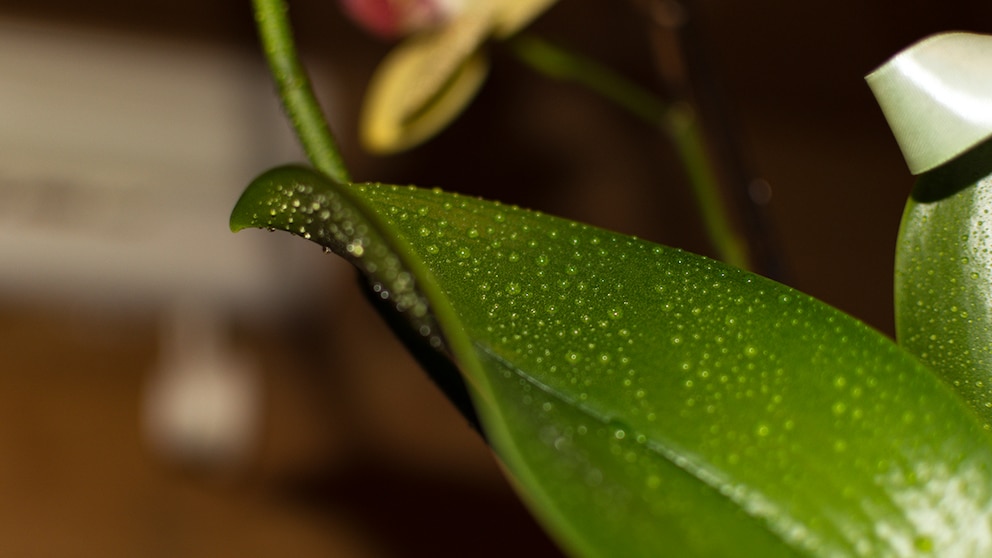
Sometimes you only notice them at second glance: small, transparent to slightly sticky droplets on the leaves of your beloved orchid. Many hobby gardeners are alarmed—is this a sign of disease, pest infestation, or even a care mistake? In fact, these sticky secretions can have various causes, and not all of them are reasons for concern. myHOMEBOOK consulted the German Orchid Society.
Why Orchids Sometimes Have Sticky Droplets
There can be various reasons why sticky droplets appear on the leaves and stems of orchids, explains Bernd Treder, president of the German Orchid Society (D.O.G.). He reassures: “If this is observed only to a small extent, they are no cause for concern.”
1. Guttation Droplets
In many cases, these are so-called guttation droplets, the expert explains. “These naturally occur through transpiration, which is the release of water vapor through the stomata,” Treder elaborates.
To understand this, one must briefly follow the path of water through the plant. Plants absorb water through their roots and channel it like a pipeline through the stem to the leaves. With this water, important nutrients also reach the leaves, which the plant needs to grow.
“In the leaves, the water is then converted into sugar and oxygen during photosynthesis along with carbon dioxide using light energy,” the expert explains. However, the water can also simply be released in droplet form. These can sometimes contain excess sugar. “They not only feel sticky, but they even taste sweet,” Treder adds.

Yellow Leaves on Your Orchid? Here’s What It Means

Expert Explains When Orchids Can Still Be Saved
2. Pest Infestation
In some cases, a pest infestation is the cause when sticky droplets appear on the orchid. “Some pests, such as aphids, are sometimes the culprits of the droplets because they tap into the phloem and leave their excretions, the sticky sweet honeydew, on the plant,” Treder explains.
However, one should generally investigate when sticky droplets appear, because according to the expert, the sugary liquid can also attract pests. To prevent this, Treder advises simply wiping the sticky droplets off the orchid with a lukewarm, damp cloth.
3. Stress
In addition to normal guttation droplets or a pest infestation, sticky droplets on the orchid can also be a sign of stress, Treder explains. “Especially in Phalaenopsis and Cattleya, such guttation droplets are often observed when there are temperature fluctuations of more than five degrees between day and night. This is often the case in conservatories, where strong sunlight during the day causes relatively high temperatures.” Other stress factors, such as drought, waterlogging, or drafts, can also cause droplet formation, the expert adds.