

November 4, 2026, 10:23 am | Read time: 3 minutes
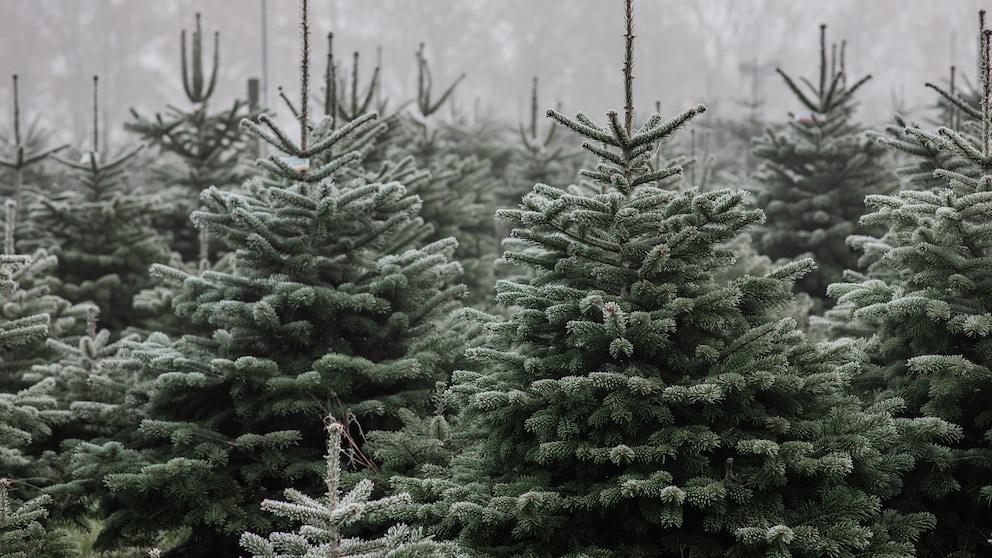
The days are getting colder, and the trees are gradually losing their leaves. However, during a walk in the forest, you can still see conifers that retain all their needles. When thinking of a decorated Christmas tree, it becomes apparent that unlike other trees, conifers do not lose their needles. But why is that? myHOMEBOOK asked the Association of German Tree Nurseries.
Follow myHOMEBOOK on WhatsApp now
The Difference Between Leaves and Needles
While deciduous trees shed their colorful leaves in the fall, most conifers retain their needles almost year-round. The water balance plays a significant role in this. “In principle, needles contain the same components as leaves,” explains Hajo Hinrichs, president of the Association of German Tree Nurseries (BdB). However, needles are rolled up and surrounded by a wax layer called the “cuticle” to protect them from dryness and evaporation. In contrast, leaves are quite thin and have a broad surface, causing them to evaporate and dry out more quickly. The coating allows needles to withstand the cold winter months and remain on the tree. Nevertheless, like leaves, they are capable of photosynthesis, the expert emphasizes.
No Frostbite and Also Long-Lasting
Cold is definitely not a problem for conifers. They can survive temperatures as low as minus 50 degrees, according to Hinrichs. This is partly due to their narrow, rolled-up shape, which protects against evaporation. The stomata are deep and often protected by wax. Additionally, a structural reinforcement provides hardness and resilience: In winter, a glycol-like substance is produced in the needles, acting as an antifreeze in extreme cold. “Conifers are thus able to produce O₂ and filter fine dust even in winter during mild temperatures!” explains nursery owner Hinrichs.
Why Are Some Conifers Still Yellow?
Nevertheless, you can still see some conifers with yellow needles. Unlike most conifers, the larch sheds its needles in the fall. Before doing so, it withdraws essential nutrients from the needles and stores them in other parts of the plant, such as the roots. During this process, the green chlorophyll is broken down, causing the needles to turn yellow before they eventually fall off.
Many other conifers, however, retain their needles for several years. “The needles can remain on the tree for up to 30 to 40 years before they fall off,” explains BdB President Hajo Hinrichs. Only under drought stress do they fall off earlier, but they can also regenerate. Small and thick needles are often advantageous in dry locations, such as those found in some pine and cedar species. However, conifer species differ significantly in how well they cope with heat and drought.
Why Some Trees Look Bare in September
Caring for Conifers in Winter
Where You Can Find Many Conifers
Conifers thrive in cold and nutrient-poor regions. Their distribution area is therefore larger than that of deciduous trees. Hinrichs cites the boreal coniferous forest in the Northern Hemisphere as an example. Better known as the “taiga,” it is particularly impressive because it is one of the largest contiguous forest belts on Earth.
Expert Recommends Planting a Conifer Yourself
There are also good opportunities to use conifers, or more simply put, compact-growing coniferous shrubs, in our gardens, emphasizes the nursery owner. They are not only evergreen and thus eye-catching, but their dense needle cover also provides protection for local wildlife from winter weather and predators.
Hajo Hinrichs concludes the interview with an appeal: “In the long term, conifers will be the winners of climate change in nature and should therefore be planted more frequently.”