

July 13, 2023, 2:03 pm | Read time: 7 minutes
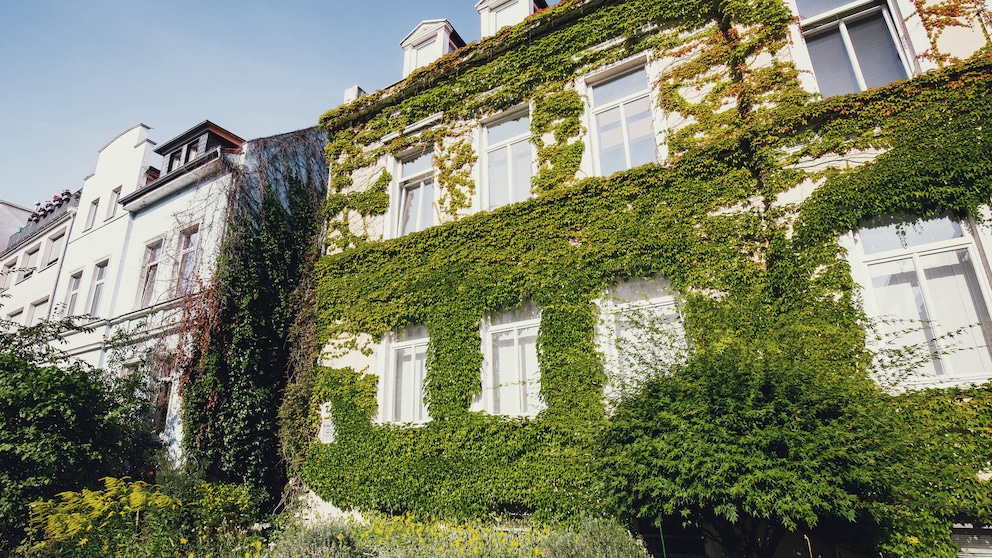
Facade greening is an important tool to prevent cities from overheating. Homeowners can also use edible plants. Landscape architect Jürgen Eppel from the Bavarian Institute for Urban Greenery and Landscape Construction explains what to consider, as requested by myHOMEBOOK.
Those living in Duisburg-Baerl are currently sweating a lot. Few places in Germany are hotter than this district: 35.7 degrees Celsius was recorded there on July 8, 2023. Climate change is driving temperatures up, and concrete cities are heating up more and more, affecting people, animals, and nature. With constant sunlight and current temperatures, the south wall of a house can quickly heat up to 50 to 60 degrees Celsius–and a city has thousands of such walls, all radiating this heat. One solution: large-scale facade greening.
Overview
The Benefits of Facade Greening
“The mature technology for this has been available for 50 years, yet we have practically achieved nothing. However, there is a primal fear of plants among people, but now is the time to move towards normalizing greening,” says Jürgen Eppel, head of the Institute for Urban Greenery and Landscape Construction at the Bavarian State Institute for Viticulture in Veitshöchheim, Franconia.
Landscape architect Eppel passionately advocates for the greening of roofs and facades, especially large areas of public buildings such as gymnasiums, city halls, or town halls, he says. Architects should consider greening when constructing buildings, for example, by planning the fixtures for plant climbing aids. Planted house walls are a diverse form of environmental protection. Jürgen Eppel lists the reasons why:
- Cooling the environment through transpiration cooling and shading of the facade
- Promoting biodiversity: new habitat for plants and animals such as insects, birds, or small mammals
- Improving air quality: plants use carbon dioxide to produce oxygen and bind particulate matter and nitrogen oxides on the leaf surface
- Insulating the building: the additional layer around the building saves cooling and heating energy
- Protecting the building envelope: the facade is protected from environmental influences, increasing its lifespan
- Establishing edible plants: possibility of multiple uses through the cultivation of food
- Design possibilities
Related: When financial support for roof greening is available
Does a Green Facade Cool the Building?
However, a homeowner should not expect a green wall to drastically lower the temperature inside the house. “With a green layer, I will never achieve the same insulation effect as with a PU foam insulation with a thickness of 8 to 10 centimeters,” explains Eppel. “But the greenery slows down the heating of the house’s interior.”
Nevertheless, the data supports green walls: Their surface temperatures can be reduced by up to 30 degrees, and the surrounding air temperature by up to 5 degrees due to the vegetation. It is also generally true that the worse the house is insulated, the more effective facade greening is.
What even the owner of a well-insulated house will notice: The accumulation of cool air around the greenery due to the evaporative cooling of the plants, which convert CO2 into water. Opening a window on hot days can provide a pleasantly fresh breeze.
What Should Owners Consider?
It remains to clarify what the homeowner should do–and what to avoid for optimal facade greening.
Suitable Masonry
A damaged wall is a disqualifying factor. Where plaster is already crumbling or cracks are appearing, nothing should be planted, as the masonry will be permanently damaged by the plants. If the wall is intact, the plant cannot penetrate it.
Growth Opportunities for Plants
It must then be clarified whether the greenery should be planted in a ground-based or wall-based system. Jürgen Eppel always advises private homeowners to opt for the low-maintenance and cheaper ground-based construct, meaning planting the plant in the soil, much like a tree. “But there must be enough space in front of the facade.” A plant needs about 0.5 cubic meters of root space.
“Wall-based is a luxury, significantly more expensive to maintain, and only for companies that want to make their facades more stylish.” In this case, the plants hang in troughs and must be regularly supplied with water and nutrients, which is hardly achievable without appropriate automatic systems. “Such a system must be constantly monitored,” warns expert Eppel. “If the water supply fails on a hot summer weekend, half of the plants can quickly dry out.”
Caution with Self-Climbers
It’s not just about planting a plant in the ground and waiting for it to climb the wall. In this case, the expert refers to self-climbers–and landscape architect Eppel advises against them: “You will then have problems inspecting the facade afterward.” Ivy is the most well-known self-climber. It grows rapidly–but also where it is not good for the house, as the plant likes to penetrate dark spaces and crevices. This includes roof overhangs, roller shutter boxes, or the verge in the roof area.
More on this: How to permanently remove ivy from the house wall
The Right Climbing Aids
So what is better? Controlled growth on a support structure, a climbing aid, which is attached to the roof overhang as well as the ground and at a distance of 7 to 10 centimeters from the house wall. But the distance from the wall is just one point to consider, as Eppel’s institute lists. It also involves:
- Orientation of the facade (cardinal direction)
- Shading / exposure by buildings, trees, etc.
- Coordination of system and facade construction
- Maximum load-bearing capacity of the facade (loads include plant weight, weight of the greening system, wind and vibration loads, loads from moisture/snow/ice)
- Fall protection for growth over 3 meters in height
- Accessibility for maintenance and upkeep
- Water supply and drainage
- if necessary, coordination of plant type and climbing aid
- Connection of electrically conductive components to the building grounding
Climbing aids can be: grids, nets, wire ropes, tension wires, or trellises. However, these should not have too thick or massive a cross-section, otherwise the plants cannot wrap around the bars. Depending on the plant, 2.5 to a maximum of 25 millimeters is a good measure.
The clematis is, for example, a good plant for facade greening. The climbing plant grows quickly, likes sun and partial shade, and winds around the climbing aid. But if the bars are too thick, the plant cannot wrap around them. “Here I recommend a kind of chain-link fence,” says plant expert Eppel. “Climbing aid and plant must always be coordinated.”
Installation of Climbing Aids
Many climbing aids also need to be attached to the house wall, and there are plenty of good systems available to prevent moisture from penetrating the masonry. But simply drilling a hole in the wall and then screwing the aid in place–that doesn’t work. “Because if you have a thermal insulation composite system, you can’t just drill into it,” warns Jürgen Eppel. “Because you first drill into Styrofoam, so an 8 or 10 screw doesn’t do much.”
So you need a professional fastening system that can be attached to the load-bearing masonry. Because the climbing aid must support a significant load when the greenery alone is fully grown. There are also loads from snow and rain–and strong winds.

Why New Buildings Often Look Monotonous Today
What to Keep in Mind When Building a House in Winter
Which Plants Are Suitable?
Speaking of plants: Not every plant is suitable for a small house. Wisteria is beautiful to look at, “but it has the growth power of a tree and requires a lot of space,” warns landscape architect Eppel. “It doesn’t belong on a single-family house, terrace pergola, or garage.” The opposite is the clematis hybrid, which only reaches a height of 1.50 meters.
Better is the climbing rose. It grows horizontally, so the gardener needs corresponding horizontal climbing aids on which the rose can climb and then be tied. Jürgen Eppel also recommends climbing plants such as knotweed, pipevine, bittersweet, akebia, and climbing hydrangea. Finally, edible plants can also grow on the facade, such as apples or apricots. “This is a contribution to urban gardening. You combine the pleasant with the useful,” says the garden expert.
What Does Facade Greening Cost?
The only question left is the cost of facade greening. For the aforementioned ground-based variant with climbing plants rooted in the ground, Jürgen Eppel estimates between 15 and 35 per square meter. A worthwhile investment in a better climate, not just for people in Duisburg-Baerl.