


October 25, 2022, 1:04 pm | Read time: 6 minutes
A cold conservatory is—as the name suggests—not a heated conservatory. In winter, it remains cold because it is thermally separated from the house. Can it still be used in winter?
A cold conservatory is simpler to construct than a regular conservatory. In summer, it serves as an open living room and impresses with its open glass design. In winter, when the sun shines, it heats up quickly but cannot be used permanently. Here is an overview of the advantages and disadvantages.
Overview
- What is a cold conservatory?
- What is the difference between a cold and warm conservatory?
- Do you need a building permit?
- Freestanding cold conservatory in the garden
- What type of roof is used for a cold conservatory?
- The right flooring
- How can you use the cold conservatory year-round?
- Plants for the cold conservatory
- Can a cold conservatory be heated?

What is a cold conservatory?
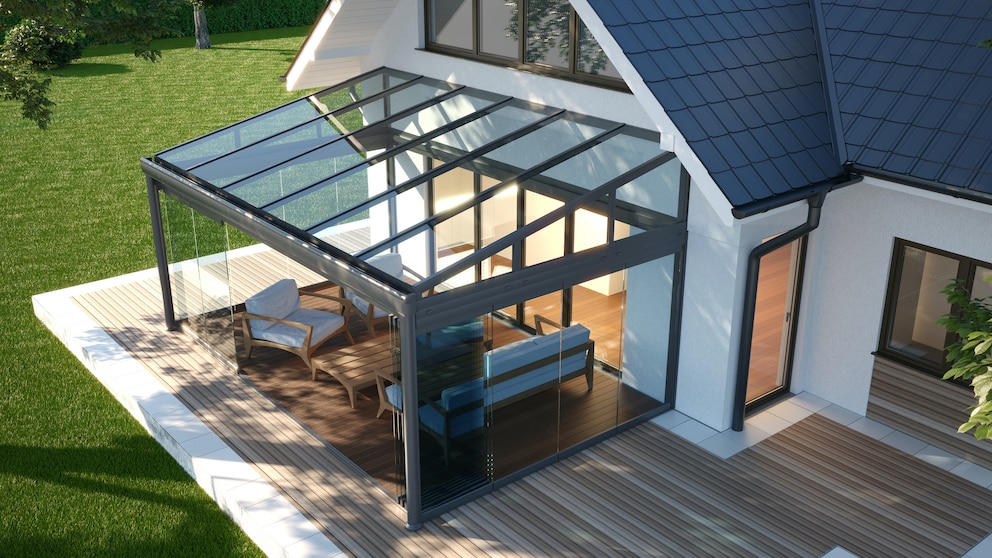
A cold conservatory, like the warm conservatory, offers a high living quality—with the one difference that it lacks thermal insulation and heating. A cold conservatory can be either freestanding or attached to the house. In most cases, it consists of a simple construction with single glazing and an aluminum frame.

Also interesting: Terrace roofing—what options are there?
What is the difference between a cold and warm conservatory?
A warm conservatory is an enclosed extension to an existing building. It must include at least one wall surface. It should be built to be rainproof, airtight, and windproof, and most importantly, separated from the outside climate. The regular conservatory can also be heated and equipped with thermally separated floors, walls, and roofs. A cold conservatory, on the other hand, is equipped with wind protection elements but is not airtight or windproof. Additionally, the wind protection elements are not rainproof.
Good to know: Since a cold conservatory is not heated, the requirements of the Building Energy Act (GEG) do not need to be met.
Do you need a building permit?
If you plan to install a cold conservatory, you should first check with the relevant building authority about any necessary permits. Whether a building permit is required often depends on the individual federal states. It also often depends on whether a connection to the house is necessary for the conservatory.
Good to know: In the federal states of North Rhine-Westphalia, Rhineland-Palatinate, Thuringia, Brandenburg, Bremen, and Hesse, you do not need a building permit under certain conditions. However, you should ensure you are well-informed and make an inquiry with the local building authority. A reliable preliminary inquiry is part of good construction planning.
Freestanding cold conservatory in the garden
If it is not an extension of living space, the unheated conservatory can also stand freely in the garden without a special floor structure. Here too, it may be possible to erect the additional living space under the open sky without a building permit. In any case, you should also check with the relevant building authority before proceeding with this project.
Note: If you hire a professional company or architect to build the cold conservatory, the experts usually take care of the legal regulations and applications.
Also interesting: Garden office—how to set up an outdoor home office
What type of roof is used for a cold conservatory?
The most commonly used roof types for conservatories are flat roofs, gable roofs, and lean-to roofs. The flat roof is the most popular because it is easier to construct. With a flat roof, there are also many design possibilities. Above all, a flat roof offers more options for designing the basic shape of the conservatory. Roof cutouts can be designed more easily and provide more light—even in the interior rooms.

Tip: By summer at the latest, a good shading system should be installed. This is necessary to counteract the sun’s rays on the roof and glass fronts. Even in a cold conservatory, it can get very hot during summer temperatures.
The right flooring
Since the regulations of the Energy Saving Ordinance do not apply to a cold conservatory, you should choose flooring that is frost-resistant even in winter. A frost-resistant terrace floor can withstand the weather despite fluctuating temperatures outdoors.
A cold conservatory is often built on an already existing terrace. A terrace floor that is also winterproof is therefore optimal for the cold conservatory. The floor is low-maintenance and does not require special requirements like thermal protection. For a new installation of a cold conservatory, these floorings are suitable:
- Porcelain stoneware and winter-resistant tiles
- Natural stone
- Wood flooring
- Concrete and screed floor structures
Note: With tiles, you should pay attention to suitable slip resistance due to the risk of slipping. The terrace floor in the conservatory can become slippery in rain and moisture, as the enclosure is not perfectly sealed. Also, watch out for condensation.
How can you use the cold conservatory year-round?
The cold conservatory unfortunately has a bad reputation because it can only be actively used from spring to fall. In the warmer months, however, the cold conservatory offers a quiet and sheltered retreat. The easily opened sliding glass doors create a feeling of open living space with a roof. Additionally, such an extension provides both wind and rain protection.

In the cold seasons, unfortunately, the space is not suitable for lingering. Due to the lack of thermal protection, it can quickly become very uncomfortable. However, you can still make it cozy with decorative lights and a warm winter coat—and maybe even see the stars in the night sky.
Also interesting: What to consider when buying and installing a new front door

How to Properly Plan a Conservatory
What to Keep in Mind When Building a House in Winter
Plants for the cold conservatory
Plants can partially overwinter in the cold conservatory—but there is no guarantee because it can also get frosty here. However, there are plants that are suitable for this. Some plants from the Mediterranean region can even withstand a few degrees of frost. However, plants overwinter better at a temperature around 41 degrees Fahrenheit. These include the olive tree, fig, and citrus plants.
Related: What care citrus plants urgently need in winter
Can a cold conservatory be heated?
Normally, insulated glazing is installed in a warm conservatory. In a cold conservatory, however, it is usually just a single pane. This means there is no thermal insulation. The produced heat is therefore quickly transferred outside. Additionally, condensation can form on the panes, creating an unpleasant climate. Therefore, in a cold conservatory, you should ventilate several times a day in winter to reduce high humidity and prevent mold growth.
Tip: If you want to use the cold conservatory in winter, you should plan for a summer conservatory instead. As mentioned, the cold conservatory is difficult to heat, and the warmth does not last long.