


June 22, 2026, 5:03 am | Read time: 5 minutes
If you want to build a private bunker, you should prepare well and allocate enough time for research and planning. After all, costs and requirements can vary greatly depending on the property, size, and features. Here, you’ll learn what to watch out for.
Permits and Planning
Before starting the planning, you must always apply for an official building permit for a bunker. Since a bunker is considered a permanent structure—because it is firmly connected to the ground, built deep into the earth, and intended for long-term use—it doesn’t matter whether it’s a bunker or an above-ground shelter. The applicable regulations always depend on the respective state building code. The size of the project and the intended use are also crucial for such a project.
Not every plot of land is suitable for a bunker. Often, too much groundwater can complicate or even prevent the project. Therefore, you should have the groundwater level checked early on. If it’s too high, it complicates planning and can drive up costs. Groundwater might even create such strong buoyancy that you need to secure the bunker additionally. Therefore, a bunker should be built to be waterproof.
Also of interest: What Is a Panic Room and Is It Useful for Your Home?
How Much Does Building a Bunker Cost?
A bunker is not cheap. The larger the shelter, the more expensive the project can become. The features and location can also drive up costs. Additionally, it depends on which materials are used. In a bunker, the equipment is usually high-quality and particularly stable. Reinforced concrete or reinforced steel is often used, which can significantly contribute to safety. Furthermore, the strength of the walls and the condition of the base plate play an important role. Lastly, keep in mind that retrofitting is generally more expensive than integrating the bunker into the house plan from the start.
It also depends on whether you build the bunker yourself or have it built. For guidance, you can use various bunker cost calculators online that can roughly estimate the costs. Standard reinforced concrete often costs around 350 euros per square meter, while heavy reinforced concrete can cost about 800 euros per square meter. In between are other variants like reinforced concrete with additional steel lining, which provides more protection but can also increase costs.
Factors such as wall thickness, ventilation, power supply, and a possible emergency exit also influence the total costs. Those looking to save money might consider converting an existing basement into a shelter. This is often cheaper than a completely new build.
For small bunkers for two to four people, experts say you should plan for at least 50,000 euros. For bunkers with space for four to ten people, you should expect costs starting at 100,000 euros.
Ventilation in the Bunker
Ventilation is an important aspect when building your own bunker. It ensures that dangerous carbon dioxide cannot accumulate. The most well-known ventilation systems usually consist of several components. A constant supply of fresh air is essential. After all, when you breathe, you release carbon dioxide, which cannot be properly removed without adequate ventilation. Additionally, without suitable filters, pollutants from outside can enter. Therefore, when building the bunker, you should integrate ventilation shafts and filter systems and ensure that you can operate the ventilation manually in an emergency.
How Deep Should a Bunker Be?
How deep a bunker should be built depends on the desired level of protection. Simple shelters can often be set up in the basement or just a few meters below the surface. Private bunkers, on the other hand, are often built at a depth of about three to ten meters.
However, depth is not the only important factor. The construction method also significantly contributes to the bunker’s safety. When planning, you should consider that as depth increases, so can construction costs. This is partly because more earth needs to be excavated, and sealing against moisture and groundwater becomes more complex. Therefore, you should check before construction begins whether the desired depth is even feasible and technically possible on the property.

Which Projects Are Possible Without a Building Permit
Can 3D Printers Really Build Houses?
How Is a Bunker Constructed?
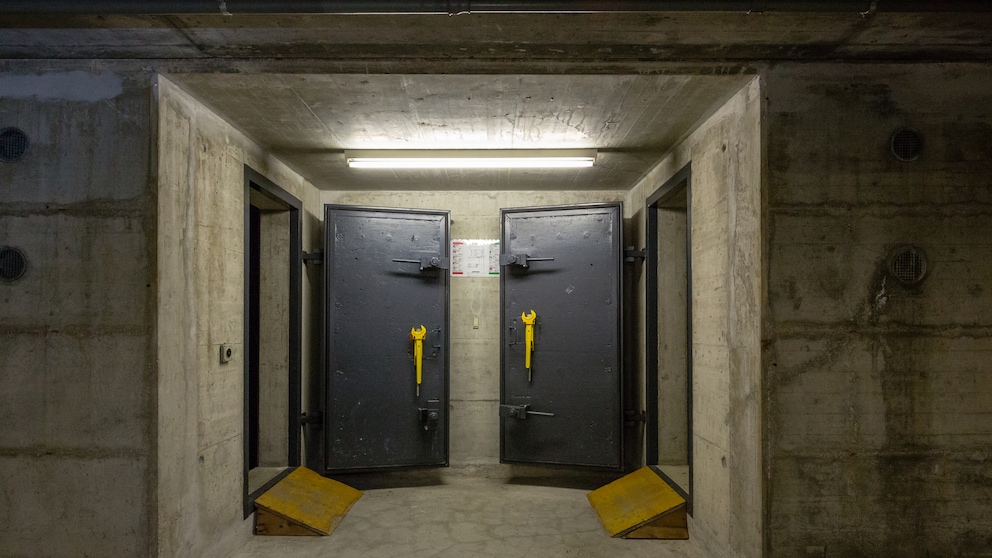
Typically, a bunker consists of a particularly stable shell made of reinforced concrete or reinforced steel. Depending on the size, you can use one or more rooms as a living area, storage room, or technical room. Additionally, a reinforced entrance door is part of the basic equipment.
If you don’t want to plan the bunker individually, you can opt for prefabricated modules. Manufacturers deliver these to the property and then place them in the prepared excavation. Such systems can often be installed faster than a completely newly built bunker. Depending on the manufacturer, you can choose between different models that vary in size, stability, and protective effect.
How Is a Bunker Built?
Building a bunker begins, much like building a house, with planning and obtaining the necessary permits. Then, an excavation is dug, a foundation is laid, and the walls and ceiling are constructed.
In the next step, the bunker is sealed against moisture and groundwater, and the technical systems are installed. These include ventilation, power supply, and possibly an emergency exit. Only then can the bunker be covered with earth and completed.