


April 30, 2026, 10:58 am | Read time: 3 minutes
For many people, the kitchen is one of the most important rooms in the home. Amid coffee makers, ovens, open shelves, and pantry cabinets, a practical question often arises: Does this space really work in everyday life? This is where a concept comes into play that seems almost inconspicuous yet makes a difference—the kitchen triangle.
The Geometry of Everyday Life
At first glance, it sounds almost trivial: three points connected to form a triangle. But behind this principle lies a well-thought-out system. It refers to the three central work areas of every kitchen: cooling/storage, washing, and cooking. When the refrigerator/pantry, sink, and stove are positioned sensibly in relation to each other, a conceptual triangle is created that forms the basis for smooth workflows.
The goal is clear: shorten paths, make movements intuitive, and avoid unnecessary detours. Anyone who has cooked in a well-planned kitchen knows the feeling when everything is within reach and nothing is in the way. Even complex dishes suddenly become more relaxed to prepare.
When Function Meets Lifestyle
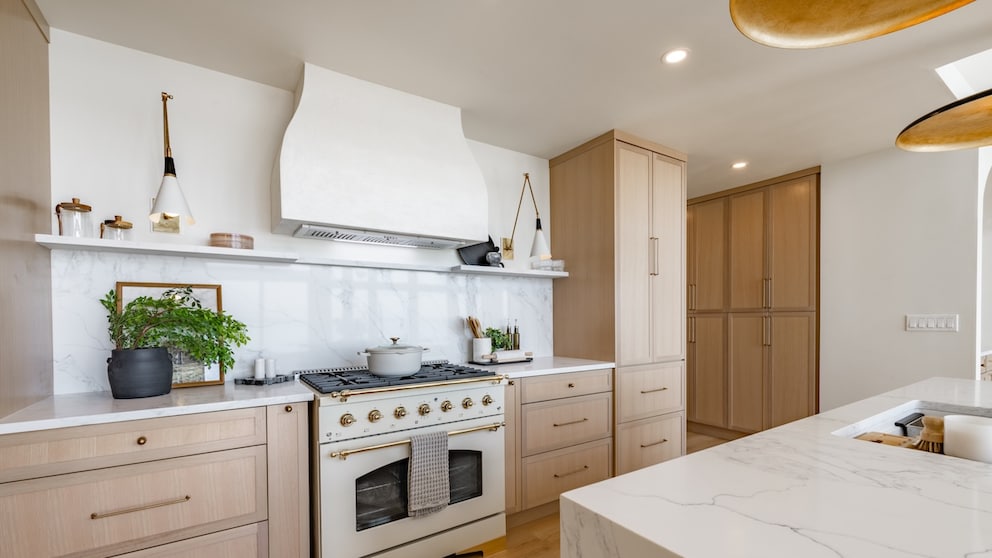
What once arose from purely functional considerations has now taken on a new dimension. The kitchen has long been part of the living space, often designed openly and visually staged. This is precisely why the kitchen triangle gains importance: It ensures order in the background while design and atmosphere can take center stage.
Because a beautiful kitchen that doesn’t function quickly loses its appeal. The triangle creates a kind of choreography. From reaching for the refrigerator to washing and then cooking, everything follows a logical sequence.
The Art of the Right Distance
As simple as the idea sounds, the details are crucial. The distances between the three points significantly determine how comfortable a kitchen feels. Ideally, the individual areas are close enough to keep paths short but not so close that it feels cramped. As a rough guide, distances of about one to one and a half meters between zones are recommended.
Too large paths lead to unnecessary back-and-forth, while too small distances can quickly become impractical, such as when doors or drawers block each other.
The perfect kitchen triangle is not a rigid construct but rather a balancing act between proximity and freedom of movement.

Setting Up a Galley Kitchen–Transforming a Long Space into a Storage Marvel
7 Key Kitchen Trends for 2026
Every Kitchen Tells Its Own Story
Whether it’s a minimalist single kitchen or a spacious family room, the principle remains the same, but the implementation varies. In open-plan kitchens, the triangle can be thought of more generously, while in compact spaces, creative solutions are often needed.
In a classic kitchen line, the triangle almost dissolves into a line. Here, the geometric shape matters less than the logical sequence of operations: from the refrigerator to preparation to the stove. In L- or U-shaped kitchens, the triangle can be integrated particularly elegantly. Almost like a silent invitation to move effortlessly through the space.
More Than Just Planning
In the end, the kitchen triangle is far more than a planning principle. It is a promise: that cooking can be not only efficient but also pleasant, that spaces support us rather than slow us down.
And perhaps that is precisely why this concept has endured despite all trends and technological developments. It reminds us that good design is not only visible but, above all, tangible.