


December 10, 2025, 4:02 pm | Read time: 5 minutes
The living room is the heart of every home—a gathering place for social hours and the favorite stage for unwinding and rejuvenating. Therefore, the right lighting must be above all: flexible, adaptable, and mood-enhancing. myHOMEBOOK shows which three fundamental mistakes to avoid in living room lighting to ensure the space shines warmly, stylishly, and flexibly.
Mistake 1: Ceiling Light Instead of Indirect Light Sources
In the past, light had to be functional. That’s why a single ceiling lamp was installed in every room to brightly illuminate the space. Today, our requirements for suitable lighting installations are much higher—especially in a room like the living room, which is versatile.
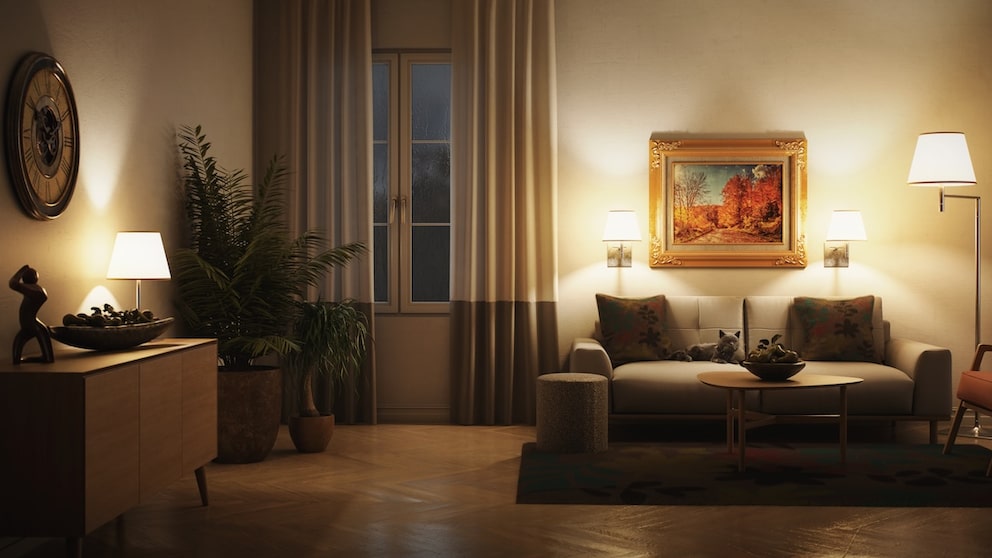
The light should invigorate but also relax, provide enough brightness but also feel cozy, and calm the nervous system. It should stylistically integrate into the interior concept and not appear too clumsy or intrusive. Therefore, the idea of a single, rigid ceiling lamp (at least in this area of the home) is long outdated. Light that comes rigidly from above may illuminate the room evenly but casts unattractive shadows, makes faces look tired, and visually presses the room downward. It creates more of a hospital atmosphere than depth and softness. The room feels ordinary and lacks scenic or cozy qualities. Instead, the living room requires a lighting concept that is individually adaptable and flexibly controllable.
How to Do It Better
Indirect light sources that set gentle accents without being too intrusive are particularly trendy. Small table lamps that direct the light beam downward are ideal and can be perfectly placed on sideboards or the coffee table. Suitable models, depending on taste, include the retro mushroom lamp “Panthella” by Louis Poulsen or the slightly softer-shaped “Nesso” by Artemide.
Interior lighting for glass cabinets is also popular. A swivel floor lamp is also recommended, as it illuminates a certain area (such as the couch) more intensely and is therefore perfect for moments of reading, knitting, or eating. Important to note: Even electronic devices like the TV emit light and should definitely be considered when developing the concept.
Also interesting: 5 Tips for the Right Bedroom Lighting
Mistake 2: Lamps as Passive Details
While the couch and dining table usually take center stage, lighting objects often remain a passive detail that receives little attention. What not everyone realizes: Lamps not only set accents, they structure living zones, influence color schemes, and have a significant impact on how a room feels. They are less like extras, more like protagonists. If they are only considered as functional accessories, a clear interior design can falter—and the living room loses one of its strongest design opportunities. For example, a small, inconspicuous ceiling lamp above the dining table looks quite lost, while a too massive floor lamp in a more minimalist environment often appears too dominant.
Materials are also important: Rattan tells a different story than metal, and glass refracts light differently than fabric. Therefore, it is all the more important to give lighting objects enough attention when choosing furnishings and to consider what style you want to pursue so that the lamps can create the appropriate atmosphere.
How to Do It Better
Before randomly furnishing the room, you should create a concept in which lamps play an important role; otherwise, the mentioned mistakes in living room lighting will occur. Then it’s time for fine-tuning. If you’re a fan of an industrial style, the lamp style can be more metallic. If you prefer an organic theme, shades made from natural materials like linen, rattan, or fabric are ideal.
Also interesting: Which Lamp Fits Which Interior Style
Because the location also affects the feeling, it requires more precise clarification: Does the room demand a focal point, or should the light be hidden and more inconspicuous? Where are splashes of color allowed, and where should the lighting be more subdued? Only those who actively engage with the topic can help shape the room atmosphere and prevent stylistic overload.
5 Tips for the Right Bedroom Lighting

Why a Single Ceiling Light Is Almost Always a Mistake
Mistake 3: No Dimmer
During the day, a lively living space; in the evening, a cozy zone or location for social gatherings—the living room has many qualities. However, most lamps in this area only know two states: on and off. The result: It’s too dark during a TV evening, too bright during dinner, even if you want to see what’s on your plate. Both scenarios require lamps that are individually controllable and can finely tune the light. Different activities require different atmospheres. Softly dimmed, warm white light is calming, inviting, and cozy. Bright, cooler white light objects have a hard, clean, and invigorating character. Those who want to relax in the evening should choose the former, while those who need enough light to work should opt for the latter.
How to Do It Better
Ideally, you start slowly to create a system that is easy and flexible to use. Smart home is the future, and today most lights can be retrofitted with individually controllable bulbs. With a click in an app or on a remote control, brightness and light warmth can be determined. Additionally, a timer and preset light moods can ensure that the light language automatically changes throughout the day. In this area, artificial intelligence is already quite advanced.