

October 26, 2026, 3:12 pm | Read time: 3 minutes
Winter is slowly approaching, and fireplaces or stoves are once again becoming essential companions alongside heating systems. But one thing is always necessary: firewood. Many people buy it ready-made from firewood dealers, but how long does wood need to be stored if it’s freshly cut? myHOMEBOOK spoke with an expert from the Association of House, Heating, and Kitchen Technology.
Oven-ready wood can go directly into the fire
If you buy your wood oven-ready from a dealer, you still need to store it depending on the quantity, but you can generally put a few logs directly into the fire. This wood is already pre-dried and suitable for burning in a fireplace or stove.
Is it prohibited to burn wet wood?
No, it is not allowed. To legally burn wood, it must meet certain conditions. These are outlined in the Federal Emission Control Ordinance, as explained by Thomas Schnabel from the Association of House, Heating, and Kitchen Technology (HKI). “According to Section 3, Paragraph 3 of the 1st Federal Emission Control Ordinance, natural split wood can only be burned if it has a moisture content of less than 25 percent, based on dry mass.” The reason is simple: Wood with a moisture content below 20 to 25 percent reaches temperatures much faster, allowing for efficient and low-emission combustion. This keeps pollutant emissions low.
Also of interest: What are the firewood prices in 2026?

What Are the Firewood Prices in 2026?

The Best Types of Wood for a Fire Pit
Consider pre-treatment, size, and storage
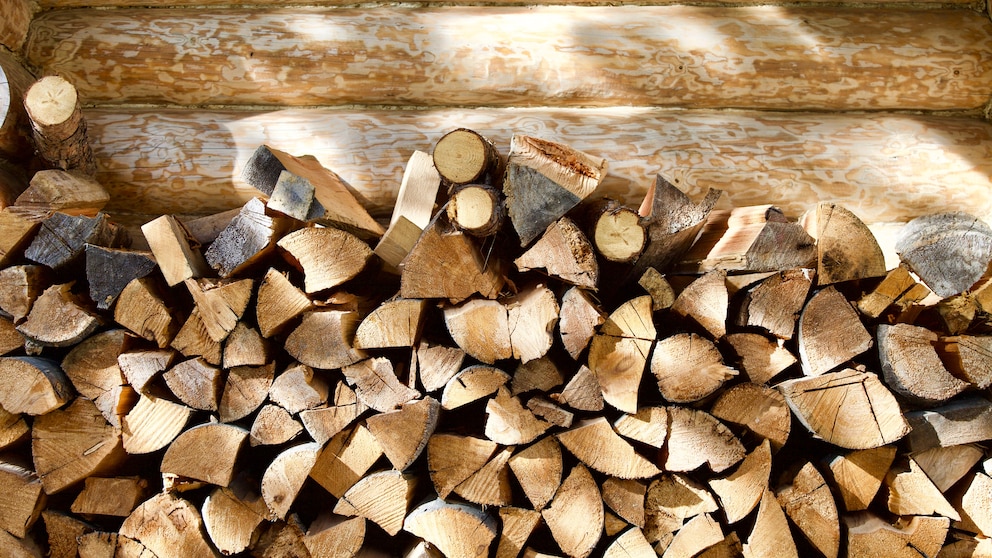
While oven-ready wood can be used immediately, fresh wood still needs to dry. There are several factors to consider, as the drying time can vary depending on the type of storage. “With proper preparation and storage, one year may be sufficient,” Schnabel explained to myHOMEBOOK. “It is crucial that the wood is split as soon as possible after cutting and then stored in a well-ventilated, covered area without ground contact. This allows air to flow freely through the woodpile. An occasional rain shower on the ends of the logs is not problematic.”
It is also important to note that the size of the logs plays a role. The smaller the logs, the faster they dry. Additionally, smaller pieces of wood burn better in the fireplace than larger logs.
To check the moisture content of wood, the expert suggests using commercially available measuring devices. Use a freshly split log and measure the moisture content on the exposed inner surface.
Rule of thumb: Let wood dry for two years?
When it comes to how long wood really needs to be stored to dry, the internet often suggests that it should be stored for about two years. But is this rule of thumb actually true? myHOMEBOOK also asked Thomas Schnabel about this. “The often-mentioned two years is a traditional rule of thumb, but not a universal requirement. How quickly firewood dries depends particularly on the type of wood, the size of the logs, air circulation, ambient temperature, and storage conditions.”
According to him, oak wood, for example, may indeed take two years to dry. Beech or coniferous woods could reach the desired 20 to 25 percent moisture content sooner, depending on storage.
The expert notes that several factors determine how long wood must be stored to dry: the right storage conditions (weather and stacking), the type of wood, and the initial moisture content. “Even longer storage does not necessarily lead to drier wood, as it can absorb moisture from the surrounding air, especially during the wetter fall and winter months.” Therefore, those who want to know exactly how long the stored wood still needs to dry should measure it periodically.