

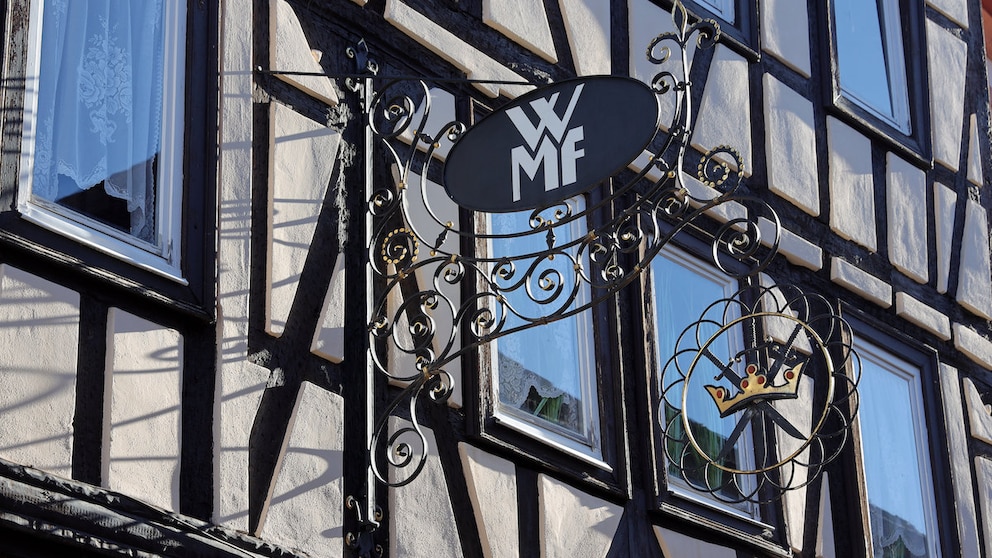
June 11, 2024, 3:48 pm | Read time: 7 minutes
Older readers will remember: When relatives came over for Sunday dinner, the good, shiny, non-rusting cutlery was brought out. And in most German households, that was from WMF. myHOMEBOOK author Andreas Kötter explains what has become of the brand.
The history of WMF GmbH, now a globally operating manufacturer of household goods, gastronomy, and hotel supplies, mirrors in many ways that of many German companies. Keywords such as IPO, World War II, global expansion, and job cuts are also found in WMF’s history. However, there are also several features that set the company apart. But first things first.
The Beginnings of WMF
Founded in 1853 by Daniel Straub and the brothers Louis and Friedrich Schweizer in Geislingen an der Steige, Baden-Württemberg, as the metalware factory Straub and Schweizer, WMF received its original name, Württembergische Metallwarenfabrik (WMF), only in 1880.
A not entirely unimportant anecdote on the side: from 1862 to 1865, a certain Gottlieb Daimler also worked for the metalware factory Straub and Schweizer. And, of course, this was the German engineer, designer, and later entrepreneur who developed the first four-stroke engine powered by gasoline. In the 1880s, Daimler then built various motor vehicles and finally, just before his death on March 6, 1900, had a racing car built. This car was named Mercedes after Daimler’s death, and the rest is automotive world history.
One of the Oldest German Corporations–and Yet Socially Responsible
But back to WMF, which went public on September 9, 1887–making WMF one of the oldest German corporations. By then, the company had been taken over by Stuttgart manufacturer and politician Gustav Siegle. His descendants remained majority shareholders in the corporation for almost 100 years until 1980.
In the 1880s, the company introduced several measures that were by no means standard at the time. In 1881, they founded a company health insurance fund with compulsory membership but also with above-average benefits. In 1883, a company savings bank followed, and in 1887, the WMF Welfare Association was established. It offered WMF employees and workers social benefits that were free or unusually affordable.
Speaking of “free”: even when meat prices continued to rise at the beginning of the 20th century, making the Sunday roast almost unaffordable, the company stepped in. In 1912, WMF built a hall in Geislingen, popularly known as the “Fish Hall,” which would go down in company history. Here, employees–by then numbering more than 3,000–could buy fish at cost price.
Incidentally, the “Fish Hall” still stands. However, today it no longer offers herring, trout, or salmon. Instead, for more than four decades, it has housed the WMF factory outlet, or as one would say today, the “Factory Outlet.”
Also interesting: How the “KitchenAid” Got Its Name
Cromargan Gives WMF Products the Status of “Invulnerability”
Since 1927, one of the brands under the WMF umbrella has been ‘Cromargan,’ later ‘Cromargan protect.’ The coined term, composed of ‘Crom’ (due to the particularly high chromium content) and Argan (Argentum, Latin for silver; shines like silver), stands for a non-rusting stainless steel with a high chromium and nickel content. This stainless steel was already developed by Krupp in 1912. And here the Sunday dinner with the relatives comes into play again. Cromargan is still used at WMF today, primarily for cutlery and kitchen utensils, pots, and pans.
Dark Times During World War II
As brilliant as the products are in both the literal and figurative sense, given their excellent quality to this day, not everything that glitters is gold at WMF. Like many other German companies, WMF’s history also knows dark times.
From 1944, more than 1,000 forced laborers, including 700 Jewish Hungarian women, were employed in an external camp of the Natzweiler-Struthof concentration camp. In this so-called external camp, there was no gas murder, but the motto was “death by destruction.” The workers had to produce aggregate parts for the world’s first jet fighter, the ME 262, in Geislingen an der Steige. The Nazis hoped this would turn the tide of the war.
Those who became ill or pregnant were transported to Auschwitz for gassing, and later, after its closure, to Bergen-Belsen. It should not be overlooked that survivors later reported that WMF employees occasionally slipped food and medicine to the workers. How to evaluate this, whether it was done to maintain the workforce or because some retained their humanity, is difficult to judge today. If it was done secretly, as “slipped” suggests, it would certainly speak for the WMF employees of the time.
“We mostly look back proudly on our 170-year company history, but the time of the Nazi regime is also part of our history,” said the WMF press office in response to a myHOMEBOOK inquiry. “During World War II, WMF became an armaments company and also used female concentration camp prisoners for forced labor.” Shortly before the end of the war, they were liberated by the Americans.
“We bear responsibility for this as a company to this day,” the press office stated. “We ask for reconciliation and are committed to ensuring that this history never repeats itself.” Therefore, WMF has been actively supporting the Geislingen initiative “Remember, Honor, Reconcile” for years.
What Happened to AEG? The Rise and Fall of a German Global Corporation
Who Is Behind the Rowenta Brand
Bauhaus Design Makes WMF Products a Must-have
After the war, WMF continued to grow, and by the mid-1960s, the number of employees had increased to 6,000. The company’s product range, which by then included not only cutlery but also small appliances and coffee machines, became a must-have in German households. Not only because WMF stood (and still stands) for the highest quality, but also because the design of the products impressed. With product designer Wilhelm Wagenfeld, they could rely on a pioneer of German industrial design, as we know today.
The ‘Bauhaus’ student founded the “Werkstatt Wagenfeld” in 1954. Like few others, Wagenfeld internalized and shaped the clear, minimalist design language according to the principle “form follows function.”
Wagenfeld designed the iconic “Bauhaus” table lamp and numerous Cromargan products for WMF, such as the “Max and Moritz” salt and pepper shaker set, egg cups in various shapes, a butter dish, a portion jug, a milk jug, and not least cutlery, to name just a few of his designs. Many of these timeless designs are still part of WMF’s program today.
WMF Goes to China
In the early 1980s, WMF was considered outdated but was successfully restructured by Wiesbaden investor Wolfgang Schuppli, who acquired a majority stake in WMF for 60 million Deutsche Marks in 1985. In the early 2000s, a factory was established in Heshan, China, where raw cutlery has been produced since 2010. The majority shareholders changed repeatedly until the company was delisted in 2015 and converted into a GmbH.
During these years, there were repeated job cuts and the closure of branches. In 2016, the French Groupe SEB, which also owns Krups, acquired WMF for 1.5 billion euros. The company is considered a world leader in small electrical household appliances and recently announced the construction of a coffee machine factory in China. WMF is now represented in 40 locations worldwide and operates nearly 200 company-owned stores in the German-speaking region.