

October 13, 2026, 2:44 pm | Read time: 6 minutes
If you’re building a house or planning to add a garden, you often consider including your own terrace. It’s perfect as a retreat after a long workday. But the question quickly arises: Is a wooden terrace or a stone one more sensible? myHOMEBOOK provides an overview of the basic steps in building wooden and stone terraces and explains the costs you might incur depending on the construction type.
Follow myHOMEBOOK on WhatsApp now
Overview
Stone Terrace vs. Wooden Terrace–What Are the Construction Differences?
Both wood and stone are popular materials for building a terrace. While both options have advantages and disadvantages, not all are immediately apparent. Is it worth trusting professionals for a terrace, or is it possible as a DIY project? What costs should be considered, and how complex is the construction in the end?

What to Consider When Building a Private Bunker
What to Keep in Mind When Building a House in Winter
Building a Wooden Terrace
The Right Location Is Important
Building a terrace requires considerable planning in advance. The property must be large enough, and the orientation should be correct. Depending on the terrace’s location, you get sunlight at different times of the day. Regardless, the location is the first crucial point of distinction.
A wooden terrace should be built in a sunny and, above all, dry location. Wood is sensitive to overly moist locations and can quickly develop an unsightly green coating depending on the location and moisture level, especially if the terrace is built too close to trees. The natural material wood is also susceptible to fungal infestation and wood rot, which is why wooden terraces need special treatment.
By the way: While a stone terrace doesn’t prevent green coating, it’s easier to remove. Stone is much more robust than wood. While wood needs to be treated with soap or a special cleaner and a soft brush, you can remove the coating on a stone terrace with a hard brush and hot water.
Also interesting: How to quickly clean the terrace
Preparation
If you’re still deciding between a wooden and stone terrace, you must consider that both options require ground preparation. Regardless of the final choice, the foundation must be laid, or even the best terrace won’t hold.
When planning a wooden terrace, remember it needs a two percent slope for water drainage. This should be considered during excavation.
Building a Wooden Terrace
Building a wooden terrace doesn’t necessarily mean the groundwork is less demanding than for a stone terrace.
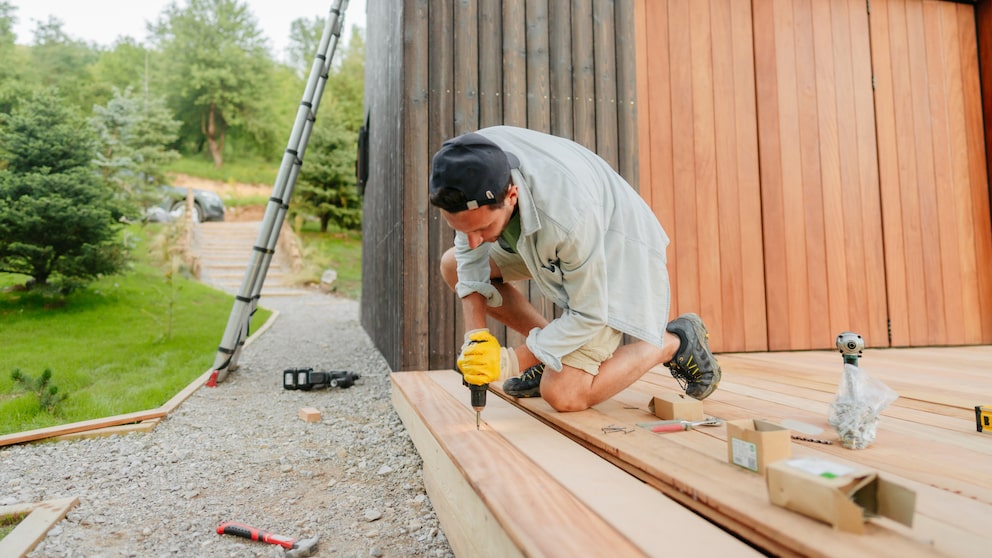
To ensure a wooden terrace is stable and durable, it needs a load-bearing, level, and water-permeable base. A weather-resistant substructure is laid on top, which should not have direct contact with the ground and should allow enough space for ventilation. A slight slope of about two percent directs rainwater away from the building and prevents waterlogging. The decking boards are mounted perpendicular to the support beams and laid with small gaps to allow the wood to expand and moisture to dry. The exact spacing of the substructure and fastening points depends on the type of wood, board thickness, and manufacturer specifications.
Also interesting: How to create a mini pond on the terrace or in the garden
The Costs of a Wooden Terrace
Beyond the effort involved in building a wooden terrace, the costs are also a significant factor. If you want a wooden terrace measuring between 15 and 25 square meters built by a professional company, remember that you will need to pay not only for labor but also for proper installation, wood materials, and the necessary ground preparation.
If you hire a garden and landscape builder for the work, you should expect costs of up to 5,000 euros for a 25-square-meter area. The exact prices depend not only on the provider but also on additional tasks included in the construction, such as excavation and soil compaction, as well as more specialized constructions if the terrace is built on a slope or if there are special requests in the design. Also, consider that stairs, railings, waste disposal, and building covers usually incur extra costs.
If you plan to build a wooden terrace yourself, you should budget between 1,500 euros and 4,000 euros, depending on material costs.
Building a Stone Terrace
Stone Also Needs a Good Location
While wood is more about not being too sensitive to moisture, a stone terrace should consider sun exposure. It’s important not only when you can and want to sit in the sun but also that if the stone terrace is exposed to too much sun, especially in summer, the material can become very hot. Besides, the terrace’s slope and proper subsoil preparation are crucial here.
Preparation
Before building a stone terrace, plants, roots, and non-load-bearing topsoil must be completely removed. The necessary excavation depth depends on the thickness of the frost protection layer, bedding layer, and terrace slabs. The subsoil is then compacted, and a base layer of gravel or mineral mix is installed, which must also be compacted in layers. This is followed by an even layer of gravel, in which the slabs are laid and aligned.
Also interesting: Surprisingly! Who is responsible for removing weeds on the sidewalk in front of the house
Building a Stone Terrace
The slabs for the stone terrace should be laid with even joints and secured with a stable edge to prevent lateral shifting. A functioning water drainage system must be considered during planning, as standing water can promote algae growth, loose slabs, and frost damage. Depending on the soil, surface, and connection to the house, additional drainage channels or solutions may be necessary.
What Does a Stone Terrace Cost?
Like wood, stone terraces can vary in price depending on the material used. Simple concrete slabs are cheaper than natural stone. If you want to entrust the construction to a professional company, you should expect prices of up to 7,000 euros for a 25-square-meter terrace, especially if you choose natural stone. If you opt for pure concrete, costs can be around 3,000 or 4,000 euros. It’s important to note that special requests, laying methods, and additional work such as excavation and general ground preparation increase the price.
If you choose the DIY project, you can expect costs of up to 4,500 euros for a 25-square-meter stone terrace. The biggest cost factors are not only the stone slabs but also excavation, joint materials, and disposal.
If you’re torn between a stone terrace and a wooden terrace, consider the three most important points for construction: What is the budget? What is the soil condition? And can you handle excavation, disposal, and other work yourself, even if multiple steps are necessary? Depending on your answers, you must decide. The terrace’s orientation and personal taste can ultimately tip the scales and determine your preference.