


April 19, 2021, 2:50 pm | Read time: 5 minutes
Smoke detectors are now mandatory in Germany. In addition to standard devices, there are also smart smoke detectors that, in addition to their safety function, measure the room climate and notify you via a smartphone app when it’s time to ventilate. myHOMEBOOK took a closer look at Bosch’s “Twinguard.”
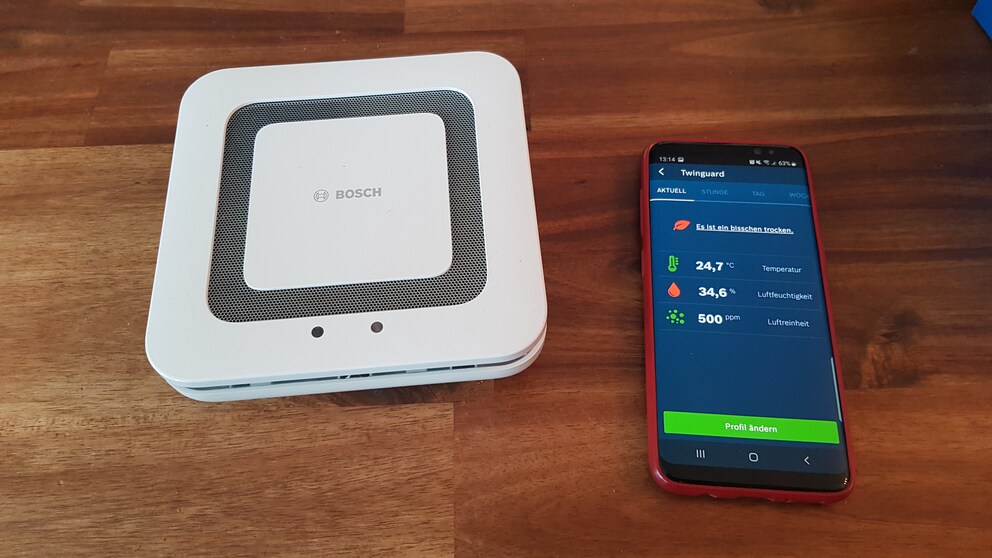
Due to COVID-19, many people are paying more attention to better indoor air quality—partly because we spend a lot of time at home. Regular ventilation is essential. Smart gadgets like Bosch’s “Twinguard” smoke detector can help by measuring temperature, humidity, and air quality. The device has been available since November 2020 and costs around 120 euros. Combined with the “Healthy Indoor Climate” feature of the Bosch app, it indicates when ventilation is needed. Additionally, the Twinguard can be combined with other components like smart thermostats, window contacts, or lighting. However, to operate the smoke detector—and all smart devices from Bosch—a controller connected to the router is initially required. myHOMEBOOK set up the Twinguard and controller and examined them in the test. The video shows the device during setup and in use.
Overview
Smart Smoke Detector “Twinguard” by Bosch in Test
For the test, Bosch provided some smart home devices on loan. In addition to the Twinguard, and the essential Bosch smart home hub, the package also included a window contact and a smart thermostat. In conjunction with the window contact, the thermostat automatically detects when ventilation occurs, turns off the heating during that time, and automatically turns it back on afterward. The window contact also serves an important function: When the alarm system is activated, it alerts the Twinguard in the event of a break-in, which then automatically activates its siren and sends a notification to your smartphone.
When connected with smart color-changing lights—such as those from Philips Hue—the system uses a traffic light to indicate whether the indoor air quality is good or bad. We limited our test to the Twinguard and controller together with the Bosch app.
Also of interest: Smoke detectors that are worth recommending—how to test, disable, replace them, and more
How Does the Installation Work?
The Bosch smart home hub is the central component of the system. All other modules can be connected to it and centrally controlled—some even from other manufacturers.
Controller
The Bosch hub is connected to the router via a LAN cable. You then create a network in the app and integrate the hub into it. Don’t worry—once you’ve downloaded and installed the app, it guides you through the setup process step by step. Once the QR code on the back is scanned, the hub is ready to use within minutes, and you can link other devices to it—such as the Twinguard.

Twinguard
First, insert the included batteries into the Twinguard, then you can integrate it into the system via the Bosch app. Here, too, you need to scan the QR code on the back or manually enter a numeric code. The app automatically transfers all relevant data to the system’s hub.
In the app, select “Management” and “Devices” to choose the Twinguard from the list.
Bosch Twinguard in Test – What We Noticed
The setup was intuitive and straightforward. Within half an hour, both the controller and Twinguard were ready. The current status of temperature, humidity, and air quality can be viewed in the app, along with additional recommendations for action. If you use the “Healthy Indoor Air” service in the app, you’ll be notified when it’s time to ventilate.

You can view detailed air quality information in the app
One should not forget: The Twinguard is also a smoke detector. When conducting a test alarm, a loud warning signal sounded, and in an emergency, you receive a call on your smartphone, which is useful when you’re on the go—in combination with the aforementioned door-window contact, these alerts are also possible in the event of a break-in.
Mounting materials (screws, dowels, mounting plate) are included, allowing you to mount the detector on the ceiling, for example. However, we noticed that the devices, both the Twinguard and the controller, don’t feel particularly high-quality. Once mounted, they don’t seem very substantial, and the plastic casing could be more robust.
Related: Smoke Detectors That Are Recommended – Testing Reveals a Cheap Battery for Power Tools Outperforms an Expensive One
Bosch Twinguard in Test – Pros and Cons
The Twinguard can be an entry point into Bosch’s smart home system—along with the controller, which is required for every application. Is the device worth it?
Pros
- Many useful features, more than just a smoke detector
- Easy installation via app
- Can contribute to better indoor air quality
- Can be networked with other devices (smart thermostats, etc.), even from other manufacturers
Cons
- Not cheap (around 120 euros)
- Plastic casing feels somewhat flimsy
Also interesting: Affordable battery for power tools impresses in test – an expensive one fails

Prevent Mold and Moisture: The Best Hygrometers for Your Home

What to Watch Out for With Smoke Detectors
What Are the Alternatives?
Of course, the question arises beforehand whether you even need a device to remind you to ventilate regularly. Smoke detectors are also available that are much cheaper, though not as smart. These typically cost around 40 euros, such as those from manufacturers like Telekom or X-Sense. These devices also alert you in case of an alarm, but the air quality sensor is a unique feature of Bosch’s Twinguard.
Conclusion
Regular ventilation is essential. Smart smoke detectors and the Bosch app can alert you when it’s time to ventilate. However, other smart smoke detectors can perform this function for much less money, so you don’t necessarily have to spend 120 euros on the Twinguard.
Regular ventilation is crucial. The Twinguard makes a good entry into Bosch’s smart home system—along with the controller, which is required for any application. Whether the device is worth it depends on your needs and budget.