


February 26, 2026, 4:23 am | Read time: 5 minutes
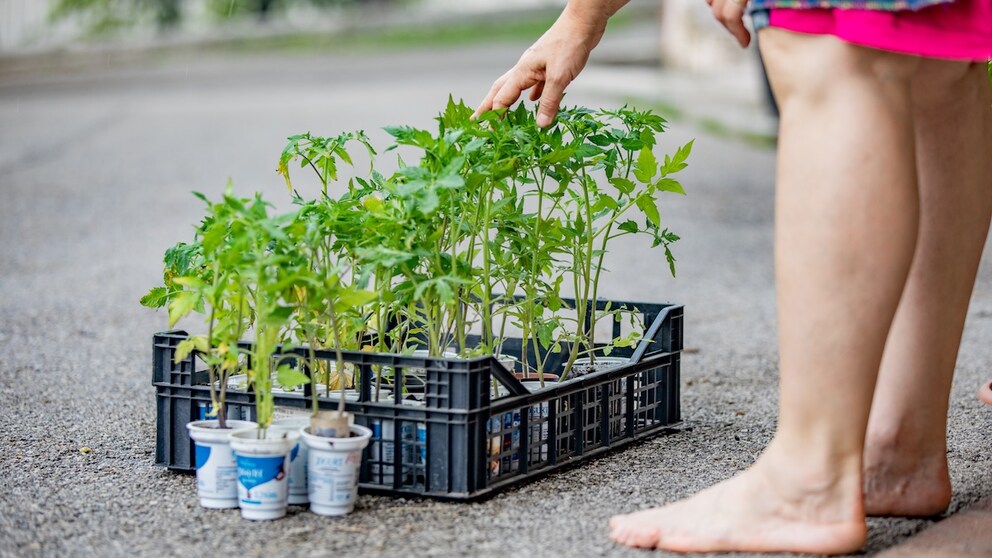
You can buy seedling containers, but you don’t have to. Simple seedling containers can be made with little effort from toilet paper rolls, fruit trays, and other household waste.
For many gardeners, the gardening season begins on the windowsill—with the cultivation of vegetables, flowers, and herbs. Some use multi-pot trays, others soil block makers or peat pellets. Those who want to do without purchased seedling supplies can find useful helpers in the recycling bin or with old newspapers.
1. Toilet Paper Rolls
Children often use empty toilet paper rolls for crafts, but the cardboard tubes are also suitable as seedling containers. Due to their height, they are particularly good for growing deep-rooted plants like beans, sunflowers, or sweet peas.
The open-bottom rolls are filled with seedling soil and placed on a waterproof tray. Then you can sow. When the plants are ready to be transplanted, you can plant them in the ground with the cardboard roll, as the cardboard quickly decomposes there. Since the rolls have no bottom, the roots can immediately grow into the surrounding soil.
The downside of this seedling method is the limited durability of the rolls. The constant moisture needed for germination makes the cardboard unstable and prone to mold.
2. Tetra Paks
Tetra Paks, such as empty juice or milk cartons, remain form-stable due to their waterproof coating and are less prone to mold. They can be used in two ways: horizontally and vertically.
Laid horizontally and opened from the top, Tetra Paks can be used as seed trays for sowing many seeds together. You can sow crops here that need to be pricked out later, such as tomatoes, peppers, chili, eggplants, lettuce, kohlrabi, or Swiss chard.
Once the young plants have formed their first true leaves, they are moved to individual containers. For tomatoes, peppers, chili, and eggplants, further Tetra Paks are suitable—this time as vertically standing plant pots. The young plants can continue to grow in them until they are planted out. Lettuce, kohlrabi, or Swiss chard, on the other hand, are often planted out earlier or only briefly in smaller pots.
Important to note: Before filling the Tetra Paks with soil, they should be thoroughly rinsed. Additionally, generous holes should be cut in the bottom to allow excess water to drain.
3. Plastic Trays
For the first phase of cultivation, sturdy plastic trays from the supermarket are also suitable, such as the stable packaging for fruit, mushrooms, or spinach. Trays with lids are particularly practical because they create high humidity underneath and prevent the soil surface from drying out quickly. If no lid is available, the tray can be covered with foil. Alternatively, a second tray of the same size can be used as a cover.
To prevent waterlogging, the trays need holes in the bottom. Some plastic trays already have suitable holes. If no holes are present, they must be cut in. Once the seedlings have formed their first true leaves after the cotyledons, they are separated and pricked out into larger pots.
Multicell Trays Bring Order to Seedling Cultivation

How to Easily Make Seedling Pots from Toilet Paper Rolls
4. Egg Cartons and Eggshells
Egg cartons can also be used as simple seedling containers. The compartments are filled with seedling soil and placed on waterproof trays. Then they are watered and finally sown. For planting out, you can plant the young plants with their cardboard cell into the soil, as the cardboard quickly softens. If the plants need more space before planting out, the individual cells can also be placed in larger pots. To make it easier for the roots to grow into the surrounding soil, the bottom of the cardboard cells can be carefully torn open.
As with toilet paper rolls, the downside of growing in egg cartons is the risk of mold. Additionally, the cartons may be contaminated with germs. Clean working and hand washing are therefore advisable.
Eggshells are also suitable as mini pots for seedlings. To do this, carefully drill or poke drainage holes in the bottom of the shells before filling them with soil. Egg cartons are ideal holders for the eggshell pots, but need a waterproof tray. If you’re concerned about possible germ contamination, use shells from boiled eggs. If you want to use raw shells, rinse them well.
5. Seed Snails
If space on the windowsill is limited, seed snails are a good option. They allow numerous seedlings to grow in a small area. This method is not suitable for crops that grow very large, like pumpkins, cucumbers, or zucchini.
Seed snails are easy to make:
- A strip of waterproof foil, about 15–20 centimeters wide, is laid out flat.
- A layer of moist seedling soil, about 1 to 2 centimeters thick, is evenly spread on it.
- The strip is then carefully but tightly rolled up, similar to a Swiss roll, and secured with a rubber band or string.
- The resulting snail is placed upright in a waterproof, tall container.
- The substrate is gently pressed down and, if necessary, refilled.
- Then the seeds are sown along the rolled-up foil into the soil and gently watered.
When pricking out, the seed snail shows another strength. The roll is unrolled so that the young plants lie neatly next to each other and can be removed one by one. Since the roots in the snail mainly grow downward, separating them is usually easy as long as the substrate is slightly moist.
The most common mistake in caring for the seed snail is too much water. Because the soil in the roll dries out more slowly than in pots, watering should be more restrained. Additionally, a location with good air circulation ensures that mold does not develop as quickly.