


February 13, 2026, 3:55 pm | Read time: 5 minutes
Multicell trays, alsso referre to as multi-pot trays, are a great solution for gardeners who want to start vegetables and flowers in a small space. What to consider when using the trays, their advantages and disadvantages, and which pot sizes are suitable for which plants can be found here at myHOMEBOOK.
What Are Multi-Pot Trays?
While it’s still cold outside, spring is stacking up on the windowsill. First, there are five yogurt cups, then 15, and soon the entire windowsill is filled with young plants in plastic cups, Tetra-Paks, or egg cartons.
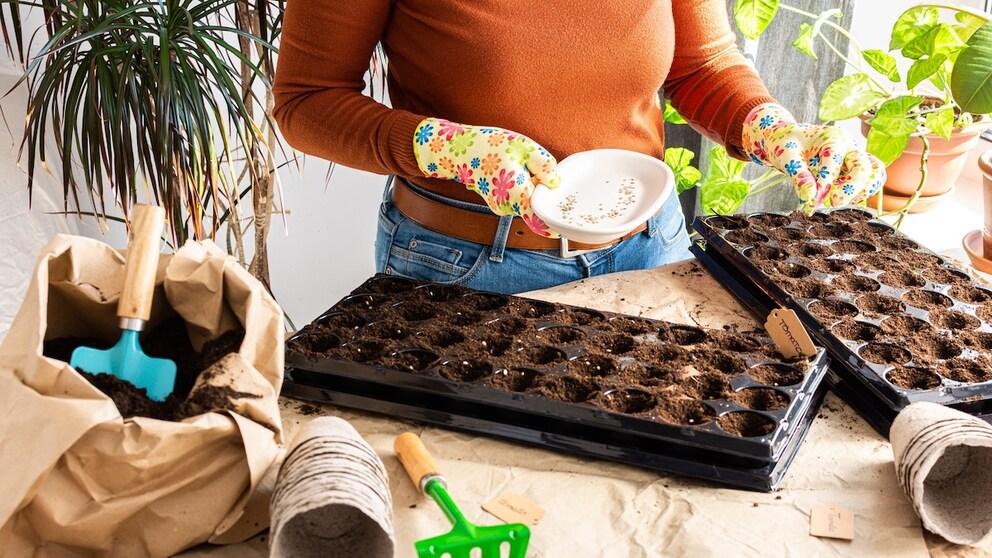
A solution that promises order and clarity is multicell trays, also known as seed trays: a set of interconnected plant pots used in professional settings and by hobby gardeners for growing vegetables and flowers.
The range of trays is large. Some trays are tightly divided and contain over 200 small pots, while others have only 15 or fewer, providing more space per plant. Each small pot has a hole at the bottom to allow excess water to drain.
How Are Multi-Pot Trays Used?
Multi-pot trays can be filled with soil in one go. The seed soil is spread over the tray and distributed by hand to fill all the small pots. The soil is then lightly pressed down and, if necessary, refilled until an even surface is achieved. This way, less soil settles during watering later.
Afterward, you can sow the seeds. As long as the seeds haven’t sprouted, water gently from above with a spray bottle or watering bulb. Once the seedlings have emerged, watering can also be done from below, as the trays sit on saucers.
Advantages of Multi-Pot Trays
- Multi-pot trays save space because many seedlings are close together in a single tray.
- They can be moved, rotated, or carried with one hand. The difference becomes apparent during hardening off when only one or a few trays need to be moved outside and back inside, instead of numerous individual cups.
- Since each plant grows in its own small pot, the roots are much less likely to become entangled.
- Transplanting is easier because the root balls can usually be pushed out cleanly and easily from below. Some trays have special lifters that allow all seedlings in a tray to be lifted at once.
- The cultivation remains organized because each variety has its fixed place, and labels are less likely to get mixed up.
- Many models are durable and can be reused for many years.
Disadvantages of Multi-Pot Trays
- In multi-pot trays, the edge pots often dry out faster than the middle pots.
- Peppers germinate most reliably at around 22 degrees Celsius, while lettuces prefer it much cooler. Ignoring such requirements and mixing incompatible crops on one tray is a recipe for frustration.
- Many multi-pot trays are relatively large, so they don’t fit well on narrow windowsills.
Three Well-Known Multicell Trays
When searching for multicell trays, you mainly come across three brands.
- Romberg primarily targets beginners. The green trays are often part of complete sets and are available in many hardware and garden centers.
- QuickPot trays are considered the top tier among seed trays. Initially used in nurseries, they have gained popularity in the hobby gardening sector in recent years. With proper care, these trays, available in many variants, last more than ten years. They are mainly found in online shops focused on organic gardening, as well as large online retailers.
- For occasional gardeners, Windhager offers a small selection available in many hardware stores.
How Expensive Are Multicell Trays?
Depending on the manufacturer, seed trays cost between 3 and 6 euros. Accessories such as saucers, covers, or lifter plates are not a significant investment either.
5 DIY and Upcycling Ideas for Growing Plants
How to Grow Kohlrabi Indoors
Pot Sizes and Suitable Plants
- Small Pots: Multi-pot trays with small pots starting at about 3 cm in diameter are suitable for a relatively short growing period of plants from which many seedlings are to be grown in a small space, such as green onions, lamb’s lettuce, chives, or winter purslane.
- Medium Pots: Multi-pot trays with medium-sized pots starting at about 4–5 cm in diameter are suitable for sowing lettuce, beets, fennel, celery, cluster growing of herbs, or pricking out summer flowers.
- Large Pots: Multi-pot trays with larger pots starting at about 8 cm in diameter provide the volume that heavy feeders need for healthy development. Tomatoes, peppers, and chili thrive best here once they have developed their first true leaves in their seed trays. Squash, zucchini, melon, and cucumber grow best individually in these pots from the start.
Alternatives to Multicell Trays
Besides multicell trays, there are many other methods to start growing vegetables and flowers.
- Seed Trays: They are well-suited for the first phase of cultivation. Seeds are sown broadly here and later pricked out into larger individual pots.
- Soil Block Makers: These devices press stable square soil blocks from moistened seed soil, eliminating the need for pots.
- Paper Pot Presses: With this wooden tool, small pots can be made from newspaper or packing paper. Since the paper decomposes quickly, the seedlings can be planted out with minimal effort.