


August 14, 2026, 11:31 am | Read time: 5 minutes
Even shady spots in the garden can be attractively planted, for example, with ground covers. These low-growing plants fill open spaces, suppress weeds, and ensure that even challenging locations under trees, shrubs, or on the north side of buildings look appealing. Which types are suitable depends primarily on the light and soil conditions. myHOMEBOOK gardening expert Katharina Petzholdt presents eleven ground covers that green shady areas in various ways, depending on whether the soil is drier or moister. This way, you can find a suitable and low-maintenance solution for almost every shady garden corner.
Not All Shade Is the Same
Many hobby gardeners consider ground covers boring. However, it cannot be denied that these plants have many advantages: They suppress weeds, protect the soil, and transform a bare area into dense greenery with little maintenance effort. Some of them can also grow in the shade.
Shady areas are often considered particularly difficult to plant: Not only is there a lack of light, but under trees, there is also a lack of water and nutrients. Those who randomly bring home a few plants labeled as “shade-tolerant” from the garden center may quickly face an unpleasant surprise. Because not all shade is the same. Shady locations are those that receive no more than two or three hours of direct sunlight, while partially shaded locations get about three to six hours of sun per day, and in dappled shade, sunlight and shorter shadow periods alternate constantly.
Besides shade tolerance, other factors also play a role, such as soil moisture and the ability to grow densely and withstand root competition. Below, we introduce well-known and popular ground covers for shady areas—categorized by their tolerance to soil moisture.

9 Perennials for Shady Spots

5 Plants Suitable for a North-Facing Balcony
Ground Covers for Shady and Partially Shaded Locations with Dry Soil
The following plants cope quite well with dry soil in the shade. They are suitable for underplanting trees or shrubs, so they can also handle root pressure.
Lesser Periwinkle (Vinca minor)
This evergreen subshrub likes partially shaded and shaded locations and can handle dry as well as fresh soil. It blooms blue-violet from April to May, with some varieties also blooming white or red-violet.
Bigroot Geranium (Geranium macrorrhizum)
This evergreen perennial can thrive in partially shaded, shaded, and even sunny locations and prefers rather dry soil. It blooms from June to August, with some varieties starting as early as May, with bowl-shaped flowers in rose, pink, and white.
Barrenwort (Epimedium)

Barrenworts have very different requirements. For shady and rather dry locations, Epimedium x perralchicum “Frohnleiten” or the Black Sea Barrenwort (Epimedium pinnatum subsp. colchicum) are best suited. However, they can also grow well in partial shade or sunny locations and on fresh-moist soils. The perennials are evergreen and show delicate yellow flowers in spring.
Ivy (Hedera helix)
This evergreen climbing plant tolerates deep shade like few other plants. However, it can also thrive in partial shade and will tolerate sunny locations if necessary. Ivy shows its inconspicuous yellow-green flowers from September to November, but only at the age of eight to ten years and only if it gets enough light. The blue-black berries are an important food source for blackbirds, thrushes, and starlings.
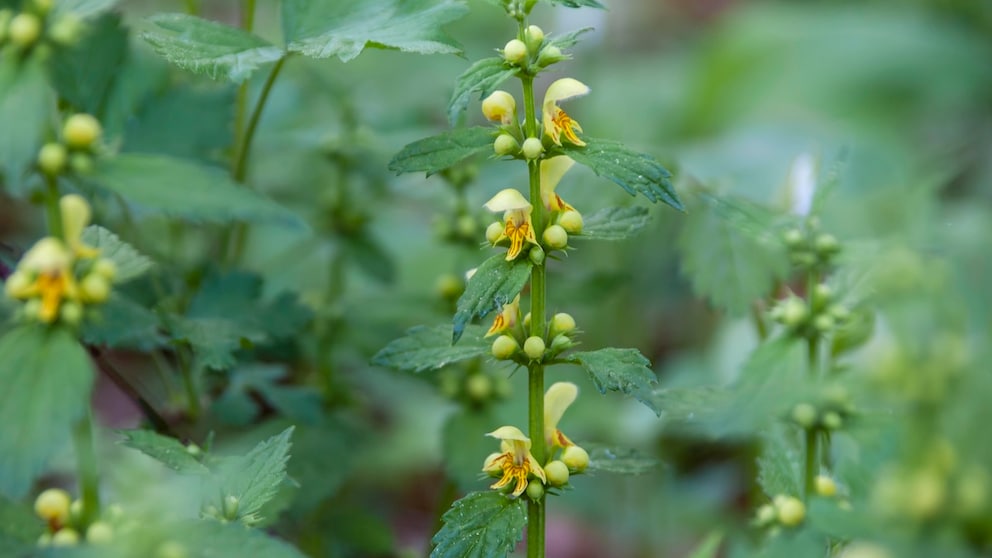
Yellow Archangel (Lamium galeobdolon)
This evergreen perennial prefers partially shaded to shaded locations and, although it likes fresh soil, withstands dry periods quite well. It blooms bright yellow from April to September and is one of the most productive bee pastures in the shade bed. Note: Do not confuse it with the silver-leaved yellow archangel, which is classified as an invasive species.
Ground Covers for Shady and Partially Shaded Locations with Moist Soil
The following plants cope well with moist soil in the shade. They are suitable for underplanting trees or shrubs, so they have no problem with root pressure.
Creeping Jenny (Lysimachia nummularia)
This perennial is evergreen in mild winters and prefers shady to partially shaded locations. It likes to stay consistently moist and is therefore well-suited for planting along pond edges, but it also thrives under trees and shrubs. From May to August, it displays its bright yellow star-shaped flowers.
Japanese Spurge (Pachysandra terminalis)
Japanese spurge is also known as shade plant or yew. This evergreen subshrub is suitable for partially shaded and shaded locations. It blooms inconspicuously cream-white in spring.
Sweet Woodruff (Galium odoratum)
This summer-green perennial needs fresh to moist soil and can stand in both shady and partially shaded areas. The white, star-shaped flower clusters appear from late April to June.
Bugleweed (Ajuga reptans)
This evergreen perennial grows best in partial shade. However, if the soil is sufficiently moist, it also thrives in the sun. From May to August, it pushes up strong, blue-violet flower spikes, less often in pink or white.
Common Lungwort (Pulmonaria officinalis)
This summer-green perennial prefers partially shaded to shaded locations. The wild species blooms from March to May. A color change of the funnel-shaped flowers is typical for lungwort. The flowers start pink and turn blue after pollination, signaling to pollinators that there is nothing more to be had here.
European Wild Ginger (Asarum europaeum)
This evergreen perennial can grow in partially shaded and shaded locations. Hidden under its glossy, heart-shaped leaves, it blooms violet to brown-red from March to May.