


February 17, 2026, 9:55 am | Read time: 5 minutes
An elderly or already dead tree is one of the underrated spots in the garden. It can be wonderfully revitalized with climbing plants. Why greening old trees can be beneficial, how it works, and which plants are suitable, you can find out here on myHOMEBOOK.
Overview
How Old Tree Structures Create New Life
Old or already weakened trees retain their value. Many animals use them as a retreat, even if foliage is sparse or completely absent. As they die, a natural decomposition process begins in the wood, creating cracks, soft zones, and small cavities that provide space for new species.
Greening enhances this effect. Dead trunks are natural frameworks where climbing plants thrive, as no canopy blocks light or space. An old tree that still has some leaves can also look beautiful when climbing plants and the remaining leafy branches form an attractive mesh. Both options add interest to the scene and transform a perceived burden into a lively focal point.
Additionally, there is practical value in leaving old trees in place. Removing a tree along with its roots is a task more likely to inspire thoughts of escape than a determined grab for the spade.
Which Trees Are Suitable
Whether a tree is suitable as a framework depends primarily on its stability and a clearly recognizable basic structure of trunk and branches. Old fruit trees, for example, are often well-suited. In open areas, vigorous climbers can quickly gain space, so it’s worth monitoring their growth, especially if the tree is near paths or property boundaries.
Safety Note
Before greening old or dead trees, their stability should be professionally assessed. Regular checks are also important afterward, especially near paths, seating areas, or property boundaries, to identify rotten or loose parts in time.

The Best Plants for Natural Shade in the Garden
Successfully Planting Kiwi Berries in Your Own Garden
Suitable Climbing Plants
1. Rambler Roses (Rosa sp.)
The classic choice for impressive greening of old trees in full sun. Rambler roses grow vigorously and reliably fill wide crowns. ‘Bobby James’ blooms white and lush in June. ‘Lykkefund’ features creamy white, pleasantly scented flowers. ‘Paul’s Himalayan Musk’ opens delicate pink, loose flower clusters in June.
2. Common Clematis (Clematis vitalba)
For larger old or dead tree frameworks with good load-bearing capacity. Common Clematis is a native species in Germany. It regularly grows into tree crowns in nature and is correspondingly vigorous. In summer, it bears many creamy white flowers, and later decorative seed heads. It is too energetic for smaller structures.
3. Mountain Clematis (Clematis montana)
For sunny locations or widely opened crowns. It is one of the most vigorous Clematis species and quickly fills large structures. ‘Rubens’ blooms pink, ‘Grandiflora’ bears white flowers.
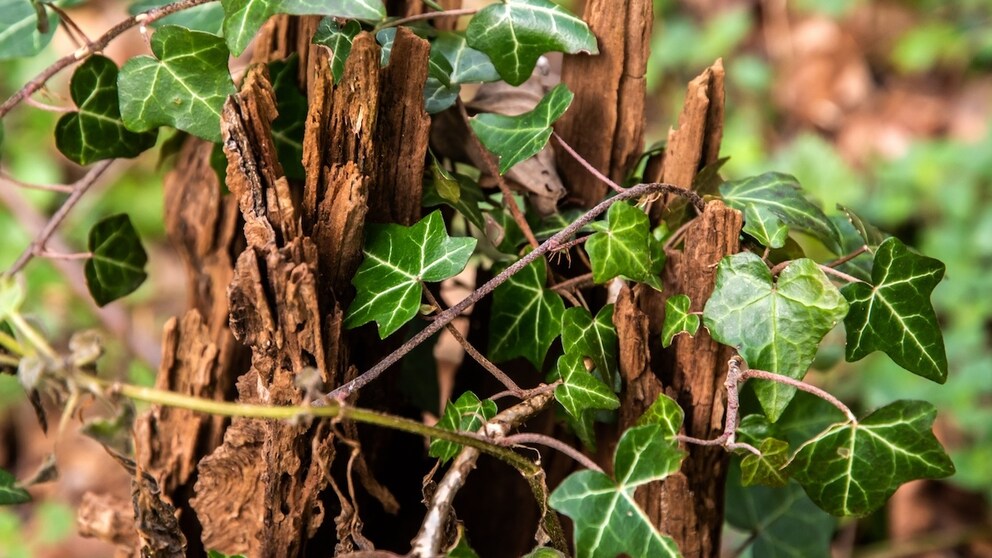
4. Ivy (Hedera helix)
For semi-shaded to shaded locations. Ivy reliably clings to the bark. ‘Goldheart’ grows up to 4 meters high and has dark green leaves with a golden yellow center.
5. Akebia (Akebia quinata)
For dead or dying trees on permeable, warm soils. Akebia makes particularly good use of old tree structures and forms long, flexible shoots that are easy to direct. ‘Alba’ blooms white, ‘Rosea’ has lavender to pink flowers.
Good to know: Akebia is considered “potentially invasive” in Germany. If you still decide to plant it, make sure that fallen fruits, seeds, and clippings do not end up in the compost but in the organic waste bin.
6. Mini Kiwi (Actinidia arguta)
For sunny tree structures with enough light and air in the branches. Mini Kiwis grow vigorously, reliably hold in the branches, and bear many small fruits that ripen well in the tree. ‘Weiki’ is considered particularly robust and aromatic but requires a male pollinator. ‘Issai’ is self-fertile and grows somewhat more compact.
7. Annual Climbers
If you’re unsure whether greening an old tree is suitable, you can use annual plants like nasturtiums, morning glories, or bell vines as a test. They grow rapidly within a season and quickly show how such a re-greening can look.
Planting and Start Phase
The climbing plants are planted at some distance from the tree to keep the tree roots undisturbed. The soil in the planting area should be well loosened and rich in humus. Cardboard layers placed tree-side in the planting pit initially reduce root competition pressure and make it easier for particularly competition-weak climbing plants to start. A ground anchor and diagonally stretched coconut ropes help the young shoots reach the tree framework. During the first years, the shoots should be guided. Once they have found a firm hold, they grow independently.