


December 14, 2025, 11:54 am | Read time: 5 minutes
In its native Mexico, the cup-and-saucer vine (Cobaea scandens), also known as cathedral bells or Mexican ivy, is a perennial. Here, the climbing plant is usually cultivated as an annual. Its attractive flowers and vigorous growth make it a popular choice for quickly greening pergolas, fences, or walls.
Appearance and Growth
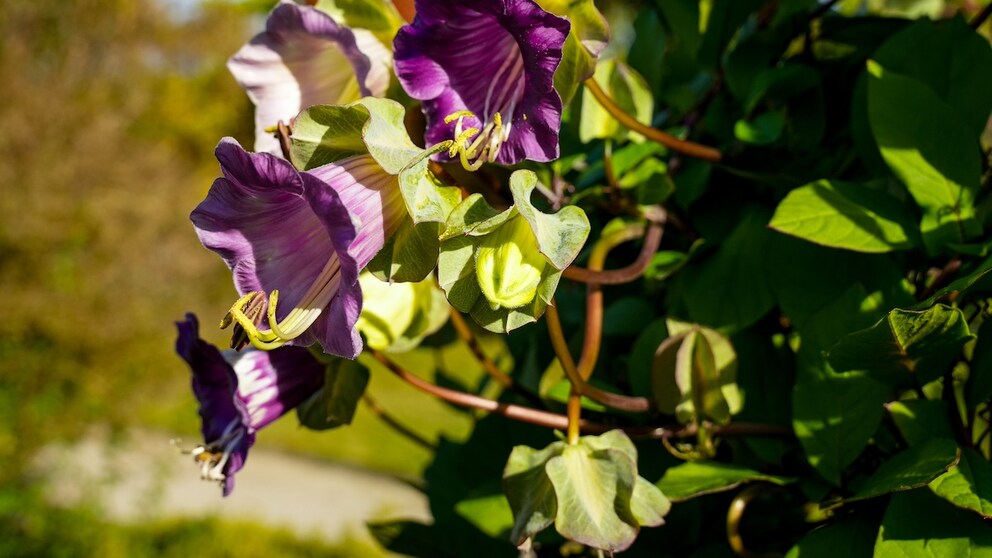
The cup-and-saucer vine grows as a highly branched climbing plant, quickly gaining height with its long tendrils. Outdoors, it reaches three to six meters, while in containers, it remains shorter. Its dense foliage consists of opposite, doubly pinnate leaves in fresh green. At their ends are finely branched, reddish tendrils equipped with hooks. These hooks allow the plant to grip rough surfaces well, while on smooth surfaces, it relies on climbing aids. From July, the large, bell-shaped flowers open. Initially greenish-light, they later turn a strong violet-blue. The light stamens stand out prominently, giving the flowers their typical effect. The scent also changes during flowering, becoming sweeter over time. In its native habitat, small green capsule fruits with winged seeds form, but in our regions, these usually do not mature due to the late flowering.
Sowing and Planting Cup-and-Saucer Vines
Starting from late February or March, cultivation can begin. Two to three pre-soaked seeds are placed about one centimeter deep in the seed-starting soil per pot. At a germination temperature of 68 to 75 degrees Fahrenheit, the seeds typically germinate within 10 to 20 days. After germination, the plants should continue to grow a bit cooler. To encourage good branching and later denser growth, it is worthwhile to trim the shoots in time. A bamboo support provided early gives the young shoots a secure hold. After the Ice Saints, when no more frosts are expected, the cup-and-saucer vines can move outdoors.
Location and Soil
Cup-and-saucer vines need a wind-protected, sunny to partially shaded location. The soil should be nutrient-rich, humus-rich, and well-drained. Waterlogging must be avoided. Cup-and-saucer vines can grow both in beds and in large containers.
Varieties
With its pure white flowers, Cobaea scandens ‘Alba’ is a beautiful complement to the blue-violet flowering species.
Caring for Cup-and-Saucer Vines
Cup-and-saucer vines are easy to care for but have a high water and nutrient demand. With the following tips, the plants will thrive optimally:
How to Water Cup-and-Saucer Vines
Cup-and-saucer vines are very thirsty and should be watered abundantly, especially in summer. Those growing in containers need more water than those growing outdoors.
Fertilization
To reach their full potential, cup-and-saucer vines should be fertilized regularly. A slow-release fertilizer in the planting hole gives them a good start. Afterward, regular fertilization with a liquid fertilizer is recommended. However, do not overdo it, as too many nutrients during the flowering phase can lead to reduced flower formation.
Do You Need to Prune Cup-and-Saucer Vines?
It is possible, but not necessary, to prune cup-and-saucer vines. To promote branching, occasionally trim individual shoot tips. Long shoots can also be cut if the plant threatens to become unruly.
Winter Hardiness
The cup-and-saucer vine is not winter-hardy. Therefore, it is usually cultivated as an annual here. Theoretically, it is possible to overwinter the plant frost-free. Cup-and-saucer vines growing in containers can be cut back vigorously and then overwintered in a bright, cool place at 54 to 59 degrees Fahrenheit. In their winter quarters, they should be watered regularly but sparingly.
Diseases and Pests
The cup-and-saucer vine is largely spared from diseases and pests. Only aphids and snails occasionally attack the plant. A garden rich in species, where the natural enemies of aphids feel at home, generally helps against aphids. Immediate measures include a water jet or spraying with a soap solution. Snails are only a problem in the young plant stage. Regular collection or a snail collar can help here.
Alternatives
If you’re looking for annual alternatives to the cup-and-saucer vine, you can plant morning glories. These toxic but beautiful climbing plants can form shoots up to five meters long. Compared to other morning glories, the heavenly blue morning glory is more insect-friendly.
Another attractive annual alternative is the large nasturtium. It is edible, insect-friendly, and forms shoots that rarely exceed two to three meters.
For a perennial alternative, you can plant the garden honeysuckle. This climber with its white-yellow-reddish flowers grows three to six meters high and is very popular with many insects, especially butterfly caterpillars.

Greening an Old or Dead Tree With Climbing Plants

How to Properly Plant and Care for Decorative Pumpkins
Use in the Garden
The cup-and-saucer vine grows at an astonishing pace. Within a few weeks, it grows several meters and covers bare areas with its long tendrils. It is suitable as a temporary privacy screen, creates pleasant shaded areas, and thrives both in the garden and on the terrace or balcony. Pergolas, fences, walls, facades, and even older, sturdy trees can be easily and attractively greened with it for a season.
Bee Friendliness
In its native habitat, specialized bats pollinate the cup-and-saucer vine. This interaction is missing here. There are no reliable statements about its attractiveness to native insects yet, but it is occasionally reported that the flowers are visited.