


September 21, 2025, 5:44 am | Read time: 5 minutes
An old wooden door can become dull, worn, or covered with many layers of paint over time. It might stick, not close properly, or show cracks in the wood. However, you don’t have to replace it immediately, as it can often be restored to a beautiful and functional state with patience and careful work. Here, you’ll learn how to renew a wooden door in a few steps.
Overview
1. Inspect the Wooden Door Before Renewing
Before renewing the wooden door, you should inspect it thoroughly. In its mounted state, you can quickly determine if the door sticks, if the lock closes properly, or if the hinges are stable. You can usually also see if the wood has warped or if the door has cracks or dents.
Small cracks can later be filled with wood filler, while deeper damage may require glue. If there are significant damages, it might be wise to consult a professional.
2. Remove and Prepare the Wooden Door
If you want to renew an old wooden door and possibly sand and paint it, you should remove it with another person to avoid injury. Many of these doors can be very heavy. After removing the door, it’s necessary to take off all fittings, hinges, locks, door handles, and key escutcheons. The hinges should be carefully stored with the screws, ideally in a small box, so nothing gets lost during reinstallation.
Additionally, you should set aside all other parts together to find them quickly. Then, it’s advisable to place the door flat on two sawhorses or easels so you can work on the front and back without it slipping.
Also interesting: The Best Time for Renovation or Remodeling
3. The Right Place to Work
Since a lot of dirt can be generated when renewing and sanding an old wooden door, it’s necessary to protect furniture and floors with drop cloths or blankets. This can significantly reduce the cleaning effort afterward. If you have no other room as an alternative, you should definitely open windows and doors while sanding and wear a dust mask and appropriate protective clothing.
It’s better to move the sanding of the wooden door to a garage, a basement room with good ventilation, or–if possible–outside in the garden. There, you not only have more space but also save yourself the hassle of cleaning afterward and can work more undisturbed. A dust mask and safety goggles are also mandatory outside to protect your airways and eyes.
4. Remove Old Paint and Coatings
Now begins the actual work process, which is important when renewing an old wooden door: removing the old surfaces. This step always depends heavily on how heavily the door is coated.
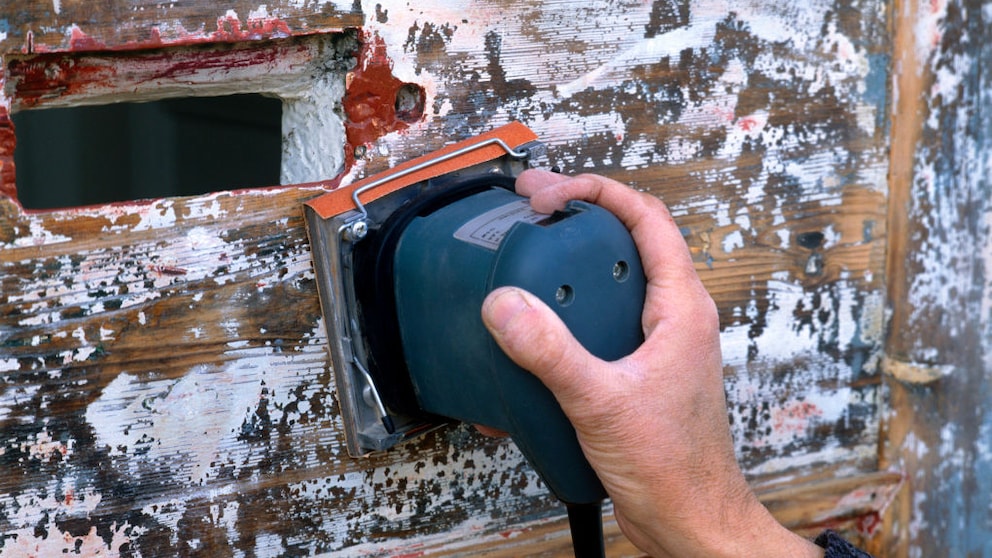
If only a thin layer of paint is visible, simple sanding of the wooden door is usually sufficient. You work step by step, first with coarse sandpaper, then with medium, and finally with fine paper until the surface is smooth and even. If there are several thick layers of paint on the door, it’s more advantageous to use a heat gun. The heat softens the paint so you can carefully lift it off with a spatula.
However, you should handle it carefully and not hold the heat gun in one spot for too long, as this can cause burns on the wood. It’s better to move the heat gun back and forth evenly to avoid damage.
For doors with many profiles or panels, a paint stripper is often the best choice. It is applied generously with a brush, needs to sit for a while, and can then be removed with the spatula along with the loosened layers. It’s important to pay attention to your own safety and use gloves, safety goggles, and a respirator, as the substances can be very strong.
Also interesting: 7 Tips for More Safety in DIY Projects

6 Tips to Conceal an Ugly Floor

How to Give Old Wooden Furniture a New Look
5. Repair Existing Damage to the Wooden Door
After the old coatings have been removed, the true condition of the wood usually becomes apparent. You might discover nicks and signs of wear that add extra character. However, deep cracks or larger holes should definitely be repaired.
For this, use wood filler or repair wax, which can be finely sanded again after hardening. This creates a smooth, even surface, almost completing the renewal of the old wooden door in a few steps.
6. Paint, Oil, or Stain
In the final step, you can paint, oil, or stain the old wooden door as desired. Oiling highlights the natural grain, while staining creates a protective film where the grain is only partially visible.
For a natural look, oil is usually the best choice. It penetrates deep into the wood, impregnates, and protects it from drying out. If you want to add a bit of color to the door, you can do so with a semi-transparent stain. For a solid color protection, paint is usually the best solution. It is more durable than oil or stain and is also suitable for high-traffic surfaces, such as in a child’s room or entryway.