


June 25, 2021, 8:52 am | Read time: 4 minutes
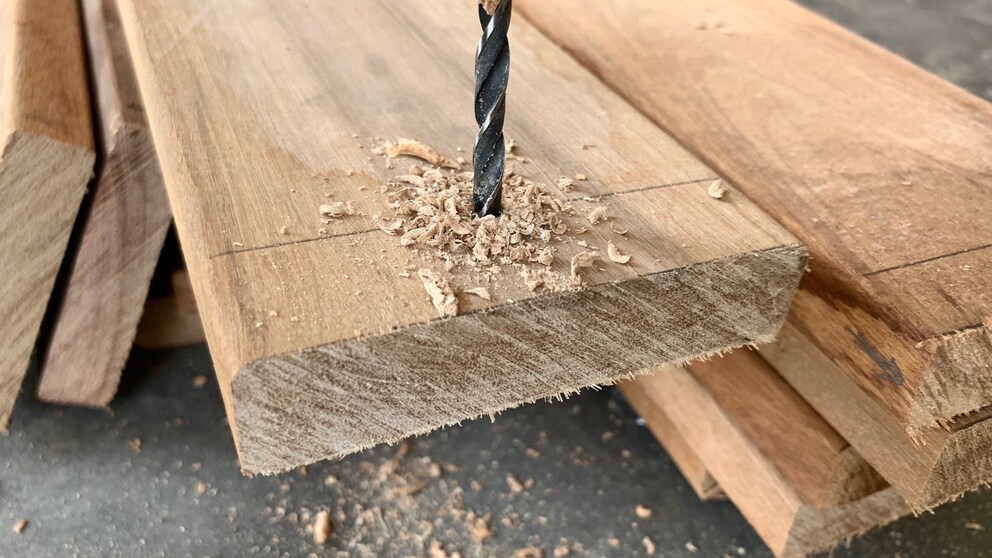
As soon as the screw turns into the wood, a fine crack appears. That’s annoying–with a pre-drilled hole, this wouldn’t have happened. However, pre-drilling also adds an extra step. When is it necessary–and when can you skip it?
When joining two pieces of wood firmly together, it’s usually done with a screw connection. But screws also hold together other materials like OSB or MDF. However, just screwing away isn’t always a good idea. As the screw penetrates the material, it can quickly tear out or splinter–especially under certain conditions. Here you’ll learn when to pre-drill wood and how large the drill hole should be.
What are the benefits of pre-drilling?
Pre-drilling a hole requires less effort to drive the screw into the wood. The resistance is lower, and the screw penetrates the wood fibers more easily. Pre-drilling also prevents the wood from splitting or cracking due to the force applied. Once it happens, it can’t be undone. Additionally, cracks can compromise the stability of the connection.
In general, pre-drilling is never a bad idea. This extra step ensures the workpiece looks clean and the connection is durable. If you’re unsure, it doesn’t hurt to do a test drill first.
Related: How to drill correctly in 5 steps
When should you pre-drill wood?
Whether it’s necessary to pre-drill a hole in wood before driving in a screw depends on two factors: the design of the screw and the wood’s hardness. It also matters where the screw is to be inserted. If the screw is near the edge of the wood board, there’s a higher risk of the wood cracking.
Screw design
There are different types of wood screws, which vary in the tip and thread.
- Standard wood screws: These screws taper to a point but have no additional features. You should pre-drill the wood to make it easier to insert the screws.
- Self-drilling screws: These wood screws–also called drill screws–have a drill tip. The manufacturer essentially attaches the drill to the screw, making pre-drilling unnecessary. However, it can still be useful for hardwood.
- Self-tapping screws: These screws have a thread cut at the end, allowing them to cut into the wood and form their own thread. However, this doesn’t necessarily mean you should skip pre-drilling compared to self-drilling screws.
Wood hardness
It’s not just about the type of screws but also the hardness of the wood. Generally, there’s a distinction between hardwood and softwood. Hardwoods like beech, oak, or robinia are usually harder than softwoods like spruce, pine, or larch. There are also certain tropical woods so hard they’re called ironwood. In general, you should always pre-drill hardwood, but it’s not always necessary for softwood.
Also interesting: How to fix oversized drill holes with a simple trick

How to Properly Use a Hole Saw
Install Cabinet Knobs and Easily Spruce Up Dressers
What diameter should you pre-drill?
The sizes of the drill holes differ for hardwood and softwood. Since screws penetrate softwood more easily, the diameters of the drill holes are smaller. Important: The drill holes should always be smaller than the outer diameter of the screw thread to ensure a good hold. The table shows the appropriate drill hole size for each thread size:
| Outer thread diameter of the screw | Drill hole size for pre-drilling in softwood (coniferous wood) | Drill hole size for pre-drilling in hardwood (deciduous wood) |
| 3 mm | 2 mm | 2 mm |
| 3.5 mm | 2 mm | 2 mm |
| 4 mm | 2.5 mm | 3 mm |
| 4.5 mm | 3 mm | 3 mm |
| 5 mm | 3 mm | 3.5 mm |
| 6 mm | 4 mm | 4 mm |
| 7 mm | 4.5 mm | 5 mm |
Also interesting: 7 mistakes to avoid when using wall plugs
How deep should the drill hole be?
Not only the diameter but also the length of the drill hole should be smaller than the screw to ensure a good grip. For softwood, half the screw length is sufficient–if you pre-drill at all, which is usually unnecessary for coniferous wood. For hardwood, the hole should be about two-thirds of the screw length.
Tip: How do you determine how deep to drill? Simply attach a piece of tape to the wood drill bit and drill up to this stop. And learn how to always drill straight in this article.