


October 4, 2026, 11:50 am | Read time: 4 minutes
Climbing plants have various tricks to grow upwards. Some wind their shoots around a support, others use tendrils to grab onto it or stick themselves in place. An overview of six climbing strategies of plants.
Climbing roses don’t climb. At least not with a special climbing organ. Instead, they lay their long shoots on a framework and secure themselves there. Other plants use tendrils, petioles, or adhesive roots to climb–each species in its own way. The climbing strategies also reveal which climbing aid is suitable in the garden.
Follow myHOMEBOOK on WhatsApp now
1. Twiner: The entire shoot winds upwards
In twiners, the entire shoot takes on the climbing work. It circles like a lasso, encounters a support, and winds around it in a spiral. Vertical rods, ropes, or wires are particularly suitable. The climbing aid should not be too thick.
Examples of twiners include wisteria, honeysuckle, Dutchman’s pipe, kiwi, chocolate vine, pole and scarlet runner beans, and Malabar spinach.
2. Tendril climber: Upwards with small grabbers
Tendril climbers send out thin tendrils that wrap around a suitable support. Unlike twiners, not the entire shoot wraps around the framework, but only specific tendrils. Botanically, this tendril is a modified shoot. Therefore, fine grids, nets, and wires work particularly well. A well-known example is the grapevine. Passionflowers, cucumbers, and some other cucurbits also belong to this group.
Also interesting: Climbing aids–which are suitable for which plants?
3. Petiole climber: The leaf helps with climbing
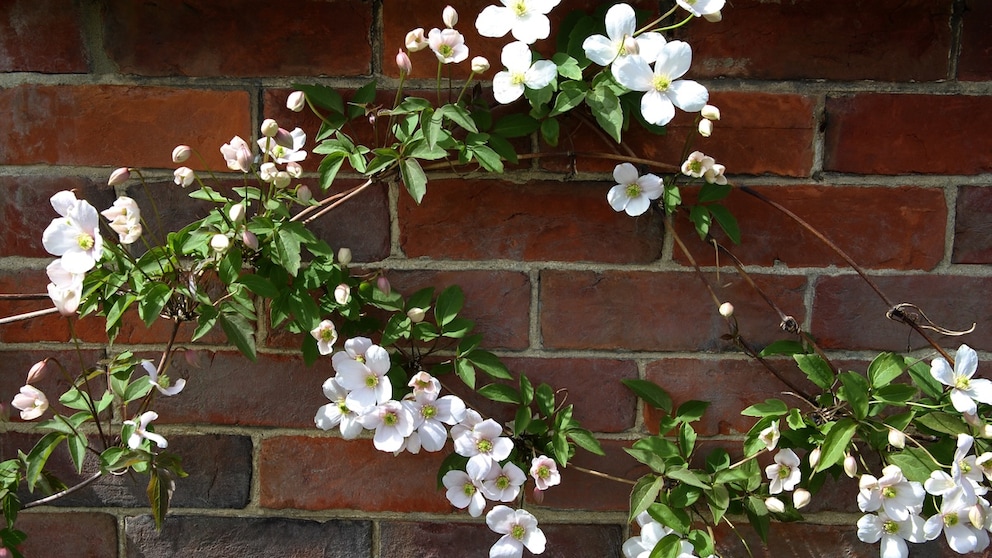
In petiole climbers, the petiole of individual leaves becomes the climbing tool. When it touches a support, it winds around it and holds the shoot in place. A typical example is the clematis, whose petioles are so fine that they can only truly enclose slender frameworks.
Petiole climbers include various clematis species such as Clematis alpina, Clematis montana, Clematis vitalba, and Clematis viticella. Peas also use modified leaf parts as tendrils. Botanically, this is not exactly the same construction as in clematis, but the principle is related: A part of the leaf takes on the role of the climbing hook.
4. Scrambler: Holding on without tendrils
Scramblers have neither tendrils nor adhesive roots. Their long, often somewhat awkward shoots lay over a framework. Depending on the species, they hook themselves with side shoots, spines, or thorns, or they simply lean against it. Climbing roses are the classic example of scramblers. They need a stable framework with as many horizontal options for hooking in as possible and should also be tied. Blackberry, firethorn, and winter jasmine are also part of this group.
Greening an Old or Dead Tree With Climbing Plants
The Best Plants for Natural Shade in the Garden
5. Root climber: With adhesive roots directly on the wall
Root climbers develop small adhesive roots along their young shoots that attach to suitable surfaces. Therefore, they don’t need a framework. The most well-known example is ivy. Climbing hydrangea, trumpet vine, and climbing spindle are also root climbers. Not every facade can handle this. On intact, solid surfaces, the growth is different than on crumbling plaster or open joints. There, adhesive roots can grow into existing damage.
Also interesting: Greening an old or dead tree with climbing plants
6. Adhesive pad climber: Sticking instead of holding on
Adhesive pad climbers initially form thin tendrils, much like tendril climbers. The difference is at their ends. There, small adhesive pads develop that act like tiny suction cups and hold onto a suitable surface. A classic climbing aid is therefore not necessary. A prime example is the Virginia creeper, also known as Boston ivy. Adhesive pad climbers include the three-lobed and five-leaved Virginia creeper as well as the variety Parthenocissus quinquefolia var. engelmannii. It’s important to distinguish from ivy: There, the adhesive roots are directly on the shoot, while in Virginia creeper, the adhesive pads are at the ends of the tendrils.