


June 16, 2026, 3:14 am | Read time: 4 minutes
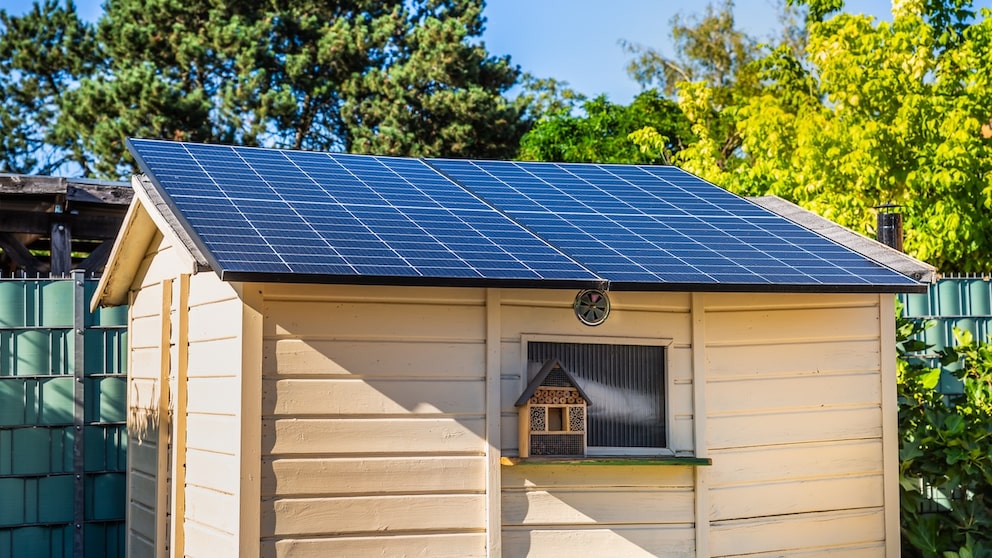
There are now small solar systems that can be installed on your own balcony. So why not place a PV system on the roof of your garden shed? Whether and how this is possible, as well as the costs and energy savings involved–myHOMEBOOK provides the answers to these questions.
What Applications Are Necessary?
Germany is known as the land of 1,000 applications. Surprisingly, the approval requirements for a solar system on your garden shed are manageable. “First, it must be distinguished what type of system is placed on the garden shed,” explains Lucas Flügel from the Federal Association of the Solar Trade (BDSH) in Berlin. “If it is a small PV system with a capacity of less than 2,000 watts peak, it falls under the balcony power plant regulation and only needs to be registered with the market master data register.”
This can be done easily via the website of the Federal Network Agency (BNetzA). A building permit is not necessary. For context: 2,000 watts peak (Wp) or two kilowatts peak (kWp) means the system produces a maximum output of two kilowatts under ideal conditions.
Also interesting: How dangerous are photovoltaic systems in a house fire?
Problems may arise if the owner of the garden shed is a member of a gardening club and the system is located on club grounds. In this case, it is essential to clarify with the board beforehand whether such a solar system is allowed.
“A PV system on the roof of an already approved garden shed is considered a ‘procedure-free project’ in most federal states, as long as the modules do not significantly protrude from the existing roof and do not fundamentally change the building’s appearance,” the expert explains. Therefore, an additional building permit is not necessary. To avoid surprises, the expert recommends inquiring by phone with the local municipality about the customary procedure.
What Costs Are Involved?
The actual total costs depend on the size of the system. The BDSH has provided myHOMEBOOK with the following overview:
| System Type | Output | Total Costs (Estimated) |
| Plug-in PV (Balcony Power Plant) | 800 W (Inverter) + up to 2 kWp (Modules) | €300 – €700 |
| Small Rooftop System (Island) | 1 – 2 kWp | €1,500 – €2,500 |
| Rooftop System (Feeder) | 2 kWp | €3,000 – €5,000 |
| Larger System with Storage | 3 – 5 kWp | €7,000 – €12,000 |
The garden shed project typically involves the aforementioned rooftop system. “A typical 2-kWp system with grid connection and about 20 meters of cable costs €3,000 to €5,000, without storage and when installed by a professional. The pure installation costs for an outbuilding are between €400 and €700,” explains BDSH spokesperson Lucas Flügel, breaking down the estimated total costs. Additionally, the following note:
Since 2023, the tax obligation for such purely privately used PV systems has been eliminated. This applies to both the self-generated and consumed electricity and the purchase of the entire system, including solar modules and inverters.
If you prefer a smaller option, consider an island solution. This eliminates the need for laying underground cables, effectively halving the total installation costs.
Also interesting: Does the PV system still work during a power outage?
Did you know that you can buy solar panels at Ikea?

Charge your electric car with solar power from your own roof
What Potential Does a Rooftop System Have?
“On average, such a 2-kWp system yields an annual output of nearly 2,000 kWh,” the expert provides a specific figure. The actual value depends on local conditions and orientation. “While such a system on the garden shed is not sufficient to power an entire single-family home, it can supply electricity to devices such as a refrigerator or chargers for power tools.”
How Large and Heavy Can Such a PV System Be?
“This cannot be precisely quantified. The calculation depends on the available area and the load-bearing capacity of the roof,” emphasizes the BDSH spokesperson. It is worthwhile to seek advice from a professional company.
The installation should also be carried out by a certified company, the professional recommends. In the event of damage, the savings from self-installation would not justify the costs of rectifying an incorrect installation. “As the Association of the Solar Trade, we also recommend taking out PV insurance against elemental damage and theft for such a garden shed project, as this is not a standard component of a homeowners insurance policy,” emphasizes spokesperson Lucas Flügel. The costs for this are between €30 and €70 per year.